
Claude Routines Just Shipped. Here's What It Means.
Key Takeaways
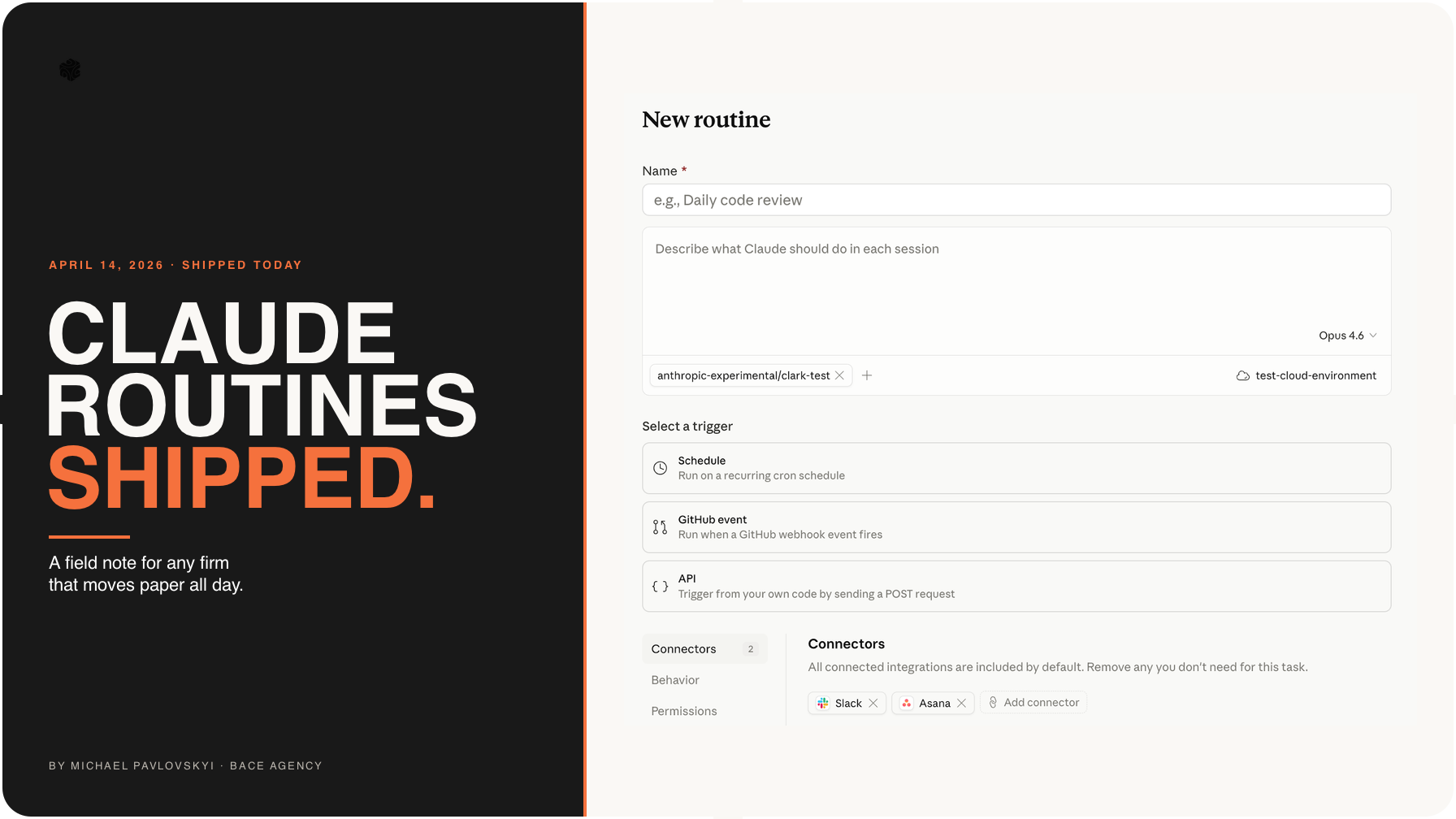
- ✓ Claude Routines — shipped April 14, 2026 — are saved AI jobs that run on a schedule, on an API call, or on a GitHub event, without needing your laptop open.
- ✓ The feature looks like a developer tool, but the pattern — prompt plus data plus trigger — generalizes to any job where someone reads something, thinks, and produces output.
- ✓ For paper-heavy firms, the routine pattern fits workflows like intake summaries, quote comparisons, and renewal drafting — the kind of work that eats 60% of a senior team's week.
- ✓ The plumbing is now free. The build — which policies to encode, which client data stays off the cloud, who reviews what — is still the hard 80% of a real rollout.
- ✓ Firms whose adjusters, attorneys, and account execs are too senior to be pushing paper should treat this launch as the signal that the delta between the firms that rewire and the firms that don't is about to widen fast.
I've been awake since 3 AM. Yesterday, at 11:14 AM Pacific, Anthropic quietly shipped a feature called routines. Most of the coverage I have read is treating it as a developer tool update — "Claude Code got cron jobs, cute." That reading is wrong. I am sitting on the couch in Lake Forest at 3:17 AM with a cold cup of coffee trying to decide whether to call six of my clients on Monday morning and tell them the shape of their week just changed.
This post is the long version of what I would have texted them. If you run a firm whose actual product is paper — and if you have ever looked at your headcount and thought, "half of these people are just routing documents all day" — you are going to want the whole thing.
My name is Michael Pavlovskyi. I run Bace Agency out of Lake Forest, Illinois. We build custom AI automation for small, high-touch firms across Chicago's North Shore — mostly law, insurance, wealth, and healthcare. 97 projects delivered, 95% client retention, three years in. I have spent the last 14 months building, by hand, the thing Anthropic shipped yesterday.
What Actually Shipped Yesterday
I'll keep this short because the specifics are not the point.
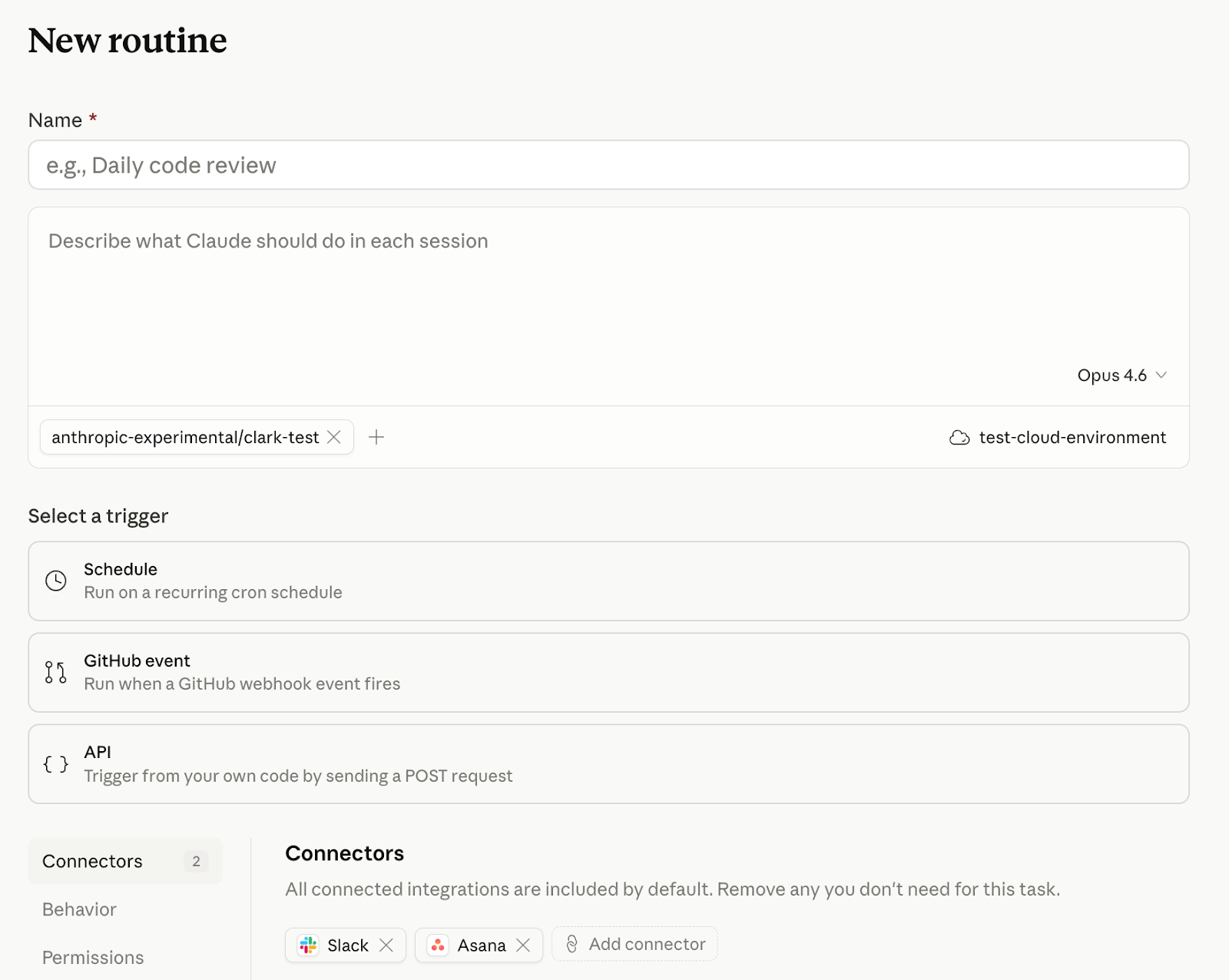
A routine is a saved Claude Code job. You write it once. It has a prompt, a list of data sources, and a trigger. Then it runs without you. It runs on Anthropic's servers, not your laptop. That means it fires whether you are asleep, on a plane, or sitting in a carpool line.
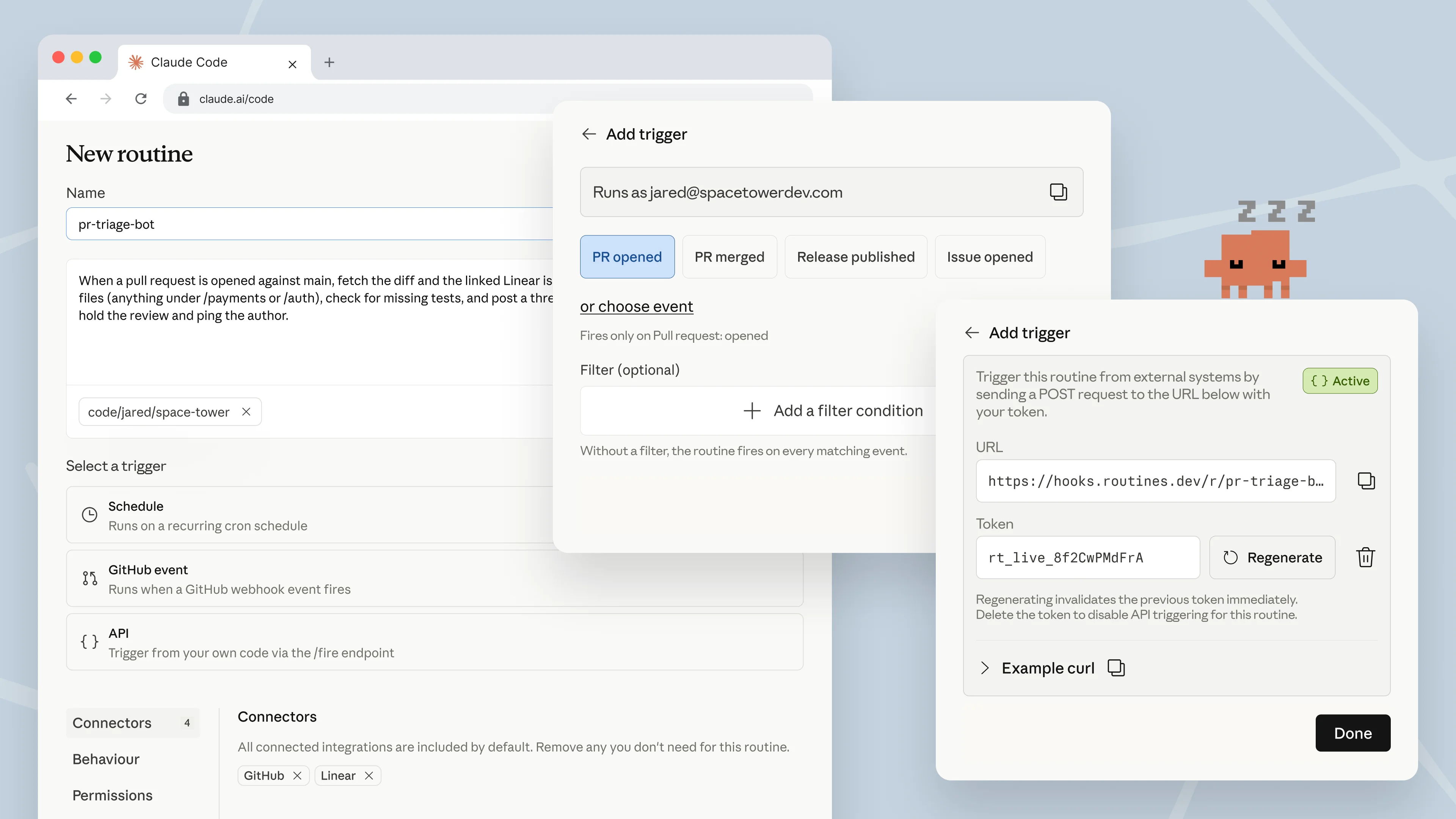
There are three triggers you can attach, and you can mix them on the same routine:
- Scheduled — fires on a cadence. Hourly, nightly, weekly, whatever you need.
- API — the routine has its own URL and its own token. You POST to it from any other system and it runs.
- GitHub event — it fires when something changes in a connected code repository. A pull request opens. A release goes out. Etc.
You build one in a web form at claude.ai/code/routines, or through the Claude Code CLI with a new /schedule command. Either way, the routine shows up in the same list and you can click into any past run to see exactly what Claude did.
The pricing: Pro subscribers get 5 runs a day. Max gets 15. Team and Enterprise get 25. It is in research preview, which means the thing is live but Anthropic is going to change behavior in public while the early adopters kick the tires.
That is the feature. Boring on paper. A scheduler, a cloud worker, three trigger types. That is the point of this post. I'll explain why boring-on-paper is the whole signal.
The Quiet Part Nobody Is Saying Out Loud
Most of the write-ups treat this like a better cron job for developers. "Schedule your nightly PR reviews. Automate your backlog triage. Triage your alerts." Fine. All true. All developer stuff.
The write-ups are missing the shape of the thing.
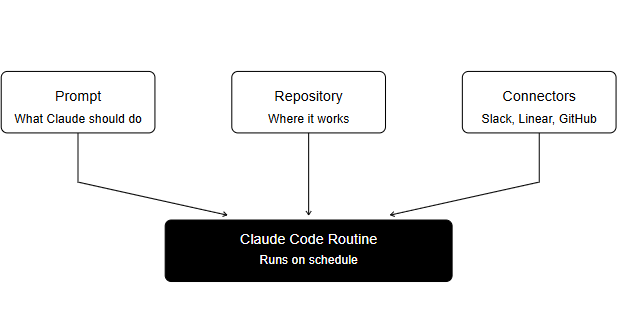
A routine is just three pieces: a prompt, data, a trigger. That abstraction works for any job where somebody reads something, thinks about it, and produces something new. That abstraction is most office work.
Right now the feature is dressed up in developer clothes. The docs talk about repositories, pull requests, GitHub webhooks. The nouns are all coded for one audience. Fair enough — you ship to the crowd that is in front of you, and Anthropic's first big cohort on Claude Code is developers. But the nouns are a costume. The substrate underneath is not developer-specific.
Substitute pull request with new intake packet. Substitute GitHub webhook with DocuSign webhook. Substitute repository with client folder in Google Drive. Substitute code review with coverage comparison. You just mapped the feature onto a completely different industry without changing a single piece of the underlying plumbing.
That is what I have been staring at all night. Anthropic just standardized, in public, the architecture that is going to eat the middle of every professional services firm in the next three years. The developer wrapper is a trailing indicator. The wrapper will come off.
A quick translation table so this is concrete. If the feature docs say pull request, you read intake form. If the docs say merge conflict, you read conflicting schedules across two carriers. If the docs say deploy hook, you read signed engagement letter hitting the drive. If the docs say release notes, you read renewal summary. If the docs say CI check, you read QA pass on a drafted memo. Every one of those lines is the same architecture under a different noun. Once you see it you cannot unsee it.
A Business That Drowns In Paper
Let me describe a kind of business I see a lot of up here.
Small. Senior team. Twenty years of experience per head. Very specific clientele — the kind of client you do not get from a Facebook ad. The revenue per head is high. The work is high-touch, high-trust, high-judgment. The owner is, on a good day, a trusted advisor to somebody whose net worth you would not believe if I told you.
Also: about 60% of the week is document work.
Intake packets on new clients — 40 pages. Coverage schedules. Scheduled-asset lists (when a client has a jewelry collection worth more than a house, that collection is its own document). Declarations pages. Endorsements. Policy comparisons across three carriers that all use different forms and different language for the same thing. Renewal packets that run 80 pages and need to be cross-checked against last year's packet to make sure nothing quietly moved. Binder reviews. Claims packets. Attorney correspondence on a single exclusion clause. A six-line email that took an hour to write because the PDF wouldn't copy-paste cleanly and somebody had to retype half of it.
The people doing this work are not junior. Most of them are too senior for it. They are doing it anyway because nobody has solved it for them, and the solution most of the industry built — offshoring, virtual assistants, a BPO somewhere — works for the easy 70% and breaks on the gnarly 30% where the judgment actually lives.
So the 20-year veterans stay late on Tuesdays to compare a Chubb quote to a PURE quote and write a one-page memo that goes to one client. That is a real thing that happens in real offices all around the North Shore, every single week. A firm I know added a fourth person last year not because they had more clients but because they had more paper. The paper grew. The people to push around the paper grew. The book did not.
The claims side is even worse, and people who don't work in this world underestimate it. A claim on a specialty policy can generate 200+ pages of correspondence across the insured, the adjuster, the carrier, the restoration vendor, and an attorney if one is involved. Every page needs to be read by somebody. Every decision references three earlier pages. Every time the file hands off to a new person, they spend an hour reading back through the trail before they can do their next action. Multiply that by the number of open claims sitting on a senior adjuster's desk in any given week and you see what I mean about the people being too senior for the work.
If this is starting to describe your Monday, keep reading. This is the exact shape of problem routines are pointed at.
The Routine Pattern, Translated
Now take the routine pattern and map it onto that business. I am not speculating. I have built versions of each of these for clients already. What changed yesterday is that Anthropic moved the plumbing to their servers, so the builds are going to get roughly three times cheaper and five times faster.
Scheduled routine. Every Monday at 6:45 AM Central, pull all DocuSigned intake packets from the shared drive that were signed in the last seven days. For each one: read it, summarize it into a standard risk memo using the firm's own template, tag the memo with the carrier lanes that fit the risk, and drop the draft memos into a specific channel in Slack. The team walks in on Monday morning. The memos are already there. The 20-year veterans spend Monday talking to clients instead of typing.
API routine. The agency management system has a "new client" button. When somebody clicks it, the system POSTs to the routine's endpoint with the client name and a link to their file. The routine runs — it pulls last year's coverage schedule, compares it to the asset list the client just submitted, and drafts a renewal quote-request packet addressed to the three carriers you work with most. The draft is sitting in Google Docs when the account exec opens their laptop.
Event-triggered routine. A carrier-returned quote lands in the shared drive. That drop fires a webhook — every modern document system emits these now. The routine runs against the new quote, pulls last year's version of the same policy for the same client, surfaces the five most material changes — limit drops, exclusion additions, endorsement reshuffles, premium moves — and attaches a one-page "here is what moved and why it probably moved" memo to the quote before anybody on your team even opens it.
Combination routine. You can also attach all three triggers to the same job. A quote-review routine can run nightly to catch anything missed, fire on demand when a broker drops a quote into the shared drive, and also run when a colleague flags a specific quote for a second look. One prompt. Three ways in. Consistent output.
Claims-intake routine. A new claim arrives — a PDF from a carrier, an email from the insured, a phone note from the adjuster. A routine kicks in, pulls the underlying policy, cross-references the coverage schedule, flags the clauses that apply, identifies any exclusion that might bite, and drafts a first-touch email back to the insured confirming receipt and setting expectations. Every claim gets an instant, consistent, on-brand first response. Your senior adjuster opens their morning with a queue of claims that have already been triaged — not a stack of envelopes waiting to be read.
None of these are hypothetical. I have built each one in some flavor for some flavor of client. Before yesterday, the scheduler piece ran on a small virtual machine I stood up in AWS, the orchestration layer was either n8n or a custom Next.js API route, and I had to write all the glue myself. Yesterday all of that collapsed into one dropdown in a web form. The plumbing became a primitive. That is the news.
What This Does To Your P&L
I want to be careful here, because I have watched plenty of founders get excited about numbers they have not actually measured. So I will tell you what I have measured on my own builds, and you can decide what it is worth for your firm.
Baseline across eight small-to-mid insurance and wealth shops I have worked with: about 55 to 65 percent of the senior team's week on document work. Post-build, after the first 60 days: the same people doing roughly 15 to 25 percent of the week on document work. The rest of that time goes back to client calls, judgment calls, and strategy.
Three things happen when you take paper off the plate of your best people.
One: you can serve roughly twice the book with the same headcount. Not because the build is magic. Because the work that was gating the senior team from taking on more relationships was, all along, paperwork. Remove the paperwork and they have Tuesday afternoons back.
Two: turnaround time on any given document collapses. The industry benchmark for "quote turnaround" is measured in days. When a routine drafts the comparison before the quote hits a human, the human's job becomes a 20-minute QA pass instead of a four-hour build. I have clients whose internal turnaround on a new quote dropped from 72 hours to under 8.
Three — and this is the one that moves the P&L in a way that shows up 12 months out — your senior people stop burning out. The people who are good at client work get to do client work. Retention goes up on both sides: your clients' retention, because they feel the responsiveness, and your team's retention, because nobody quits a job they like. The second-order revenue effect from not losing a $1.4M book because your account exec took a better offer across town is very hard to measure and very, very real.
The Honest Part
Now here is the part the coverage of this launch is going to miss entirely, and I want to say it plainly because I am tired of AI content that dodges the hard parts.
Anthropic's routines are the plumbing. The plumbing is not the hard part. The plumbing is 20% of any real build.
The other 80% is the consulting work. It is the three weeks we spend in your office figuring out which carriers' PDFs are machine-readable and which ones need OCR first (most are; one is famously not). It is deciding which parts of a client file should never touch a cloud LLM at all — Social Security numbers, dates of birth, account numbers, specific asset schedules above a threshold — and which parts are fine (a cover letter, a redacted coverage schedule, the boilerplate exclusion language). It is mapping your actual policies against your actual carriers against your actual clients, and designing the prompts that respect all three.
It is also the political work, which is what most of the "AI transformation" decks I see conveniently forget. Which partner sees the output first. Whether it arrives in email, in Slack, in Google Docs, or inside your agency management system. Whether the senior person wants a draft or wants a QA checklist. Whether your junior team is going to learn anything if the routines do all the grunt work — and if not, what new thing they are going to learn instead, so the bench gets deeper instead of shallower. These are real conversations. They take weeks. They are the difference between a pilot that sticks and a pilot that gets quietly abandoned in April.
And a few things I will tell you not to do, because I have watched every one of them happen. Do not start with the hardest workflow in your firm. Start with the one that repeats the most. Do not ship a routine without a human QA pass on the first fifty runs — you need to see where it drifts before you let it go unattended. Do not skip the measurement step. If you cannot tell me in numbers what changed 60 days after the pilot, you built the wrong thing, or you built the right thing and nobody noticed, and both of those are failures. And do not let a vendor sell you an "AI platform" to solve a workflow problem. Workflow problems get solved with specific builds against specific workflows. A generic platform that promises to solve all workflows, solves none of yours.
So here is the truth on the record. Routines are going to remake this industry. And most firms that try to adopt them alone are going to get 15% of the value and walk away thinking the whole thing was oversold. Because the plumbing is free now, but the plumbing is not the product. The build is the product. The build is what Bace does.
If you run a firm that moves documents all day — law, insurance, wealth, healthcare, family office, private practice — and you want to know what this actually looks like inside your stack, not generically but specifically, book a free 30-minute AI audit. I will ask you five questions about how your team actually works. I will tell you where the routines pattern is going to give you the biggest wins, which pieces you should build yourselves, which pieces you probably shouldn't, and where the traps are. No pitch deck. No follow-up sequence. I am not going to try to sell you a subscription because Bace Agency is not a platform. We are a shop. We come in, we understand your business, we build the thing, and we leave. You can find us at baceagency.com.
Anthropic just did the one part of this build that was going to take you two years to do yourselves. I will do the rest.
Frequently Asked Questions
What is a Claude routine? +
A routine is a saved Claude Code job with a prompt, data sources, and a trigger. It runs on Anthropic cloud infrastructure, so your laptop does not have to be open. There are three trigger types: scheduled (runs on a cadence), API (fires on an HTTP POST to a dedicated endpoint), and GitHub event (fires when something changes in a connected repository).
Can Claude routines help non-developers? +
The current research preview is developer-focused and works against GitHub repositories. The underlying pattern — scheduled AI agents running against your data — applies to any knowledge work. At Bace Agency we are already building equivalent flows for insurance, law, and wealth firms using Claude's broader API and MCP connectors, without GitHub in the mix.
How much do Claude routines cost? +
Routines ship with existing Claude Code subscriptions. Pro subscribers get 5 runs per day. Max gets 15. Team and Enterprise get 25. Overage is metered if you enable extra usage in billing. Routines draw from the same usage allowance as interactive sessions.
What is the hard part about adopting this pattern for document-heavy firms? +
Not the plumbing — Anthropic gave that away. The hard part is mapping your actual policies to prompts, deciding which parts of client data can touch a cloud LLM and which cannot, and wiring the output into the apps your team already uses. That is the consulting work, and it is roughly 80% of a real build.
Where should a firm start? +
With one workflow that happens every week and eats time. Not the hardest one. The most repetitive one. Document intake, renewal drafting, or quote comparison are all good candidates. Ship one routine, measure the delta honestly for 60 days, then expand.
Related Articles

Want to see how AI fits in your firm?
Book a free 30-minute AI audit. No obligation, no pitch deck.
Book a Free AI Audit →