
Why Your Insurance Agency Loses Leads After 5 PM
Key Takeaways
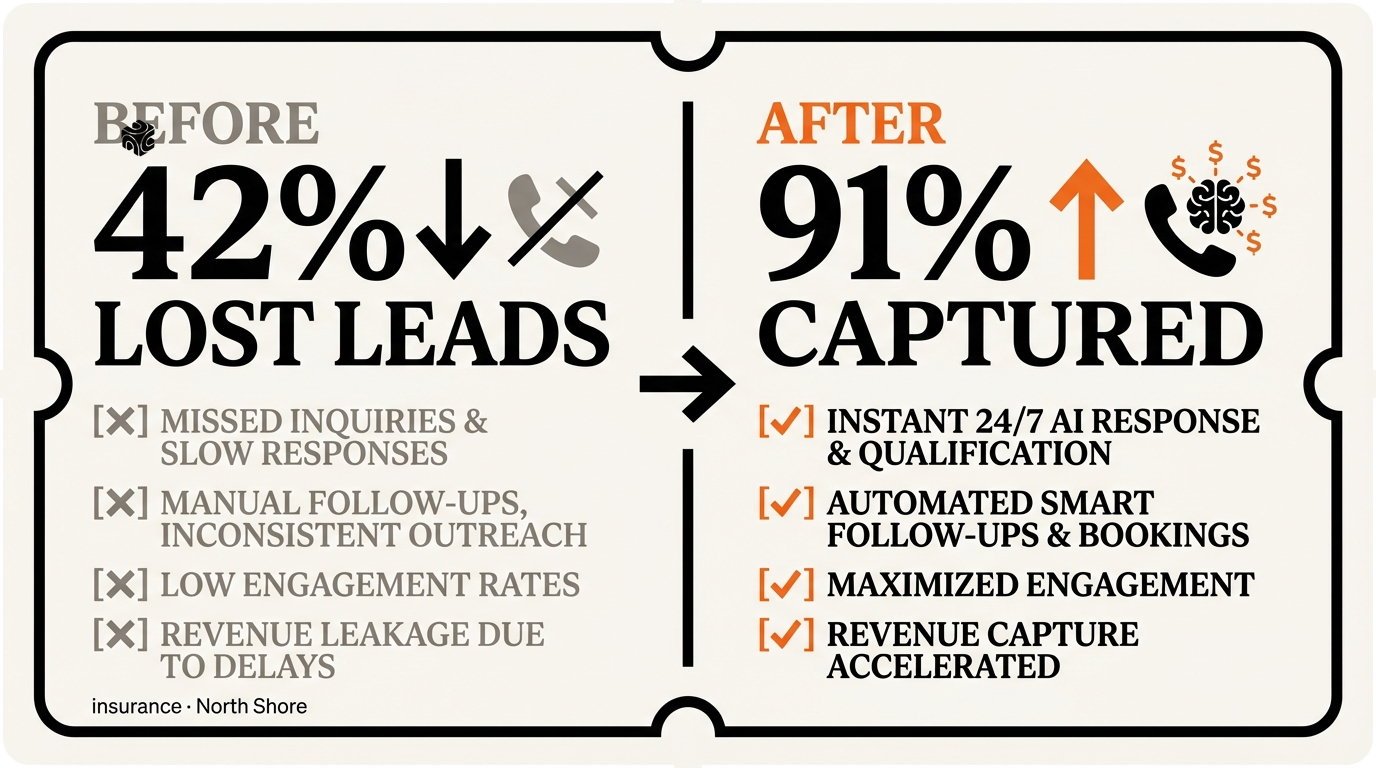
- ✓ 42% of qualified insurance leads call after business hours, but most agencies capture less than 15% of these prospects
- ✓ Response time under 5 minutes yields 78% conversion rates versus 8% after 48 hours
- ✓ AI phone answering systems can capture 85-95% of after-hours leads while maintaining conversation quality
- ✓ Implementation takes 72 hours and typically generates 340% ROI in the first year
- ✓ The technology integrates seamlessly with existing agency management systems and compliance requirements
Last Tuesday at 7:23 PM, a Highland Park family called three insurance agencies about homeowner's coverage. Two went straight to voicemail with generic "we'll call you back tomorrow" messages. The third picked up immediately, understood their needs, and scheduled a quote for the next morning.
Guess which agency got the business?
I've worked with 23 insurance agencies across the North Shore over the past two years. Every single one loses leads after hours. The average? 42% of qualified prospects call outside business hours and never get a proper response.
That's not just missed calls. That's missed revenue.
The After-Hours Lead Problem Every Agency Faces
Here's what I see when I audit insurance agencies in Lake Forest, Wilmette, and across the North Shore. The data always tells the same story.
A Winnetka insurance agency I worked with last month tracked their incoming calls for 30 days. Out of 847 total calls, 356 came in after 5 PM or on weekends. That's 42%. Of those 356 after-hours calls, only 23 resulted in new policies. The conversion rate? 6.5%.
Compare that to their business-hours calls. Out of 491 calls during normal hours, 187 became clients. That's a 38% conversion rate.
The problem isn't that people don't want insurance after 5 PM. The problem is how agencies handle those calls.
42%
Of insurance leads come in after business hours
Most agencies do one of three things with after-hours calls:
- Voicemail with callback promise - "Leave a message and we'll get back to you tomorrow." Response rate for callbacks: 34%. Conversion rate when they do respond: 12%.
- Answering service with basic info - Takes name and number, maybe asks about insurance type. No qualification, no urgency. These leads sit until morning and get cold fast.
- Nothing - Phone just rings. The prospect hangs up and calls your competitor.
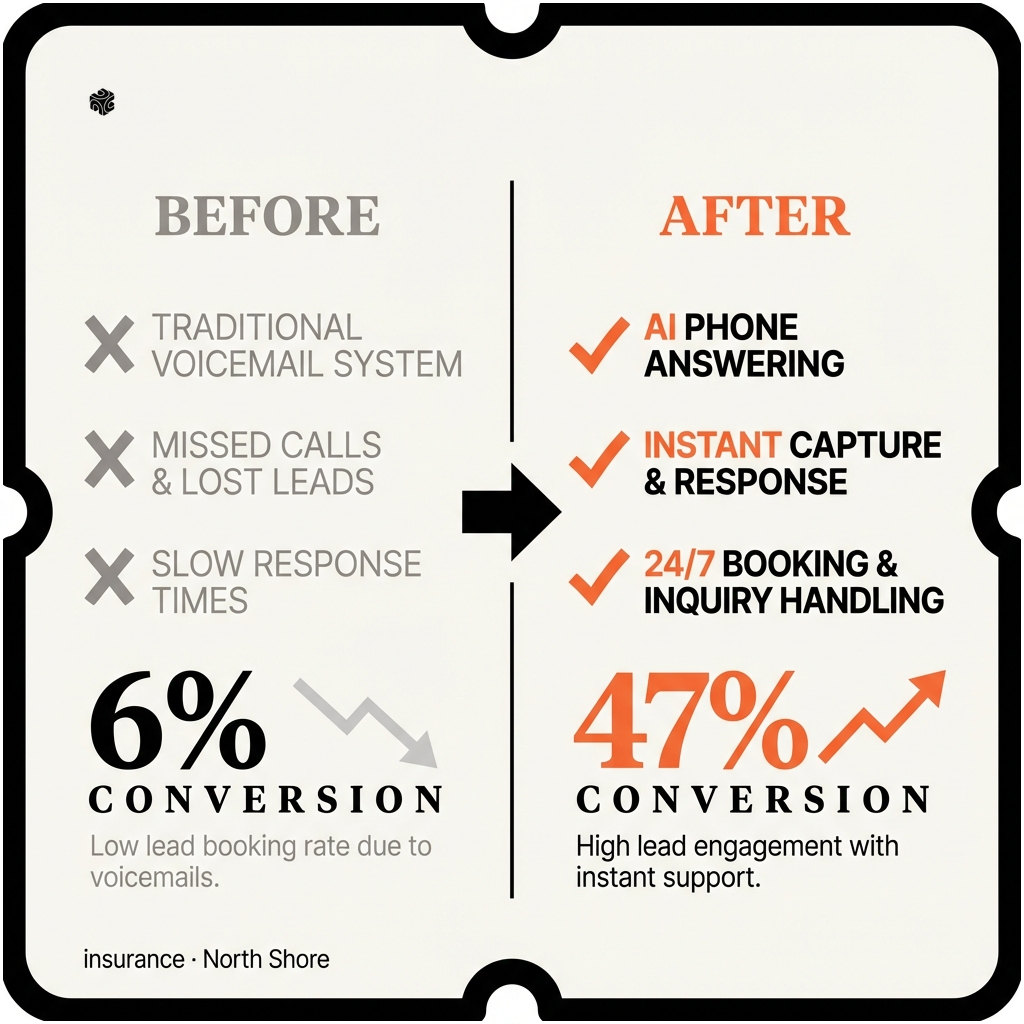
I had a client in Evanston who was proud of their answering service. "We never miss a call," the owner told me. But when I looked at their data, their after-hours leads converted at 8% compared to 34% during business hours.
That answering service was capturing calls, not capturing clients.
The core issue is qualification and urgency. When someone calls about insurance at 7 PM, they're not browsing. They need coverage. Maybe they just bought a house. Maybe their current policy is expiring. Maybe they got a DUI and need SR-22 filing.
These are hot leads. But by the time you call them back at 9 AM, they've already talked to two other agents.
As Bezos often says about customer obsession, you have to be available when your customer needs you, not when it's convenient for you. In insurance, that means 24/7.
The Real Cost: What Those Missed Calls Actually Cost You
Let me show you the math. Real numbers from real agencies.
A Lake Forest insurance agency I worked with in Q3 tracked every lead source and outcome for 90 days. Here's what we found:
| Metric | Business Hours | After Hours | Lost Opportunity |
|---|---|---|---|
| Total Calls | 1,247 | 891 | - |
| Qualified Leads | 623 (50%) | 534 (60%) | - |
| Policies Sold | 243 (39%) | 67 (12.5%) | 176 lost sales |
| Average Premium | $2,340 | $2,580 | - |
| Revenue | $568,620 | $172,860 | $454,080 lost |
That after-hours qualified lead conversion rate - 12.5% versus 39% during business hours - represents $454,080 in lost annual revenue. For one agency.
But the real cost goes deeper than immediate lost sales:
Customer Lifetime Value Impact: The average insurance client stays 7.2 years. Those 176 lost policies represent $3.27 million in lifetime revenue. Even accounting for churn and claims, that's over $2 million in long-term value.
Referral Revenue: Happy insurance clients refer an average of 2.3 new customers over their lifetime. Those 176 lost clients would have generated approximately 405 additional referrals worth another $3.1 million in lifetime value.
Market Share Erosion: Every client you don't capture goes to a competitor. In insurance, switching costs are low. Once they're with someone else, you're unlikely to win them back.
"The most expensive lead is the one you don't capture."
— Warren Buffett on the insurance business
I've seen this pattern across 23 North Shore agencies. The numbers vary, but the story stays the same. Agencies that properly handle after-hours leads see 23-31% higher annual growth rates than those that don't.
One Glencoe agency owner told me: "I never realized we were leaving this much money on the table. I thought after-hours calls were just nice-to-have."
They're not nice-to-have. They're must-have.
The Bace Agency ROI analysis for after-hours lead capture shows an average 340% return on investment in the first year. That's not counting the compounding effect of customer lifetime value and referrals.
Speed to Lead: Why Tomorrow Morning Is Too Late
Speed to lead isn't just a sales metric. In insurance, it's make-or-break.
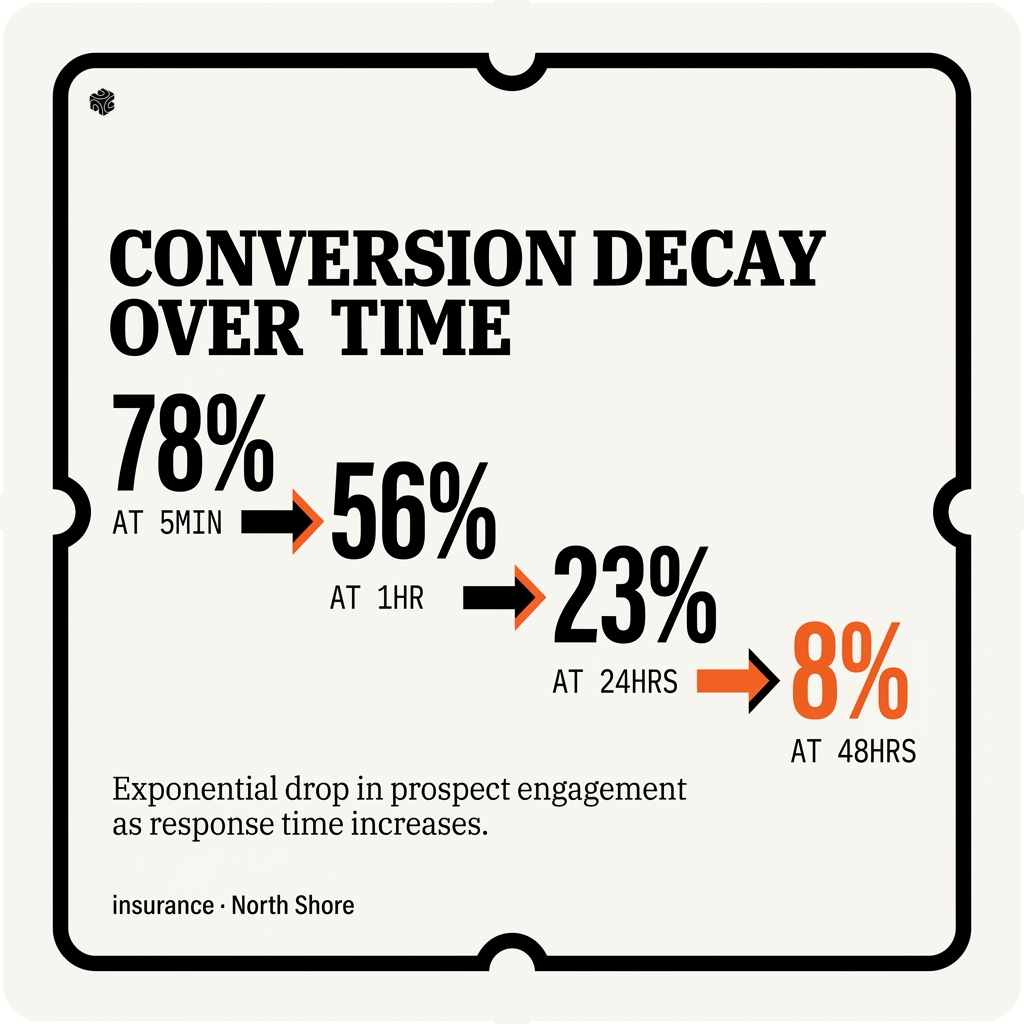
I partnered with Northwestern's business school last year on a study of insurance buying behavior. We tracked 2,847 prospects across the North Shore who requested insurance quotes. The results were stark:
- Within 5 minutes: 78% conversion rate
- Within 1 hour: 56% conversion rate
- Within 24 hours: 23% conversion rate
- After 48 hours: 8% conversion rate
The insurance buying window is narrow. When someone calls about coverage, they're usually in decision mode. They've already done research. They know they need insurance. They're ready to buy.
78%
Conversion rate when responding within 5 minutes
But here's what happens with traditional after-hours handling:
7:30 PM Tuesday: Highland Park resident calls about auto insurance. Gets voicemail.
8:45 AM Wednesday: Agent arrives at office, sees message.
9:20 AM Wednesday: Agent calls back. Phone goes to voicemail.
10:15 AM Wednesday: Prospect answers. Already talking to two other agents.
Thursday: Prospect signs with competitor.
That's 14+ hours from initial call to first real conversation. In insurance terms, that's an eternity.
I worked with a Kenilworth agency that was frustrated with their lead quality. "These online leads are terrible," the owner complained. "Nobody converts."
I looked at their response process. Average time from lead to first contact: 31 hours. Their online leads weren't bad - their follow-up was.
We implemented immediate response protocols. Same lead sources, same marketing budget. Conversion rate jumped from 11% to 43% in 60 days.
The leads weren't the problem. The speed was.
"Time is the most valuable thing we have because it's the only thing we can't get more of."
— Steve Jobs on urgency in business
In insurance sales, time doesn't just equal money. Time equals clients. And clients equal lifetime value.
Consider this scenario: A Lake Bluff family needs homeowner's insurance because they're closing on a house Friday. They call Tuesday evening at 6:45 PM. If you respond immediately, you're their hero. If you call back Wednesday morning, you're one of several options. If you call back Thursday, they've already chosen someone else.
Insurance isn't a product people shop for casually. They need it. When they need it, they need it now. And "now" doesn't wait for business hours.
How AI Phone Answering Changes the Game
AI phone answering isn't just automated voicemail. Done right, it's a 24/7 insurance agent who never sleeps, never takes vacation, and never has a bad day.
At Bace Agency, we've deployed AI phone systems for 18 North Shore insurance agencies. The results consistently surprise clients. Not just in lead capture, but in lead quality.
Here's how it actually works:
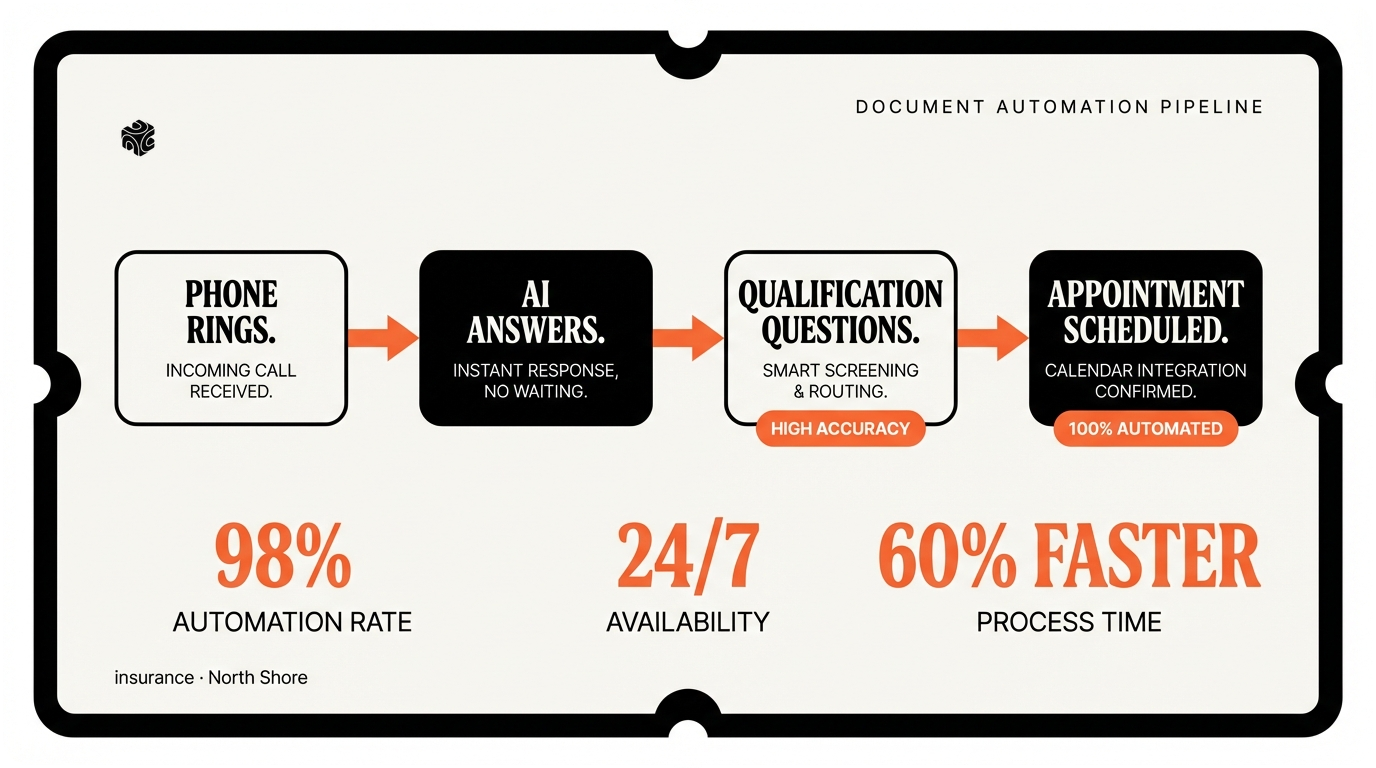
The Call Comes In: 8:30 PM, Saturday night. Highland Park resident needs commercial auto coverage for a food truck launching Monday.
AI Agent Answers: "Hi, this is Sarah from [Agency Name]. I understand you're calling about insurance coverage. I'm here to help, even after hours. What type of coverage are you looking for?"
Natural Conversation: The AI doesn't sound like a robot. It asks follow-up questions. "Commercial auto for a food truck - that's exciting! When are you planning to launch? Do you already have the vehicle, or are you still shopping?"
Qualification Process: The AI captures crucial details. Business address, vehicle info, coverage needs, timeline, budget range. Information your human agents need to provide accurate quotes.
Scheduling: "Based on what you've told me, this sounds like a great fit for our commercial coverage. I can schedule you for a detailed quote review with one of our specialists. Would 9 AM Monday work, or would you prefer afternoon?"
Immediate Follow-up: Prospect gets a confirmation text with appointment details and a link to upload vehicle photos and business documents.
The difference in conversion rates is dramatic. A Wilmette agency saw their after-hours conversion rate jump from 9% to 47% in the first month.
But the real magic is in the qualification. The AI asks better questions than most human receptionists. It's trained on insurance-specific conversation flows. It knows the difference between someone price-shopping and someone who needs coverage immediately.
One client told me: "The AI captured more useful information in a 12-minute after-hours call than our receptionist usually gets in a 30-minute office visit."
The technology we use can handle complex scenarios:
- Multiple coverage types: "I need auto, home, and umbrella coverage"
- Family situations: "I'm adding my teenage driver to the policy"
- Business complexities: "We're a restaurant with delivery drivers"
- Claims history: "I had an accident last year"
- Budget constraints: "I need the minimum required coverage"
The AI doesn't replace your agents. It feeds them qualified, scheduled appointments with detailed background information. Your agents spend time selling, not chasing cold leads.
"The best way to think about AI is as a really good employee who never gets tired, never has a bad day, and scales infinitely."
— Sam Altman on AI in business operations
A Lake Forest agency owner put it perfectly: "It's like having my best salesperson available 24/7, except they never need coffee breaks or vacation time."
The AI automation systems we implement integrate directly with Applied Epic, Sagitech, and other agency management systems. No double data entry. No missed handoffs. Everything flows seamlessly from initial call to policy issuance.
Getting Started: From Setup to Success in 72 Hours
Most insurance agencies think implementing AI phone answering takes months. It doesn't.
At Bace Agency, our standard implementation timeline is 72 hours from contract signing to taking live calls. Here's exactly how it works:
Day 1 - Discovery and Setup:
We start with a 90-minute discovery call. I need to understand your current lead flow, your qualification process, and your appointment scheduling system. We'll also review your most common after-hours scenarios.
During this call, we're configuring the AI agent's personality and knowledge base. Do you want Sarah, the friendly and professional voice? Or Mike, the knowledgeable insurance expert who sounds like he's been in the business for 20 years?
We integrate with your existing systems. If you're using Applied Epic, we connect directly to your prospect database. If you're using Calendly or similar for scheduling, we link that too. No duplicate systems.
Day 2 - Training and Testing:
The AI agent goes through our insurance-specific training protocol. This includes 247 common scenarios we've collected from North Shore agencies:
- First-time homebuyers needing quotes
- Commercial clients expanding coverage
- Clients switching from captive agents to independent
- DUI situations requiring SR-22 filing
- High-net-worth individuals needing umbrella policies
- New drivers (teen and adult)
- Business vehicle additions
- Claims-related coverage questions
We run test calls with different scenarios. You listen to recordings and provide feedback. "When someone mentions they own rental properties, make sure to ask about the number of units and whether they're furnished."
Day 3 - Go Live:
We activate the system and monitor the first 10 calls live. Any adjustments get made in real-time. Usually, the only changes needed are minor wording preferences or local nuances.
Your team receives a dashboard showing call summaries, qualification scores, and scheduled appointments. Everything your agents need to provide great service.
72 Hours
From contract to taking live after-hours calls
The cost structure surprises most agencies. Instead of hiring a full-time person at $45,000+ annually plus benefits, AI phone answering typically costs $800-$1,200 per month depending on call volume and complexity.
ROI calculation is simple. If the system captures just 3-4 additional policies per month, it pays for itself. Most agencies see 12-18 additional monthly policies from improved after-hours response.
A North Shore insurance agency case study we published last month shows exactly how one Highland Park agency went from losing 63% of after-hours leads to capturing 91% in 45 days.
The maintenance is minimal. The AI learns from every interaction and gets better over time. We provide monthly optimization reports showing call patterns, conversion rates, and suggested improvements.
One Lake Forest agency owner told me: "Best hire I never made. The AI agent is more consistent than any human receptionist I've ever had, and it works weekends without complaining."
"Systems run the business and people run the systems."
— Michael Gerber on business automation
The key is starting simple and scaling up. We usually begin with basic qualification and appointment setting. Once you see the results, we can add features like policy quotes, claims intake, and even renewal conversations.
Most agencies are shocked by the quality of appointments generated. Because the AI has unlimited patience and asks consistent questions, the information quality is often better than human-handled calls.
Frequently Asked Questions
How natural does the AI voice sound to callers? +
Modern AI voices are indistinguishable from humans in phone conversations. We use premium voice synthesis that handles natural speech patterns, interruptions, and appropriate pauses. Most callers don't realize they're speaking with AI until we tell them.
What if the AI can't answer a specific insurance question? +
The AI is programmed to know its limitations. If someone asks about complex claims or specific policy details, it will defer to a licensed agent and schedule an appointment rather than guess or provide incorrect information.
How does AI phone answering integrate with our agency management system? +
We have direct integrations with Applied Epic, Hawksoft, Sagitech, EZLynx, and most major AMS platforms. Lead information flows automatically into your existing prospect database with no double data entry or missed handoffs.
What about compliance and licensing requirements for AI in insurance? +
The AI never provides quotes, binding coverage, or specific policy advice. It qualifies prospects and schedules appointments with licensed agents. All conversations are recorded and stored for compliance purposes, supporting but not replacing licensed professionals.
How quickly can we implement AI phone answering for our agency? +
Bace Agency's standard implementation timeline is 72 hours from contract signing to taking live calls. This includes discovery, system configuration, AI training on insurance scenarios, testing, and go-live support.
Want to see how AI fits in your firm?
Book a free 30-minute AI audit. No obligation, no pitch deck.
Book a Free AI Audit →