
Inside the Fight Against Healthcare Fraud, and What It Means for Your Industry


A few weeks ago, I attended the NHCAA conference in Nashville, the annual gathering of the National Health Care Anti-Fraud Association. The room was full of fraud investigators, compliance officers, insurance executives, healthcare providers, and technology builders, all focused on a single problem: how do you stop people from stealing from a system designed to help the most vulnerable?
Healthcare fraud costs the United States an estimated $100 billion every year. That is not a typo. One hundred billion dollars siphoned out of a system that is supposed to pay for medical care, therapy for children with autism, prescription medications for seniors, and rehabilitation for people recovering from serious injuries. The scale is staggering, and the methods are increasingly sophisticated. Fraudsters use shell companies, falsified patient records, upcoded billing, and phantom services to extract money from Medicaid, Medicare, and private insurers.

Nashville was exactly what you'd expect: live music everywhere, good food, and a lot of conference small talk. But inside the conference halls, the mood was urgent. The message was clear: traditional methods of detecting fraud are not keeping pace with the people committing it. The industry needs better tools. It needs artificial intelligence.
I was there because of my work building AI-powered fraud detection, real-time quality scoring, and quality improvement tools for Applied Behavior Analysis therapy, the primary evidence-based treatment for children on the autism spectrum. But as I sat through sessions and spoke with investigators, compliance leaders, and payer executives, I kept thinking about how the principles we applied in healthcare fraud detection translate directly to the industries I serve through Bace Agency here on Chicago's North Shore: insurance agencies, law firms, and financial advisory practices.
The Problem We Set Out to Solve
ABA therapy is the gold standard treatment for children with autism spectrum disorder. It involves intensive, one-on-one sessions with trained therapists who work with children on communication, social skills, and behavioral management. Medicaid covers ABA therapy in most states, and the demand has grown enormously over the past decade as autism diagnoses have increased.
With that growth has come a serious problem: fraud, waste, and abuse. Some providers bill for sessions that never happened. Others employ underqualified staff and bill at higher rates. Electronic visit verification systems, designed to confirm that sessions actually occurred, are sometimes gamed. And because ABA therapy is so individualized, it has historically been difficult to measure quality at scale. A parent might not know whether their child is receiving effective therapy or just being babysat by someone with a clipboard.
The system we built addresses this with three core capabilities. First, real-time quality scoring that evaluates therapy sessions as they happen, using AI to assess whether clinical best practices are being followed. Second, fraud detection algorithms that identify billing anomalies, impossible service patterns, and suspicious provider behavior across large datasets. Third, quality improvement tools that give honest providers actionable feedback to get better at their jobs.
What makes this work meaningful, and what I am most proud of, is that we collaborate with both providers and payers to strengthen oversight and elevate care across Medicaid. This is not a surveillance tool designed to punish therapists. It is a system that helps good providers demonstrate their quality, helps payers identify bad actors, and ultimately ensures that children with autism receive the care they deserve.
Why Both Sides of the Table Matter
One of the most important lessons from the NHCAA conference was about collaboration. The most effective fraud-detection programs are not adversarial. They do not pit payers against providers in a zero-sum game. Instead, they create transparency that benefits everyone.
When providers know that their work is being monitored in real time, the honest ones welcome it. They finally have a way to prove their quality. They can show payers and parents that their sessions meet clinical standards, that their staff is properly trained, and that their billing accurately reflects the services delivered. Good providers actually want transparency. It proves they're doing the work.
Payers benefit because they can allocate investigative resources more efficiently. Instead of conducting random audits or waiting for whistleblower complaints, they can focus on the specific providers whose data patterns suggest problems. This is faster, cheaper, and more effective than the traditional approach.
And patients, in this case children with autism and their families, benefit because the overall quality of care improves when bad actors are removed and good providers are incentivized.
This collaborative model is not unique to healthcare. It applies to every industry where trust between parties is essential. And that includes every industry I work with at Bace Agency.

Three AI Principles from Healthcare Fraud Detection That Apply Everywhere
After three days of sessions, panels, and late-night conversations in Nashville, I distilled what I learned into three principles. These are not abstract ideas. They are practical, tested approaches to using AI for compliance, quality, and efficiency, and they apply directly to insurance agencies, law firms, and financial advisory practices on the North Shore.
Principle 1: Real-Time Monitoring Beats Periodic Audits Every Time
Traditionally, fraud detection in healthcare means looking backward, auditing old claims months after the fact. A payer reviews claims data months after services were rendered, flags anomalies, and then launches an investigation. By the time fraud is identified, the provider may have billed millions of dollars in fraudulent claims. The money is gone. The damage is done.
Real-time monitoring changes the equation entirely. When you can analyze data as it flows in, flagging suspicious patterns immediately rather than months later, you catch problems before they compound. You can intervene when a provider bills for an impossible number of hours in a single day rather than discovering it six months later during an audit. You can alert a compliance officer the moment a billing pattern deviates from established norms rather than waiting for a quarterly review.
I see the same risk across professional services firms.
For insurance agencies: Real-time claims monitoring can flag policies that are out of compliance before they result in coverage gaps or E&O exposure. Instead of discovering during a renewal review that a client's coverage lapsed or a required endorsement was never added, an automated system alerts your team the moment something is off. Real-time policy compliance checks mean fewer surprises, fewer errors, and fewer late-night phone calls from clients who just discovered they are not covered.
For law firms: Document version control and deadline tracking are the legal profession's equivalent of claims monitoring. Missing a filing deadline or working from an outdated version of a contract can be catastrophic. AI-powered systems that monitor case calendars, flag approaching deadlines, and ensure that every team member is working from the current version of every document eliminate the kind of errors that lead to malpractice claims and client complaints.
For financial advisors: Portfolio compliance monitoring in real time means you know immediately when a client's holdings drift outside their stated risk tolerance or investment policy statement. Regulatory monitoring tools can alert you to changes in SEC or FINRA requirements that affect your practice, rather than discovering them during your next compliance review. The difference between real-time awareness and periodic discovery can be the difference between a clean audit and a regulatory action.
Principle 2: Quality Scoring Automates the Judgment Calls That Slow You Down
One of the most powerful aspects of the system we built is the quality scoring engine. Instead of relying solely on human reviewers to evaluate whether a therapy session met clinical standards, the AI analyzes multiple data points and produces a quality score. Your team still makes the call on complex cases. But it dramatically reduces the volume of cases that require manual review and ensures that every session gets at least a baseline level of scrutiny.
The concept of automated quality scoring is transformative for professional services firms that deal with high volumes of decisions, assessments, and evaluations.
For insurance agencies: Think about what happens when a new client submits an application. An AI scoring system evaluates dozens of risk factors at once (claims history, property characteristics, business operations, driving records) and produces a risk score. High-risk applications get more scrutiny. Low-risk ones move through faster. Your underwriters spend their expertise where it actually matters.
For law firms: Case prioritization stops being gut-driven. An AI system scores incoming matters on complexity, potential value, resource requirements, and likelihood of favorable outcome. Your senior attorneys still decide, but now they're looking at a ranked pipeline instead of an undifferentiated list.
For financial advisors: Forget the one-time risk questionnaire that clients fill out and never update. An AI system can continuously evaluate a client's risk profile based on actual behavior: trading patterns, withdrawal frequency, response to market volatility, life changes. You get a current, accurate picture of each client's true risk tolerance. Better advice follows.
Principle 3: Transparency Builds Trust in Every Relationship
In Medicaid, the relationship between providers and payers has historically been adversarial. Providers feel surveilled. Payers feel deceived. Neither side trusts the other, and the patients caught in the middle suffer. What the best fraud-detection programs do is replace that adversarial dynamic with transparency. When both sides can see the same data, when scoring criteria are clear and consistent, and when the system rewards quality rather than just punishing fraud, trust grows.
This lesson is profoundly relevant to every professional services firm on the North Shore.
For insurance agencies: Your clients want to know why their premium went up and what they can do about it. Show them a dashboard that explains exactly how their rate was calculated, what factors changed, and what levers they have. That frustrating phone call turns into a productive conversation. Now your clients are partners in managing their own risk.
For law firms: Billing is the number one source of tension with clients. Give them a real-time view of how time is being spent on their matter: clear categories, automated tracking, no surprises on the invoice. The firms that do this retain clients longer and get more referrals. It's that straightforward.
For financial advisors: Trust is the product. Clients want to see portfolio performance, fees, and whether your recommendations match their goals. Real-time reporting dashboards that show all of this clearly don't just check a regulatory box. They deepen the relationship in ways a quarterly PDF never could.
The Bigger Picture: Every Industry Has Waste, Fraud, and Inefficiency
Healthcare fraud is dramatic. The numbers are big, the victims are sympathetic, and the bad actors make for compelling news stories. But here is the truth that the NHCAA conference reinforced for me: every industry has its own version of waste, fraud, and inefficiency. The scale varies, but the patterns are remarkably similar.
In insurance, it is the duplicate data entry that wastes hours every week. It is the renewal that slips through the cracks because no one was tracking it. It is the compliance requirement that gets missed because the process depends on someone remembering to check a spreadsheet.
In law, it is the contract review that takes three days when it could take three hours. It is the brief that gets filed late because the deadline was buried in an email thread. It is the associate who spends twenty hours on research that a properly trained AI tool could have completed in two.
In finance, it is the quarterly report that requires a week of manual data compilation. It is the compliance filing that gets submitted with errors because the underlying data was not validated automatically. It is the client meeting that goes poorly because the advisor did not have time to review the portfolio before walking in the door.
AI finds these inefficiencies. Not because it is magic, but because it is tireless. It reviews every claim, every document, every transaction, every deadline, without fatigue, without bias, without forgetting. The same fundamental capability that powers healthcare fraud detection allows a well-designed automation to catch a missed renewal, a compliance gap, or a data entry error.
The businesses that will thrive in the next decade are not the ones that avoid AI. They are the ones that point it at their most expensive, most error-prone, and most time-consuming processes and let it do what it does best: find the patterns that humans miss.
How This Connects to What Bace Agency Builds for North Shore Firms
Everything I just described is the work we do at Bace Agency. We take the same principles that are transforming healthcare fraud detection and apply them to the specific workflows of insurance agencies, law firms, and financial advisory practices on Chicago's North Shore.
Here is what that looks like in practice.
Automated compliance checks. We build systems that continuously verify that your firm meets its regulatory obligations. For insurance agencies, that means automatic checks on policy compliance, licensing requirements, and carrier guidelines. For law firms, it means deadline monitoring and filing verification. For financial advisors, it means portfolio compliance checks against investment policy statements and regulatory thresholds. These systems run in the background, every day, without anyone needing to remember to check a spreadsheet.
Quality assurance workflows. Borrowing directly from the quality-scoring approach we use in healthcare, we build workflows that evaluate the quality of your firm's output. Are client communications going out on time? Are documents following your templates and standards? Are processes being followed consistently across team members? Quality assurance workflows catch deviations before they become problems.
Transparent audit trails. Every action, every decision, every change is logged and traceable. When a regulator asks how a decision was made, when a client questions a recommendation, or when you need to reconstruct the history of a file, the audit trail is there: complete, accurate, and instantly accessible. This is the same transparency principle that makes healthcare fraud detection work, applied to your firm's daily operations.
Real-time dashboards and notifications. Instead of waiting for weekly reports or monthly reviews, your team has access to live dashboards that show the current state of your operations. Approaching deadlines, compliance status, workload distribution, client engagement metrics, all visible at a glance. And when something needs immediate attention, the system sends a notification rather than waiting for someone to notice.
If any of this sounds like it would solve problems your firm is dealing with right now, the place to start is a single workflow: pick the one that costs you the most time or carries the most compliance risk, and map exactly where an automated check would fit.
Why Firms That Embrace AI-Driven Compliance Will Win Client Trust
There is a competitive dimension to all of this that I do not want to understate. The firms that adopt AI-driven compliance and quality assurance tools are not just reducing their own risk and saving their own time. They are building a trust advantage that their competitors cannot easily replicate.
Think about it from the client's perspective. You are a business owner in Lake Forest looking for a new insurance agency. Agency A tells you they review your policy annually and will let you know if anything changes. Agency B shows you a real-time compliance dashboard, sends you automated alerts when your coverage needs attention, and can pull a complete audit trail of every interaction and recommendation they have ever made. Which agency do you trust more?
The same dynamic plays out for law firms competing for corporate clients, for financial advisors competing for high-net-worth families, and for every professional services firm where trust is the foundation of the relationship. The firms that can demonstrate, not just claim but actually demonstrate, that they have robust, transparent, AI-powered systems for ensuring quality and compliance will attract and retain the best clients.
This is not a future prediction. It is happening now. The firms that are investing in these capabilities today are building an advantage their competitors can't easily replicate.

From Nashville to the North Shore
The NHCAA conference in Nashville reminded me why I do this work. Healthcare fraud is a massive, urgent problem, and the technology we built is making a real difference in the lives of children who depend on ABA therapy. That work matters deeply to me.
But it also reinforced something I tell every client: the principles that drive effective AI solutions are universal. Real-time monitoring beats periodic audits. Automated quality scoring frees your best people to focus on their highest-value work. Transparency builds trust. These are not healthcare-specific ideas. They are operational truths that apply to every professional services firm.
If you are running an insurance agency, a law firm, or a financial advisory practice on Chicago's North Shore and you are wondering whether AI-driven compliance and quality tools are right for your firm, the answer is almost certainly yes. The question is not whether to adopt these tools but how quickly you can get started and how significant the advantage will be over competitors who wait.
I would love to have that conversation with you. Reach out to Bace Agency and let us show you what these principles look like when they are applied to your specific workflows, your specific challenges, and your specific goals. We offer a free AI audit (30 minutes, no obligation) where we map your biggest workflow pain point and show you exactly where to start.
What You Can Do This Week
- Set up automated renewal date tracking. If your team is still relying on spreadsheets or memory to track policy renewals, filing deadlines, or client review dates, move that into a system that sends alerts automatically. Even a simple calendar integration eliminates the most common compliance gaps.
- Create a compliance checklist for your most common workflow. Pick the one process your team runs most often (new client onboarding, policy renewal, quarterly review) and write down every compliance step it requires. If any of those steps depend on someone remembering, that is your first automation target.
- Audit one week of data entry for errors. Pull a random sample of records entered this week and check them against the source documents. The error rate will tell you exactly how much risk your firm carries from manual processes, and how much time an automated verification system would save.
- Ask your team where they waste the most time. Sit down with each team member for ten minutes and ask one question: "What task do you do repeatedly that feels like it should be automatic?" The answers will map directly to your highest-value automation opportunities.
- Review your audit trail. If a regulator walked in tomorrow and asked how a specific decision was made six months ago, could you reconstruct it? If the answer is "not easily," you need a transparency layer, and that is exactly what AI-powered compliance tools provide.
Michael Pavlovskyi is the founder of Bace Agency, an AI workflow automation consultancy based in Lake Forest, Illinois. He works with insurance agencies, law firms, and financial advisors on Chicago's North Shore to eliminate manual work and modernize operations. He also hosts the RedNote Podcast.
Related Articles
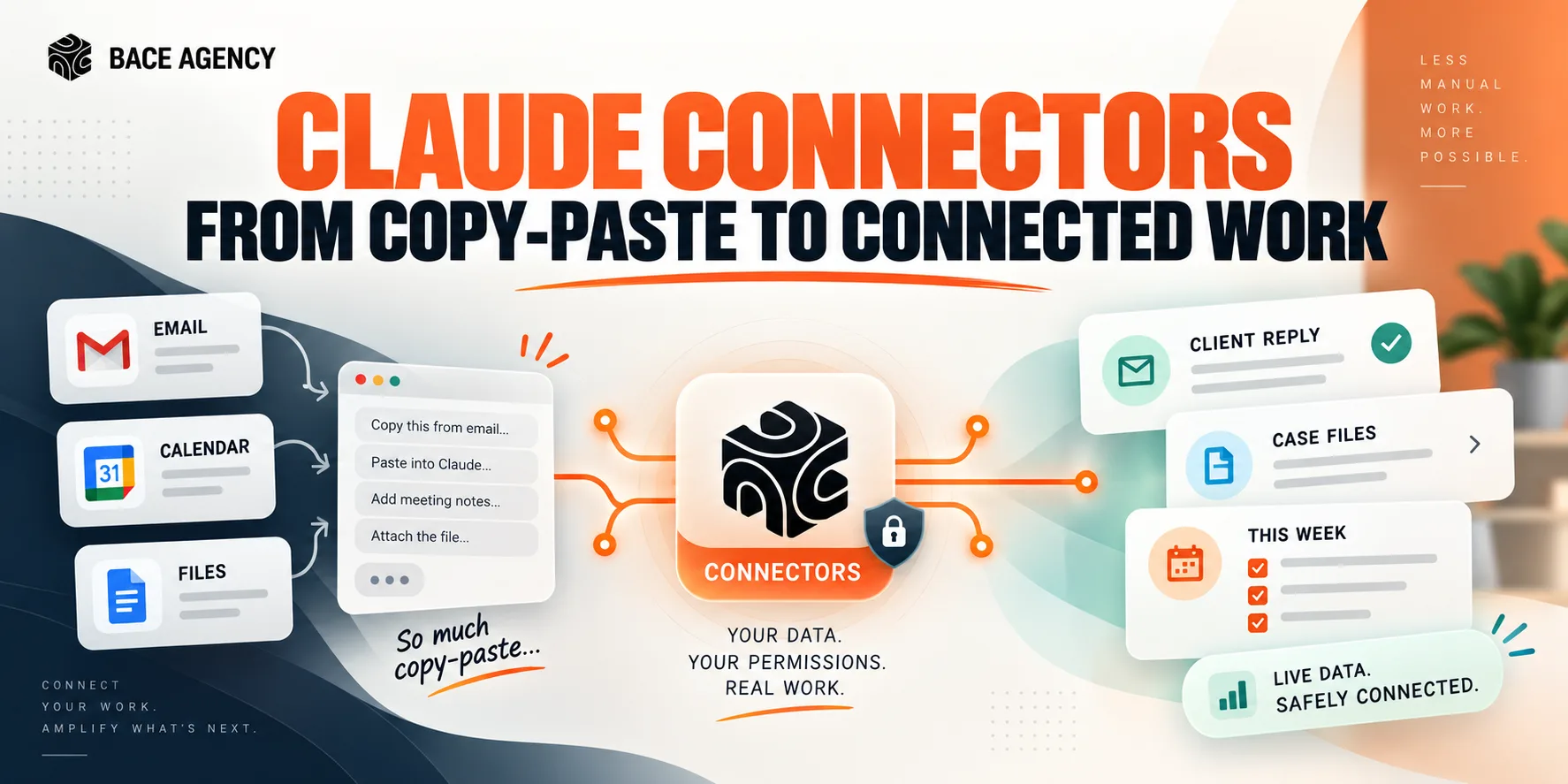
Claude Connectors for Winnetka Accounting Firms
AI stays a clever assistant until it can see your real email, files, and calendar. Connectors are that bridge, and the win depends on connecting narrowly and keeping the writes on approval.
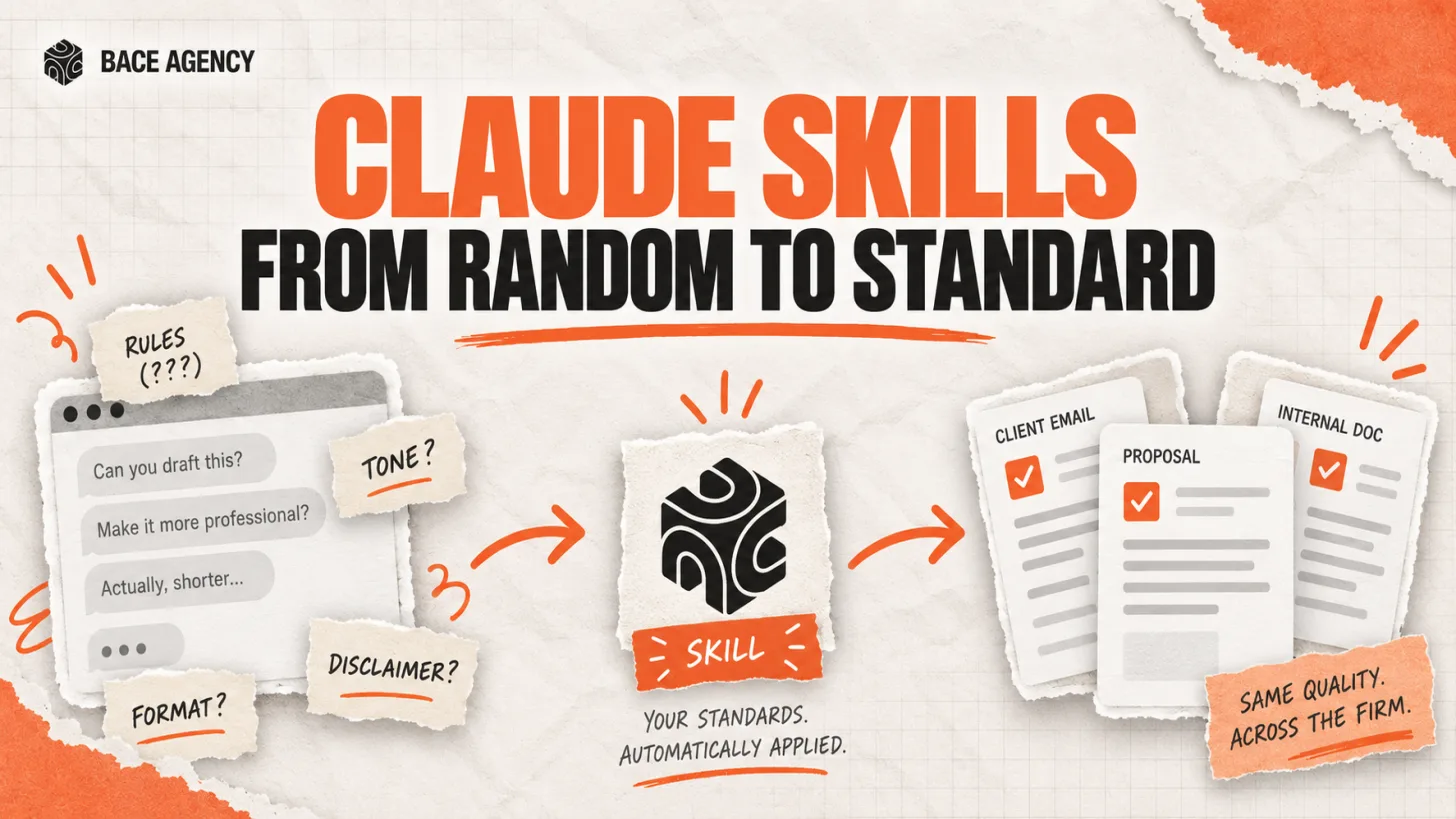
Claude Skills Give a Law Firm One AI Standard
One associate gets sharp drafts, another gets generic filler from the same tool. A Claude Skill turns one person's rules into a standard the whole firm can rely on.
Small North Shore Firms Are Beating Big Ones to AI
While a national firm spends a year debating AI strategy, the small practice down the street already answers clients faster. The gap compounds every week.
About the author

Written by
Michael Pavlovskyi
Founder, Bace Agency
Michael builds custom Claude and GPT workflows for insurance agencies, law firms, and PE firms on Chicago's North Shore. Speaker at Northwestern and Lake Forest College on practical AI adoption for professional services.
Connect on LinkedInSee it in your firm
Book an audit.
A free 30-minute AI audit. No obligation, no pitch deck.
Book a free AI audit