
5 Hiring Lessons That Changed How I Think About Business Efficiency


Hiring changed how I think about business. Two months into running my first pipeline, it clicked: the principles that make hiring efficient are exactly the same principles that make a professional services firm efficient. Screening, filtering, qualifying, following up. It's the same workflow whether you're evaluating candidates or managing client relationships.
Here are the five lessons I learned, and how each one maps directly to running a better insurance agency, law firm, or financial advisory practice on the North Shore.
Lesson 1: Referrals Outperform Cold Outreach, Every Time
Every great candidate I hired came through someone who already knew they were good. Not through a job board. Not through a LinkedIn recruiter blast. Through a genuine personal connection. One person said, "You need to talk to this person," and they were right.
The numbers backed it up. Candidates who came through referrals had a dramatically higher conversion rate through our pipeline. They showed up prepared, already understood what we were building. I didn't have to sell them on it. They were pre-qualified by someone whose judgment I trusted.
Cold applicants needed more work. More screening, more interviews, more back-and-forth before we could even tell if they were serious. Some looked great on LinkedIn but couldn't answer basic questions about the role. Many didn't make it past the first conversation.
What This Means for Your Firm
Your best clients come through referrals too. Think about it: when a current client tells their neighbor in Kenilworth about your insurance agency, that lead is practically pre-sold. They already trust you before they walk through the door. Compare that to someone who found you through a Google search. They're comparing you against five other firms simultaneously.
So why do most firms invest heavily in lead generation but almost nothing in referral cultivation? The answer is usually logistics. Follow-ups, review requests, staying in touch: that takes time you don't have when you're already swamped.
This is one of the first things I look at when working with professional services firms at Bace Agency: automated referral and re-engagement pipelines. The shape is simple. After a policy renewal, an automated but personalized message can go out asking if the client knows anyone who could benefit from similar coverage. After a successful case resolution, a law firm's clients can receive a thoughtful follow-up with a review request. After a quarterly portfolio review, an advisor's clients can get a prompt to share the advisor's contact with friends who might be looking for guidance.
This doesn't replace the relationship. It makes sure the relationship actually generates business. Because the best referral system in the world is useless if nobody remembers to activate it.
Lesson 2: Tailoring Matters More Than Volume
I expected candidates to customize their resumes for the position. It takes minimal effort, especially with AI tools available today. But the majority didn't bother. They sent the same generic resume to every opening. And it showed.
The candidates who took fifteen minutes to tailor their application, highlighting relevant experience, addressing specific requirements from the job description, explaining why this role specifically interested them, stood out immediately. In a stack of fifty applications, the five that felt personal were the ones I read carefully.
What This Means for Your Firm
How many of your client communications are generic? When a prospect fills out your contact form, do they get a personalized response or a templated auto-reply? When you send renewal notices, do they reference the client's specific policies and circumstances, or do they look like a mass mailing?
The insurance agency that sends a renewal notice saying "Dear Valued Client, your policy is up for renewal" is the equivalent of the candidate who sends an untailored resume. It's technically correct, but it signals that you didn't invest any thought.
The agency that sends "Hi Sarah, your homeowner's policy on Elm Street is coming up for renewal on May 15th. Given the recent updates we discussed about your kitchen renovation, this would be a great time to review your coverage limits" is sending the personalized application. That's what earns trust.
AI makes this kind of personalization scalable. At Bace Agency, the systems I build pull client-specific data from your CRM and management system and generate communications that reference actual client details, not "Dear Valued Client". They reference real details about real clients. They just don't require a human to manually write each one.
Lesson 3: Pre-Screening Saves Everyone's Time
Before scheduling a single meeting, I started sending candidates seven screening questions. Simple, direct questions that revealed whether the candidate was actually a fit for the role. Things like their availability, their salary expectations, their understanding of the industry, and their approach to common challenges.
The result was dramatic. Instead of spending 30 minutes on a call with someone who clearly wasn't a match, I could identify misalignments in three minutes by reviewing their written answers. The candidates who made it to the interview stage were consistently stronger. And neither of us wasted time.
What This Means for Your Firm
How much time does your team spend on initial conversations with prospects who turn out to be unqualified, out of scope, or just price-shopping? For law firms, this is a massive drain. A partner spends 30 minutes on a consultation call, only to discover the matter isn't in their practice area. For insurance agencies, an agent spends time quoting a prospect who was never going to switch from their current carrier.
Pre-qualification solves this. And it doesn't have to feel impersonal. An AI-powered intake system can ask the right questions upfront (What type of coverage are you looking for? What's your timeline? Have you worked with an attorney on this type of matter before?) and route the inquiry appropriately before it ever reaches a human.
The qualified leads get fast-tracked to the right person. The unqualified ones get a polite, helpful response directing them to a better resource. Your team saves time. The prospect gets a faster answer.
Intake qualification systems like this are exactly the kind of thing AI handles well. The pattern is always the same: a few well-chosen questions, asked at the right moment, save hours of wasted meetings.

Lesson 4: First Impressions Are Made in Minutes, Not Hours
I introduced a brief 15-minute video call as a "chemistry check" before committing to a full interview. The purpose wasn't to evaluate technical skills. It was to assess whether we could actually work together. Communication style, energy, genuine interest in the work. You can tell a lot in fifteen minutes.
This step filtered out candidates who looked great on paper but weren't a cultural fit. It also surfaced candidates who might not have had the most polished resume but clearly had the right mindset and drive.
What This Means for Your Firm
Your prospects are making the same kind of snap judgment about your firm. When someone calls your office and gets voicemail, they form an impression. Silence for two days after a form submission? Same thing. Having to repeat information they already provided? Even worse.
And in most cases, that impression is: "This firm isn't organized enough to earn my business."
The firms that win the first-impression game are the ones that respond instantly, acknowledge the inquiry with relevant context, and make the prospect feel like they're the most important person in the pipeline. That doesn't require hiring more staff. It requires having the right systems in place.
An AI-powered response system acknowledges the inquiry within seconds, asks a few qualifying questions, schedules a callback, and briefs your team before the conversation happens. The prospect's first impression is "This firm has it together." And you didn't have to lift a finger.
Lesson 5: Some Things Still Require Being in the Room
After the video screen, I always brought final candidates in for an in-person meeting. You can't fully assess time management, pressure handling, and interpersonal energy over a screen. There's something about being in the same room that reveals whether someone is genuinely a fit.
Remote interviews are efficient, and I use them. But for high-stakes decisions, in-person evaluation is irreplaceable. The way someone shows up, on time, prepared, present, tells you everything about how they'll perform.
What This Means for Your Firm
AI is incredible at handling the tasks that don't require human presence: screening, filtering, scheduling, data entry, follow-ups, document processing, compliance checks. But the moments that matter most, the client meeting at your office in Lake Forest, the consultation where you explain complex legal strategy, the portfolio review where you build trust with a family's life savings, those still require you.
The whole point is freeing you up for what only you can do: the relationships, the expertise, the face-to-face moments.
I live on the North Shore. When I sit down with a firm owner at Starbucks in Lake Forest to discuss their workflows, I'm not doing it over Zoom from San Francisco. I'm here because the relationships matter. And the AI systems I build are meant to protect your ability to prioritize relationships, too.
The Through-Line: Screening and Filtering Is What AI Does Best
Looking back at these five hiring lessons, the common thread is obvious: the biggest efficiency gains came from better screening and filtering. Referrals pre-screened for quality. Tailored applications filtered for effort. Pre-call questions screened for fit. Video checks filtered for chemistry. In-person meetings confirmed the final decision.
Your firm's client pipeline works the same way. Leads come in. Some are great. Some aren't. Some need immediate attention. Some can wait. Some require a partner's time. Some don't.
The firms that screen and filter efficiently grow faster because their team's time goes to the highest-value work. The firms that treat every inquiry the same, or worse, let inquiries sit unattended, lose opportunities and burn out their staff.
AI is built for screening and filtering. And when you apply it to your firm's client workflows (intake, qualification, follow-up, routing, scheduling) the impact is immediate and measurable. I walk through specific examples in my article on how AI is transforming insurance agencies on the North Shore.
What This Looks Like at Bace Agency
At Bace Agency, we take these same principles and apply them to professional services firms.
- Discovery: We sit down with you and map how your firm actually works, not the org chart version, but the day-to-day reality of how inquiries come in, how work gets assigned, and where things fall through the cracks. (This workflow-first approach is something I learned building AI fraud detection systems in healthcare.)
- Build: We design and implement AI-powered workflows that handle the screening, filtering, and administrative tasks that consume your team's time. These integrate with your existing management software and CRM, so nothing breaks.
- Handoff: We train your team on the new systems and make sure everything runs smoothly. No ongoing dependency. No consulting fees that never end.
Same goal as hiring: protect human time for the work that only humans can do, and let systems handle everything else.
If you're a firm owner on the North Shore wondering where to start, book a free AI audit. 30 minutes, no obligation. We'll identify the one workflow that's costing you the most time and talk about what automation could look like. No obligation, no pitch deck. Just an honest conversation about where AI fits in your firm.
What You Can Do This Week
You don't need to overhaul your entire operation. Start with one of these:
- Add 3 qualifying questions to your intake form. Before someone gets on your calendar, make sure they've answered the basics: What do they need? What's their timeline? Have they worked with a firm like yours before? This alone can cut unqualified consultations in half.
- Set up an auto-response for new inquiries. Even a simple "We received your message and will get back to you within 2 hours" buys you time and tells the prospect you're on it. Most firms send nothing, and silence is your biggest competitor.
- Ask your team what they re-explain most often. If your staff answers the same questions every day, those answers should live in a templated response or FAQ. Save the human conversation for the nuanced stuff.
- Review your last 10 lost leads. Look at the ones who inquired but never became clients. How long did it take to respond? Did they get a personalized reply or a generic one? The pattern will tell you exactly where the leak is.
- Block 30 minutes to map your referral workflow. From the moment a happy client says "I'll tell my friend about you" to the moment that friend becomes a client, what actually happens? If the answer is "nothing systematic," that's your biggest growth lever.
Michael Pavlovskyi is the founder of Bace Agency, an AI workflow automation consultancy based in Lake Forest, Illinois. He works with insurance agencies, law firms, and financial advisors on Chicago's North Shore to eliminate manual work and modernize operations. He also hosts the RedNote Podcast.
Related Articles
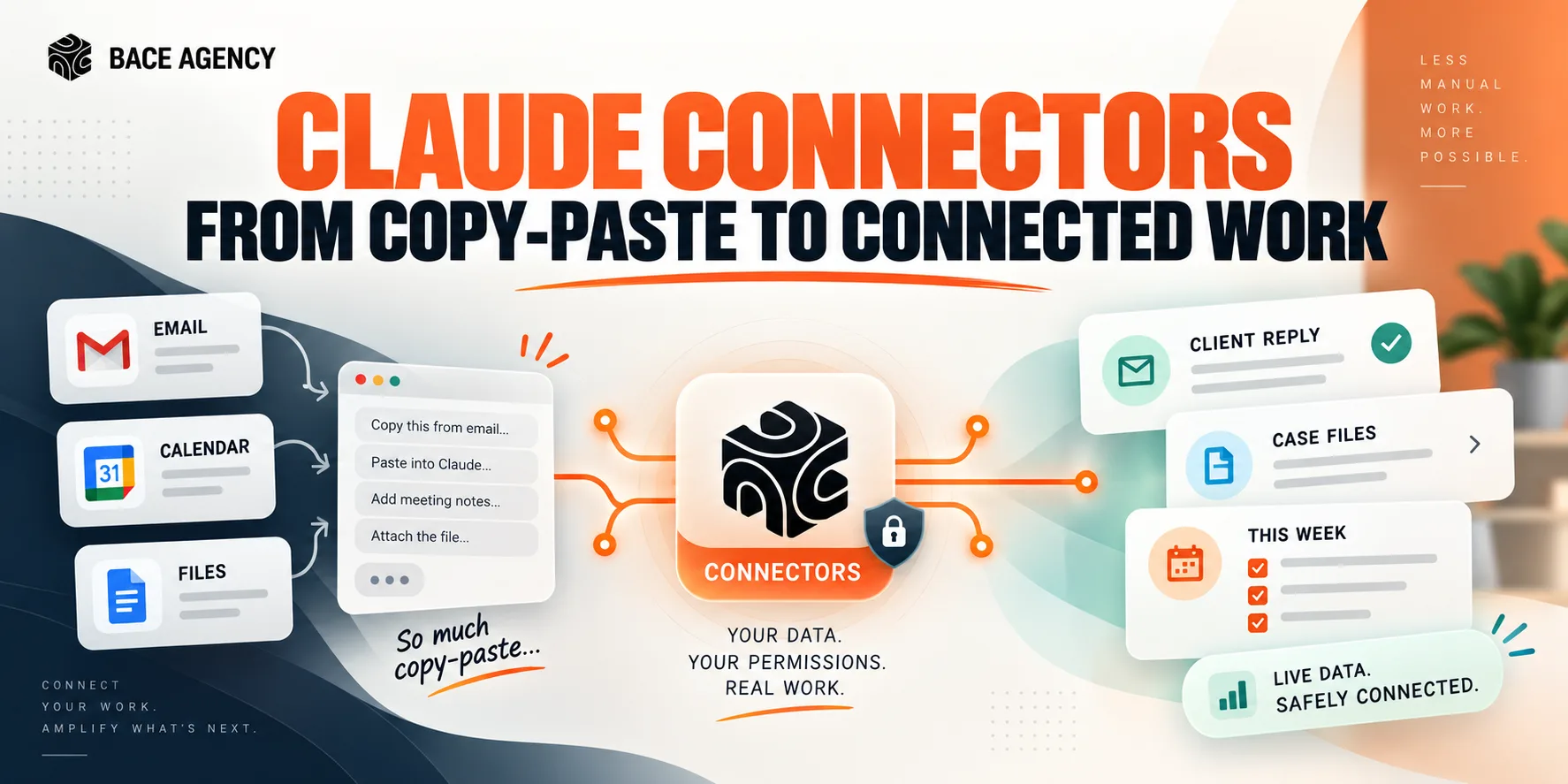
Claude Connectors for Winnetka Accounting Firms
AI stays a clever assistant until it can see your real email, files, and calendar. Connectors are that bridge, and the win depends on connecting narrowly and keeping the writes on approval.
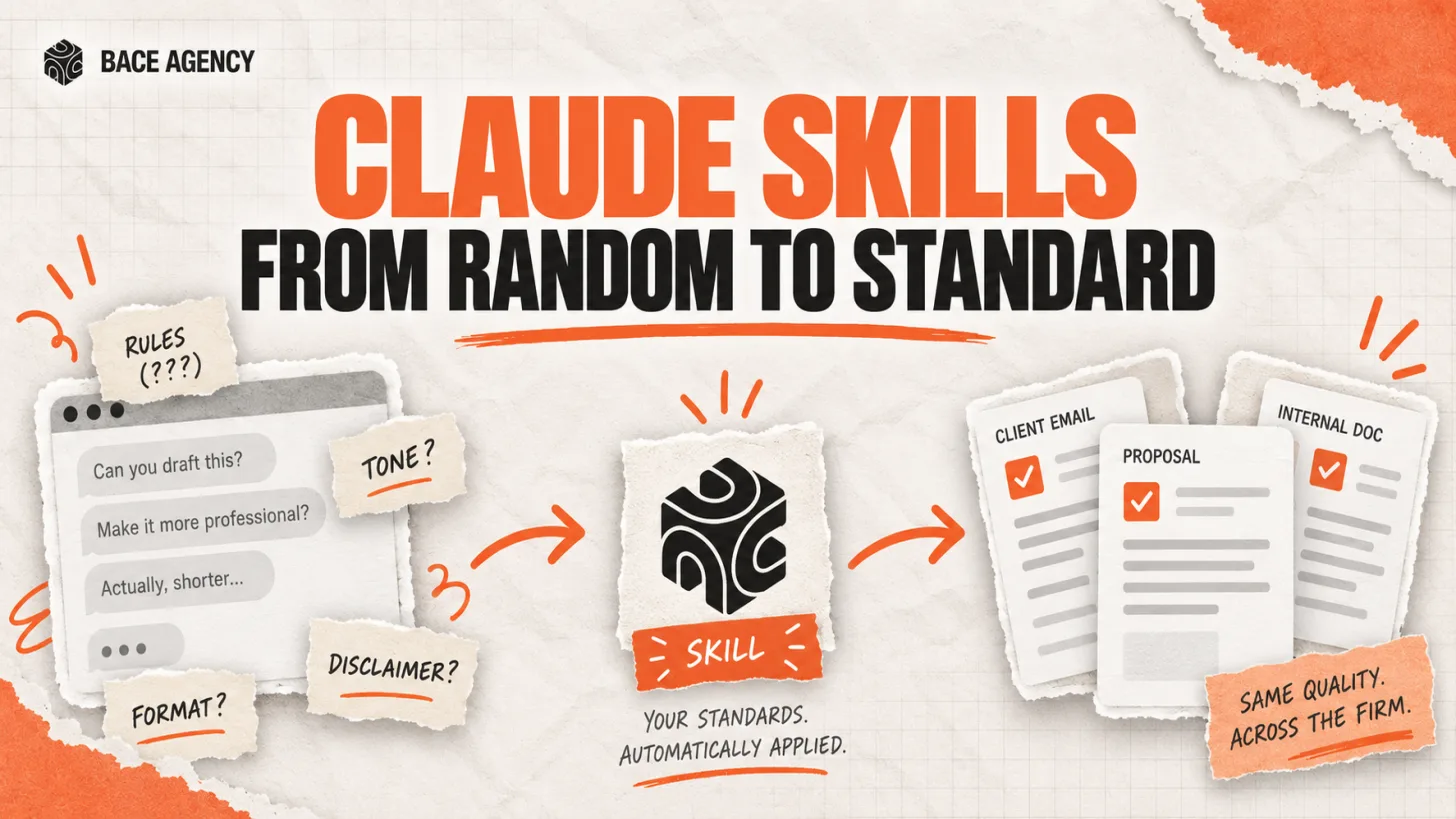
Claude Skills Give a Law Firm One AI Standard
One associate gets sharp drafts, another gets generic filler from the same tool. A Claude Skill turns one person's rules into a standard the whole firm can rely on.
Small North Shore Firms Are Beating Big Ones to AI
While a national firm spends a year debating AI strategy, the small practice down the street already answers clients faster. The gap compounds every week.
About the author

Written by
Michael Pavlovskyi
Founder, Bace Agency
Michael builds custom Claude and GPT workflows for insurance agencies, law firms, and PE firms on Chicago's North Shore. Speaker at Northwestern and Lake Forest College on practical AI adoption for professional services.
Connect on LinkedInSee it in your firm
Book an audit.
A free 30-minute AI audit. No obligation, no pitch deck.
Book a free AI audit