
What I Told Lake Forest College Students About AI


A few weeks ago, I stood in front of a room full of students at Lake Forest College's Entrepreneurial Club. The topic was supposed to be straightforward: how to stand out in hiring when AI can do what junior employees used to do. But the conversation quickly became something bigger. It turned into a discussion about what AI actually changes, what it doesn't, and how every industry is about to go through the same reckoning.
I left that room thinking about you: the insurance agency owner on Deerpath, the managing partner at a law firm in Highland Park, the financial advisor in Wilmette. Because the same forces I described to those students are heading straight for your firm. And the firms that understand this shift first will be the ones that win.
What I Actually Told the Students
The core message was this: AI tools like Claude, ChatGPT, and Cursor aren't replacing people. They're amplifying the people who know how to use them. The students who learn to build with these tools today will look like senior employees tomorrow. The ones who ignore them will be competing against people who can do three times the work in half the time.
Three ideas really landed.
1. Personal Connections Still Outperform Everything
AI can generate a hundred polished resumes in an afternoon. The thing that still cuts through? Genuine human connection. I told the students that "genuinely connecting with people who work in the space you care about" will always outperform mass-applying online. In my experience the strongest hires tend to come through referrals, where someone already knows the candidate is good.
This isn't just a hiring lesson. It's a business lesson. (I wrote more about what hiring taught me about business efficiency.) Your best clients didn't find you through a Google ad. They came because someone they trusted told them about you. So the real question is: are you making it easy for those referrals to happen?
At Bace Agency, when we work with professional services firms on the North Shore, one of the first things we automate is the referral and follow-up pipeline. Not because relationships don't matter, but because the administrative work around maintaining relationships is exactly what AI handles best. You focus on the conversation at Starbucks in Lake Forest. We make sure the follow-up email goes out on time, the CRM gets updated, and the next touchpoint is scheduled.
2. AI Is a Force Multiplier, Not a Replacement
Everyone's worried AI will take jobs. Here's what I actually told them: AI is coming to take tasks. The people who understand the difference will thrive. The people who don't will struggle to keep up.
Think about what a junior insurance agent does in their first year. They're answering phones, entering data into the agency management system, routing documents, sending follow-up emails, scheduling renewals. It's necessary work, but it's not the work that builds client relationships or closes policies. AI can handle most of those tasks today, not in theory but in practice. These are exactly the kinds of systems I build for professional services firms.
The result isn't fewer employees. It's employees who can focus on the work that actually grows the business. The agent who used to spend three hours a day on data entry now spends that time meeting with prospects. The paralegal who was buried in document formatting now reviews case strategy with the partner. The financial advisor's assistant who was manually compiling portfolio reports now prepares for client meetings.
The students who learn to build with these tools today will look like senior employees tomorrow.
This is exactly what I told the students, and it applies to your team just as much. The question isn't whether your firm will use AI. It's whether your firm will figure it out before your competitors do.
3. The AI Paradox: More Noise, More Opportunity
Here's the paradox I described to the room: AI is simultaneously flooding every channel with generic content while making it easier than ever to deliver genuinely personalized, high-quality work. The students who use AI to mass-send identical resumes will get ignored. The students who use AI to deeply research each company and craft tailored applications will stand out more than ever.
The same paradox exists in professional services. AI chatbots are popping up on every website. Automated email sequences are filling every inbox. Generic "AI-powered" tools are being pitched at every conference. Most of it is noise.
But the firms that use AI thoughtfully, to genuinely improve client experience, to respond faster, to catch details that humans miss, to personalize every interaction, those firms will create a competitive advantage that's hard to replicate.
How This Translates to Your Insurance Agency
These are exactly the patterns Bace Agency's automation services are built to address.
Here's what I see in most North Shore agencies. Phones ring after hours and nobody answers. Leads come in from the website and sit in an inbox for 24 to 48 hours before someone responds. Renewal notices go out late because someone forgot to update the spreadsheet. Policy documents get routed to the wrong department because the intake form wasn't filled out correctly. CSRs spend hours entering the same data into the management system that was already captured on a paper form.
Every one of these problems is a task problem, not a people problem. Your team isn't lazy or incompetent. They're buried in repetitive work that AI should be handling.
Here's what it looks like in practice:
- AI phone answering: Someone calls at 8 PM. The AI picks up, captures their info, figures out what they need, and routes it to the right person by morning. Urgent? It escalates immediately.
- Automated client intake: A new lead hits your website. Within seconds they get a response, a qualifying questionnaire, and they're in your CRM. Your agent already has context before the callback.
- Renewal management: No more missed renewals. AI watches every date across your book and kicks off personalized outreach at 90, 60, and 30 days out.
- Document processing: Documents come in, get classified, data gets pulled out, and your management system gets updated, without anyone retyping anything. CSRs just review and approve.
- Follow-up sequences: Prospects who don't convert aren't forgotten. They get relevant, personalized touchpoints based on what they actually asked about, not some generic drip campaign.
Every one of these is buildable today with tools that already exist. Done well, the pattern is consistent: faster response times, fewer dropped leads, less repetitive work for staff, and more policies written. The point is that none of this is futuristic. It is a matter of mapping the workflow and deciding which steps a machine should own.
What This Means for Law Firms and Financial Advisors
Same story for law firms and financial advisors. Different software, different terminology, same problems.
For law firms, client intake is the critical bottleneck. A potential client calls your office at 6 PM on a Tuesday. Nobody answers. They call the next firm on Google. You never even knew the lead existed. AI intake systems solve this immediately by capturing the inquiry, running a basic conflict check, and scheduling a consultation before your staff arrives the next morning. The integration with your practice management system means everything is documented and filed correctly from the start.
For financial advisors, the opportunity is in client communication and compliance. Portfolio review reports that take hours to compile manually can be generated automatically. Compliance monitoring that requires constant vigilance can be handled by AI systems that never sleep. Client check-ins that fall through the cracks during busy seasons can be automated without losing the personal touch. Integration with your CRM means client data is always current.
The principle is the same one I shared with those students at Lake Forest College: AI amplifies what you're already good at. It doesn't replace the expertise, the relationships, or the judgment that make your firm valuable. It removes the friction that keeps you from spending more time on the things that matter.
The Firms That Move First Will Win
I told the students something that stuck with them: in five years, every resume will mention AI proficiency. The advantage goes to the people who develop that proficiency now, while it's still a differentiator.
The same is true for professional services firms on the North Shore. Right now, most of your competitors are still doing things the old way. They're still answering phones manually, entering data by hand, sending renewal notices from spreadsheets. The window of competitive advantage is open, but it won't stay open forever.
The distinction that came up afterward really captured it: the students who treat AI as a tool, not a crutch, are the ones who pull ahead. The same distinction applies to your firm. AI isn't a magic button you press to solve all your problems. It's a powerful tool that, when applied thoughtfully to specific workflows, transforms how your team operates. That philosophy of no hype, just building is central to everything we do.
Where the Gains Actually Come From
When a firm adopts AI thoughtfully, the change isn't only about efficiency. It's about confidence. The team stops dreading Monday mornings because the inbox isn't a disaster. The owner stops worrying about missed calls because the system catches everything. Clients notice because responses come faster, renewals happen on time, and fewer things fall through the cracks.
Take after-hours leads, the single most common leak I see in agency operations. If your office sends every evening and weekend call to voicemail, a real share of those prospects simply dial the next agency on Google. An AI phone system answers, qualifies the inquiry, and schedules a callback within seconds, without anyone working late or being hired. You stop losing the business that was already coming to you.
Intake at a law firm works the same way. If a new inquiry sits a day or two before someone responds, prospects call two or three other firms in that window. Route the intake through an AI system and the first substantive response can land in minutes, with a basic conflict check run and a consultation already on the calendar. You aren't generating more leads. You're keeping the ones you had.
None of this is a Silicon Valley fantasy. The technology is available right now, it works, and it applies just as cleanly to a firm on the North Shore as to anyone else.
Where to Start
Here's where I'd start. Don't try to "implement AI" as some broad initiative. Instead, pick one workflow that's causing pain right now. Maybe it's the phone calls you're missing after hours. Maybe it's the renewal notices that go out late. Maybe it's the client intake process that takes three days when it should take three minutes.
Start there. Understand how the work actually flows, not how you think it flows, but how your team really does it day to day. Map every step, every handoff, every manual entry point. Then ask: which of these steps could AI handle while maintaining or improving quality?
That's exactly the approach we take at Bace Agency. We start with a free AI audit, a 30-minute conversation where we map your most painful workflow and identify exactly where automation would have the biggest impact. No pitch deck. Just an honest look at where AI fits.
Because the lesson I shared with those Lake Forest College students applies to every business on the North Shore: the technology is here. The question is whether you'll use it to amplify what makes your firm great, or whether you'll wait until everyone else figures it out first.
What You Can Do This Week
You don't need a full AI implementation to start making progress. Here are a few things you can do right now:
- Audit your after-hours call handling. Call your own office at 7 PM tonight. What happens? If the answer is voicemail, you're losing leads every week. Write down how many calls you estimate go unanswered after 5 PM.
- Map one repetitive workflow end to end. Pick the task your team complains about most (renewal notices, intake forms, document routing) and write down every single step. Every click, every handoff, every manual entry. You'll be surprised how many steps there are.
- Time your lead response. Submit a test inquiry through your own website. Start a stopwatch. How long until a real human responds with something substantive? If it's more than an hour, that's your biggest opportunity.
- Ask your CSRs what they re-type most often. The answer will point you straight to your first automation opportunity. If the same data is being entered into two or more systems manually, that's a workflow AI can handle today.
- Check your CRM data quality. Pull up ten random client records. Are the emails current? Are phone numbers formatted consistently? Are notes fields actually filled in? Clean data is the foundation of any automation, and a quick spot-check will tell you where you stand.
Michael Pavlovskyi is the founder of Bace Agency, an AI workflow automation consultancy based in Lake Forest, Illinois. He works with insurance agencies, law firms, and financial advisors on Chicago's North Shore to eliminate manual work and modernize operations. He also hosts the RedNote Podcast.
Related Articles

The Firms That Ban AI Will Lose Their Best People
A ban does not stop your team from using AI. It pushes your sharpest people onto risky public tools in secret, or out the door to a firm that gave them a safe one.
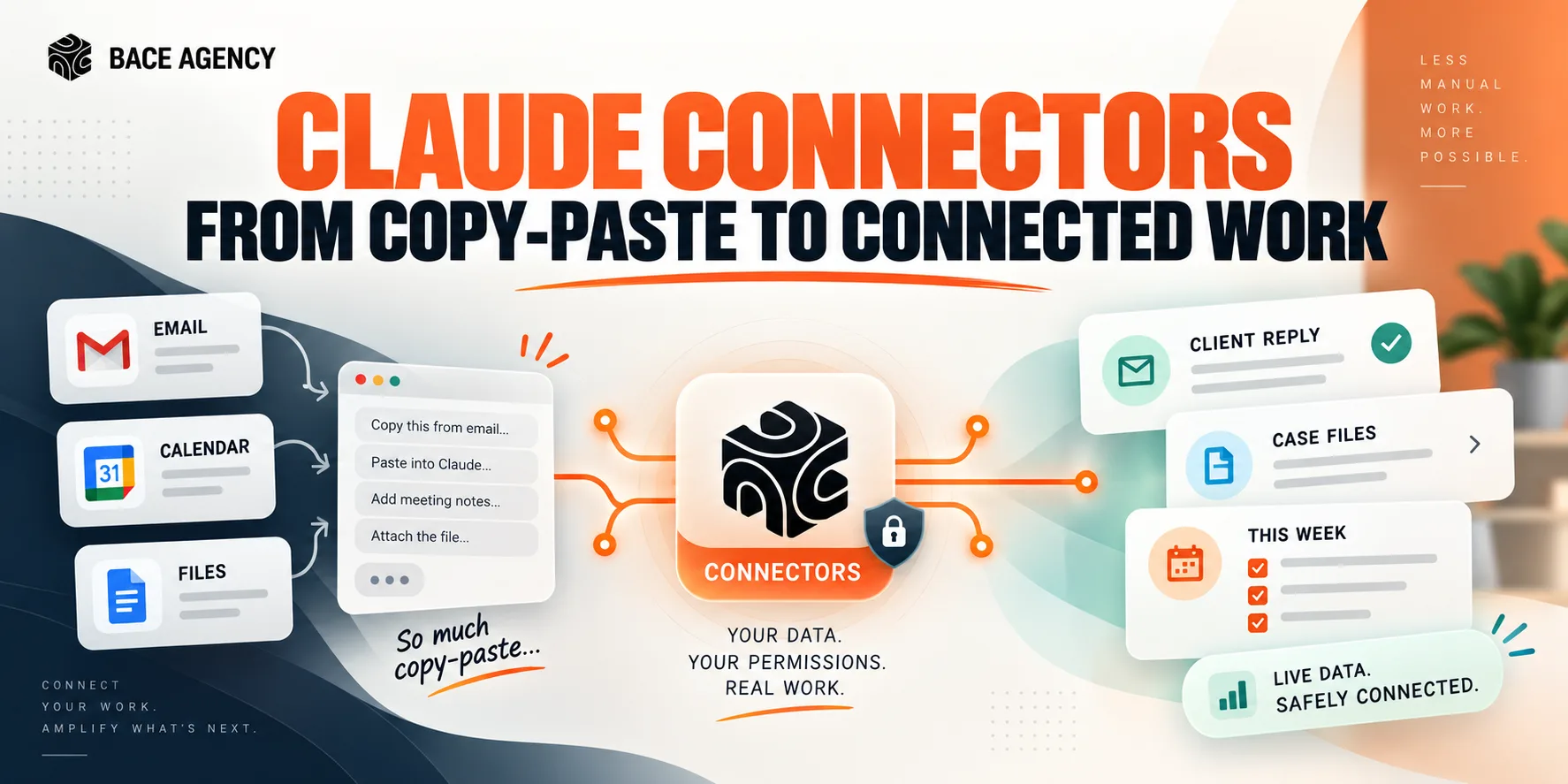
Claude Connectors for Winnetka Accounting Firms
AI stays a clever assistant until it can see your real email, files, and calendar. Connectors are that bridge, and the win depends on connecting narrowly and keeping the writes on approval.
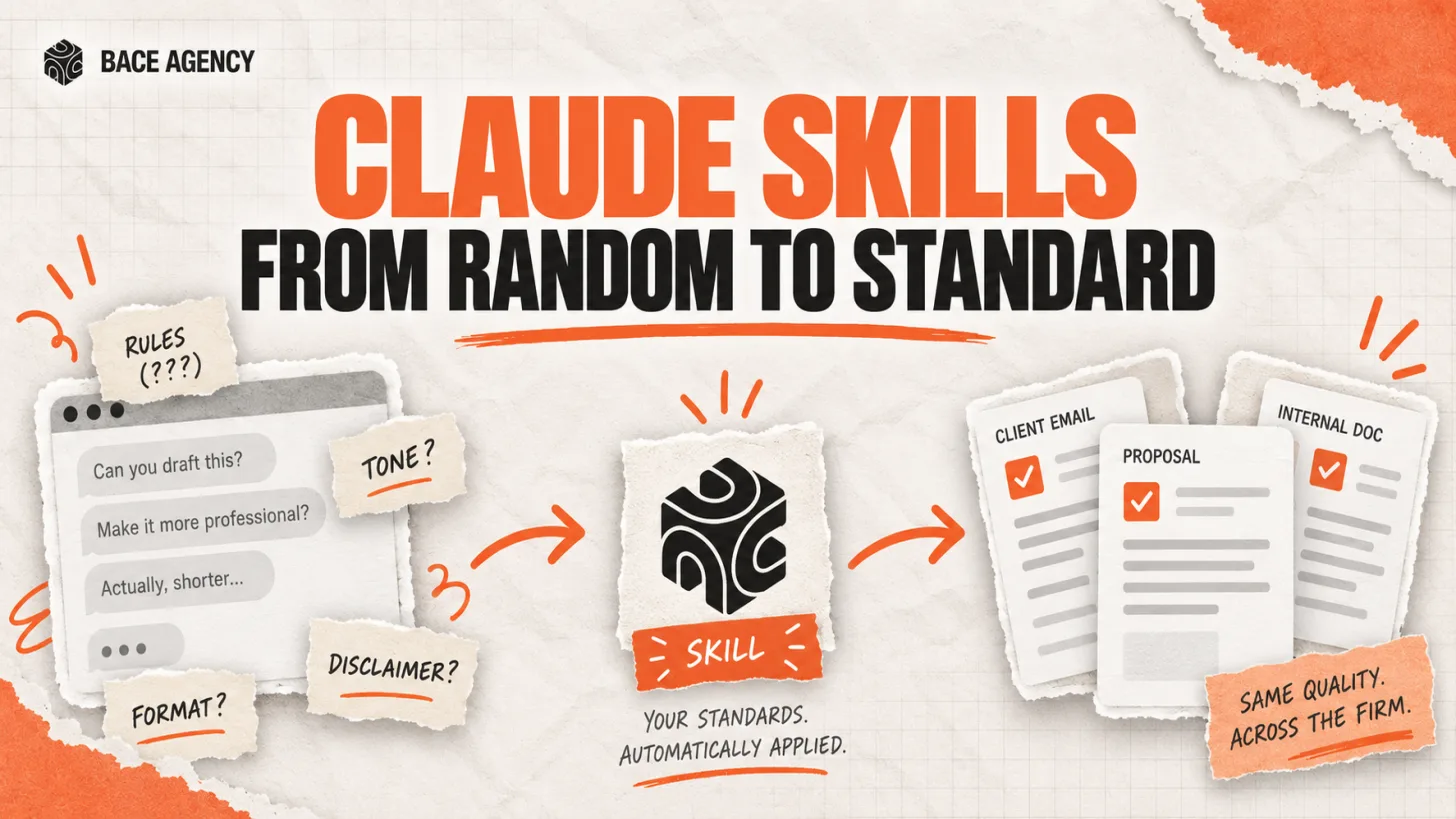
Claude Skills Give a Law Firm One AI Standard
One associate gets sharp drafts, another gets generic filler from the same tool. A Claude Skill turns one person's rules into a standard the whole firm can rely on.
About the author

Written by
Michael Pavlovskyi
Founder, Bace Agency
Michael builds custom Claude and GPT workflows for insurance agencies, law firms, and PE firms on Chicago's North Shore. Speaker at Northwestern and Lake Forest College on practical AI adoption for professional services.
Connect on LinkedInSee it in your firm
Book an audit.
A free 30-minute AI audit. No obligation, no pitch deck.
Book a free AI audit