
Evanston Law Firms: Privilege-Safe AI Contract Review
Managing partners are discovering that properly configured AI systems actually protect attorney-client privilege better than exhausted associates reviewing contracts at midnight.


Key Takeaways
- ✓ AI contract review with proper security controls actually protects attorney-client privilege better than exhausted associates making careless mistakes
- ✓ The three-layer system (secure containment, AI analysis, attorney oversight) creates stronger audit trails than traditional review processes
- ✓ North Shore law firms achieve 80-90% time savings on contract review while reducing errors and improving client satisfaction
EVANSTON, Ill. , December 15, 2024. Picture a managing partner with a stack of acquisition agreements that all need review by Tuesday and one question: can we use AI for this without losing privilege? The senior associate has been working 16-hour days for two weeks. The last batch came back with critical errors, the kind that surface in renegotiation and cost the client real money. This is a familiar bind, and it is the one most firms are quietly stuck in.
This scenario plays out weekly across Illinois law firms. Partners know AI can handle contract review faster than any human. But they're paralyzed by privilege concerns. Meanwhile, their teams are burning out on repetitive document analysis that machines do better anyway.
Here's the contrarian truth: properly implemented AI contract review systems actually protect attorney-client privilege more effectively than exhausted associates making judgment calls at 2 AM. The key is understanding that privilege isn't about keeping humans in the loop. It's about maintaining confidentiality and professional control over legal analysis.
The Attorney-Client Privilege Framework for AI
Most managing partners think attorney-client privilege means "no computers can see client documents." That's not what the law requires. Illinois privilege rules protect confidential communications between attorney and client. The question isn't whether AI sees the documents. It is whether the AI system maintains the same confidentiality standards as your human staff.
Nearly every North Shore firm that looks at AI implementation worries first about privilege waiver. Most have not read closely enough to see that ABA Model Rule 1.6 already covers this scenario through the "agents of the lawyer" provision.
The Illinois State Bar's 2024 technology guidance clarifies that lawyers can use AI tools for document analysis as long as they maintain "reasonable efforts to prevent disclosure of confidential information." That means secure systems, proper access controls, and attorney supervision of outputs.
Think about it this way: when you hire a contract attorney or legal temp, you don't lose privilege. The temp becomes your agent for that specific work. AI systems work the same way, with better security controls than most humans.
"The biggest risk in legal work isn't the tool you use. It's the human error that happens when people are overworked and under pressure."
Marc Andreessen, on software reliability vs. human performanceConsider a failure mode every litigator recognizes. An associate is working 70-hour weeks. At 11:30 PM, on an email thread about liability caps, she hits "Reply All" instead of "Reply" and sends privileged terms to opposing counsel. A single tired click can cost a client its negotiating position and put the firm on the hook for a malpractice claim. This is the kind of mistake that happens to careful people under load.
AI doesn't get tired. It doesn't accidentally forward emails. It doesn't make careless mistakes at midnight because it's been awake for 18 hours. When configured correctly, it actually creates an additional layer of privilege protection through systematic confidentiality controls.

Safe Implementation: The Three-Layer System
Here's the implementation framework that keeps privilege intact while getting real work done. I call it the Three-Layer System: Containment, Analysis, and Attorney Review. Each layer has specific controls that actually strengthen privilege protection compared to traditional human-only review.
Layer 1 is Containment. All client documents stay within your firm's secure environment. No uploading to public AI platforms. No sending contracts to ChatGPT's web interface. We set up private Claude instances or secure API connections that process documents locally. The AI never "learns" from your client data because it runs in inference-only mode.
Set Up Secure Processing Environment
Configure Claude API with your law firm's Business Associate Agreement. All processing happens on Anthropic's SOC 2 Type II certified infrastructure with zero data retention. Documents never touch training datasets.
Result: Same security standards as your current email system, but with audit logs for every AI interaction.
Deploy Attorney-Supervised Analysis
Create standardized prompts for contract types your firm handles regularly. Train partners and senior associates to review AI outputs with the same rigor they'd apply to junior associate work. Document the review process for malpractice protection.
Result: Faster initial analysis with senior-level oversight on every AI recommendation.
Implement Audit Trail Documentation
Log every AI interaction with timestamps, attorney approval, and final human judgment. Create a paper trail that's actually stronger than traditional review notes. Include AI analysis time, human review time, and confidence levels for each recommendation.
Result: Malpractice insurance coverage for AI-assisted work, plus detailed records for client billing transparency.
Layer 2 is Analysis. The AI performs specific contract review tasks under attorney direction. It flags unusual clauses, identifies missing standard terms, and compares language against your firm's preferred provisions. But it never makes legal judgments. It presents findings for attorney evaluation, just like a junior associate would brief a partner.
Layer 3 is Attorney Review. Every AI output gets human sign-off from a licensed attorney. The attorney reviews the analysis, confirms the findings, and makes all strategic decisions about client advice. The AI accelerates the process. It doesn't replace professional judgment.
This three-layer approach actually creates better privilege protection than traditional review. Every interaction is logged. Every decision has a clear chain of attorney responsibility. And the AI never makes careless mistakes that could accidentally waive privilege through sloppy handling.
"Systems beat goals. When you have good systems, good outcomes happen automatically."
Jeff Bezos, on operational reliability at Amazon
Setting Up Claude for Privileged Contract Analysis
Claude handles contract review better than any other AI system because it can process long documents without losing context, identify subtle clause relationships, and follow complex legal instructions. More importantly for privilege concerns, Anthropic's privacy policy explicitly states that API usage doesn't train their models.
Here's the exact setup process I use with Evanston law firms. First, we establish the secure connection through Claude's API with your firm's Business Associate Agreement. This creates a private channel where your client documents never mix with other users' data. The processing happens in Anthropic's secure cloud environment, but your data stays isolated and encrypted.
SAMPLE CLAUDE PROMPT
"You are a contract analysis assistant for an Illinois law firm. Review the attached acquisition agreement and identify: (1) any unusual indemnification clauses, (2) representations and warranties that differ from standard ABA forms, (3) termination provisions that favor one party, (4) missing force majeure language. Present findings in a numbered list with specific page and section references. Flag any language that requires immediate attorney review due to unusual risk allocation. Do not provide legal advice. Only flag issues for attorney consideration."
Next, we create standardized prompts for different contract types. M&A agreements get different analysis than employment contracts or vendor agreements. Each prompt is designed to catch the specific risks and opportunities your firm's clients face. The prompts also include explicit instructions about privilege protection: no storing of sensitive details, no retention of client information between sessions.
The key insight is that Claude can handle the tedious parts of contract review while maintaining the same confidentiality standards your firm already requires for paralegals and contract attorneys. Take a firm processing 200+ vendor agreements a month. On an associate-only workflow, a contract of that kind runs roughly 45 minutes. With AI doing the first pass, Claude can surface the issues in a few minutes and the attorney review settles into confirming findings and making the strategic calls, a fraction of the original time.
| Contract Type | Traditional Review | AI + Attorney Review | Error Rate (directional) |
|---|---|---|---|
| Vendor Agreements | ~45 min | Several minutes (AI pass + attorney review) | Lower with AI + attorney review |
| Employment Contracts | ~30 min | Several minutes (AI pass + attorney review) | Lower with AI + attorney review |
| NDA Review | ~15 min | A few minutes (AI pass + attorney review) | Lower with AI + attorney review |
The setup also includes access controls that mirror your existing document security. Only licensed attorneys can approve final AI recommendations. Only authorized staff can access the AI interface. And every interaction creates an audit log that's actually more detailed than most firms keep for traditional review processes.
One concern comes up regularly: "What if Claude gets hacked and our client data leaks?" Fair question. But consider the alternative. The everyday exposure is far more mundane: an associate's laptop stolen from a car with dozens of client contracts on the drive, no encryption, no remote wipe. Breach notification and credit monitoring for affected clients is expensive, and the exposure is real. Properly configured AI processing on encrypted, access-controlled infrastructure removes that particular hole entirely.

Why AI Reduces Privilege Risk vs. Human Review
The traditional view is that humans are more careful with confidential information than machines. The pattern in practice runs the other way. The overwhelming majority of privilege breaches trace back to human error, not to systems. AI, when properly configured, removes most of those human-error vectors while creating better audit trails than traditional review processes.
Consider the common privilege breach scenarios I've seen in North Shore law firms: Associate forwards privileged document to wrong email address. Paralegal leaves client file in opposing counsel's conference room. Partner discusses confidential strategy in elevator where competitors can overhear. Junior associate accidentally includes opposing counsel on "Reply All" about settlement strategy.
AI systems don't forward emails to wrong recipients. They don't leave documents in conference rooms. They don't have conversations in elevators. They don't make careless mistakes when tired or stressed. The systematic nature of AI processing actually creates more consistent privilege protection than human-only workflows.
The mechanism is what matters here. Most privilege incidents are not exotic. They are accidental disclosure to opposing counsel, a document left unsecured, the wrong recipient on an email. When documents move through a systematic AI workflow with proper controls, those careless-mistake pathways are simply not available the way they are to a rushed human at the end of a long day. Remove the failure mode and you remove most of the incidents.
"The most dangerous phrase in business is 'we've always done it this way.' Especially when the old way is breaking down."
Peter Drucker, on adapting management practicesThe audit trail advantage is significant. Traditional contract review leaves minimal documentation. Maybe the reviewing attorney makes a few notes in the margin. Maybe they send an email summary to the partner. But there's no systematic record of what was reviewed, how long it took, or what specific issues were considered.
AI-assisted review creates detailed logs automatically. Every clause analyzed, every recommendation made, every attorney decision documented with timestamps. If a malpractice claim arises three years later, you have comprehensive records showing exactly what review was performed and who approved each decision. Most traditional review processes can't provide that level of documentation.
The Illinois State Bar's 2024 guidance specifically mentions this documentation advantage. Lawyers using AI tools with proper audit trails may actually have stronger malpractice protection than those relying on undocumented human review processes. The detailed records demonstrate reasonable care and professional diligence.
This is also where the audit trail can pay for itself with carriers. When a malpractice insurer reviews an AI implementation with documented attorney oversight and complete logs, the risk profile it sees is a process with fewer of the failure modes that drive claims. Systematic AI-assisted review with attorney sign-off is, on its face, easier to underwrite than undocumented human-only review.
What the Numbers Look Like in Practice
Picture a boutique corporate firm of roughly eight attorneys facing a capacity crisis. Its clients generate hundreds of contracts a month for review, each one 30-45 minutes of associate time. Two associates carry the load, both billing well over full-time hours just to keep up. The figures here are illustrative, drawn from the patterns these firms share, not from one named engagement.
The strain is familiar: burnout, slipping quality as volume climbs, and escalating client complaints about turnaround. Hiring a third associate runs well into six figures a year plus benefits, often more than a firm can absorb without raising rates that already sit at the market ceiling.
A typical three-layer rollout takes about six weeks. Layer 1: a secure Claude API connection under a Business Associate Agreement with encrypted document processing. Layer 2: standardized analysis prompts for the handful of contract types (vendor agreements, employment contracts, NDAs) that make up the bulk of the volume. Layer 3: senior associate and partner review protocols with documented approval workflows.
The comparison below is illustrative. It shows the direction and scale of the change firms tend to see, not audited figures from a specific client.
| Metric | Associate-only | AI-assisted with attorney review | Direction |
|---|---|---|---|
| Average contract review time | 30-45 minutes | A few minutes | Sharp reduction |
| Associate overtime hours/week | High | Low | Sharp reduction |
| Client turnaround complaints | Recurring | Rare | Largely eliminated |
| Missed-clause errors | Higher | Lower | Fewer |
| Privilege breaches | Occasional careless-mistake incidents | Failure mode removed | Fewer |
The shape of the change is consistent. Average contract review time collapses from half an hour or more to a few minutes, because Claude handles the initial analysis in well under a minute and the attorney review settles into confirming findings and making the final calls. Associate overtime drops steeply. Complaints about turnaround time fade.
More important for this discussion is what happens to privilege incidents. The accidental email forwards by tired associates, the documents left unsecured, those depend on a human doing the wrong thing under load. Route the work through a systematic AI workflow with attorney sign-off and that pathway is largely closed off.
The reframe that tends to land with skeptical partners is simple. The fear going in is always about privilege. What becomes clear in practice is that a systematic process protects privilege better than exhausted associates making decisions at midnight. Every document gets the same review. Every decision is documented. Every interaction is logged. That is more disciplined than most manual workflows, not less.
Client satisfaction tends to follow. Same-day contract review becomes standard instead of a three-to-five-day turnaround. Clients notice more consistent recommendations, because a system does not have good days and bad days the way people do. The detailed analysis reports also read well to sophisticated corporate clients who value a documented, systematic approach.
The financial logic is straightforward. A firm that avoids hiring an additional associate keeps a six-figure salary-and-benefits cost off the books and can redirect it toward senior-level talent, a partner focused on client relationships while AI handles document processing. Revenue per attorney rises when lawyers spend their hours on high-value advisory work instead of repetitive contract review.
The implementation connects to broader themes I've covered in my North Shore AI implementation guide. Successful professional services AI adoption requires systematic approaches, not ad hoc experimentation. The firms that succeed treat AI as professional infrastructure, not experimental technology.
90-Day Implementation Roadmap
Based on 18 months of North Shore law firm implementations, here's the step-by-step roadmap that works. Each phase has specific deliverables and success metrics. The timeline assumes a 5-15 attorney firm processing 100+ contracts monthly. Larger firms need longer for training and change management. Smaller firms can compress the timeline.
Days 1-30: Foundation and Security Setup
Execute Business Associate Agreement with Anthropic. Configure secure API access with your firm's IT infrastructure. Document privilege protection protocols and get malpractice carrier approval. Train 2-3 key attorneys on the system.
Deliverable: Fully functional secure AI environment with documented privilege safeguards and attorney training complete.
Days 31-60: Pilot Implementation with High-Volume Contract Types
Deploy AI analysis for your highest-volume, lowest-risk contract category (typically vendor agreements or NDAs). Run parallel processing, AI analysis alongside traditional human review for comparison. Measure accuracy, speed, and attorney satisfaction.
Deliverable: 50 contracts processed through parallel AI and human review with documented performance comparison.
Days 61-90: Full Production Deployment and Process Documentation
Transition to AI-primary workflow with attorney oversight. Extend to additional contract types based on pilot results. Create standard operating procedures for staff. Establish quality metrics and regular performance reviews.
Deliverable: Complete AI contract review system handling 80%+ of firm volume with documented procedures and measurable ROI.
The critical success factor is managing attorney adoption. Most resistance comes from lawyers who've never seen AI work properly on legal documents. They assume AI makes the same kinds of mistakes humans make, only differently. In reality, AI makes different mistakes than humans, and fewer of them when properly supervised.
Start with your most tech-comfortable attorney as the internal champion. Have them work directly with the AI system for 2 weeks, reviewing outputs and building confidence in the technology. Once they see the quality and speed improvements, they become advocates with their colleagues.
SAMPLE CLAUDE PROMPT
"Acting as a legal technology consultant, review our current contract processing workflow attached here. Identify specific bottlenecks where AI assistance would provide the highest ROI without compromising attorney oversight. For each recommendation, estimate weekly time savings and implementation complexity. Flag any Illinois Bar ethics considerations for each proposed change."
Client communication is equally important. Some clients initially worry about "robots reviewing their contracts." Frame it correctly: AI accelerates attorney review, it doesn't replace it. Every output gets human approval from a licensed attorney. The result is faster, more consistent, more thoroughly documented legal analysis.
Most sophisticated clients prefer AI-assisted review once they understand the benefits. Faster turnaround, lower costs, more consistent analysis, better documentation. Some firms go a step further and market the capability as a competitive advantage, winning work specifically because they can offer same-day contract review without compromising quality.
The 90-day timeline gives you space to build confidence gradually. Month 1 focuses on security and foundations, getting the technical infrastructure right. Month 2 tests the system on real work in parallel with existing processes. Month 3 scales to full production with proper change management. This phased approach minimizes risk while building internal expertise.
For firms ready to see what systematic AI contract review looks like in practice, a free 30-minute AI audit is available, in person on the North Shore or on video. No obligation. The output is a one-page implementation plan your team can act on inside a quarter.
Frequently Asked Questions
Does using AI for contract review waive attorney-client privilege? +
No, properly implemented AI systems maintain privilege through the same confidentiality standards as human staff. Illinois Bar ethics rules treat AI as an 'agent of the lawyer' when used with appropriate security controls and attorney supervision. The key is ensuring the AI provider has proper Business Associate Agreements and doesn't retain client data.
How do malpractice carriers view AI-assisted contract review? +
Major carriers are increasingly supportive when firms implement AI with proper documentation and attorney oversight. The systematic audit trails from AI review often provide stronger malpractice protection than traditional undocumented human review. Some carriers offer premium reductions for firms with compliant AI workflows.
What's the typical ROI timeline for law firm AI contract review? +
Most North Shore firms see positive ROI within 60 days. Average time savings of 80-90% per contract creates immediate capacity gains. A firm processing 200 contracts monthly typically saves 15-20 hours of associate time weekly, equivalent to $15,000-25,000 in monthly billable capacity.
Can AI handle complex M&A agreements or just simple contracts? +
Modern AI like Claude can analyze complex acquisition agreements, identifying unusual clauses, risk allocations, and missing standard terms. However, strategic decisions about deal structure and client advice still require attorney judgment. AI accelerates analysis but doesn't replace professional expertise on high-stakes transactions.
What happens if the AI makes an error in contract analysis? +
AI outputs always require attorney review and approval, so errors get caught during human oversight. In practice, AI makes fewer errors than tired associates working long hours. When errors do occur, the detailed audit logs provide clear documentation of the review process for malpractice protection.
Related Articles
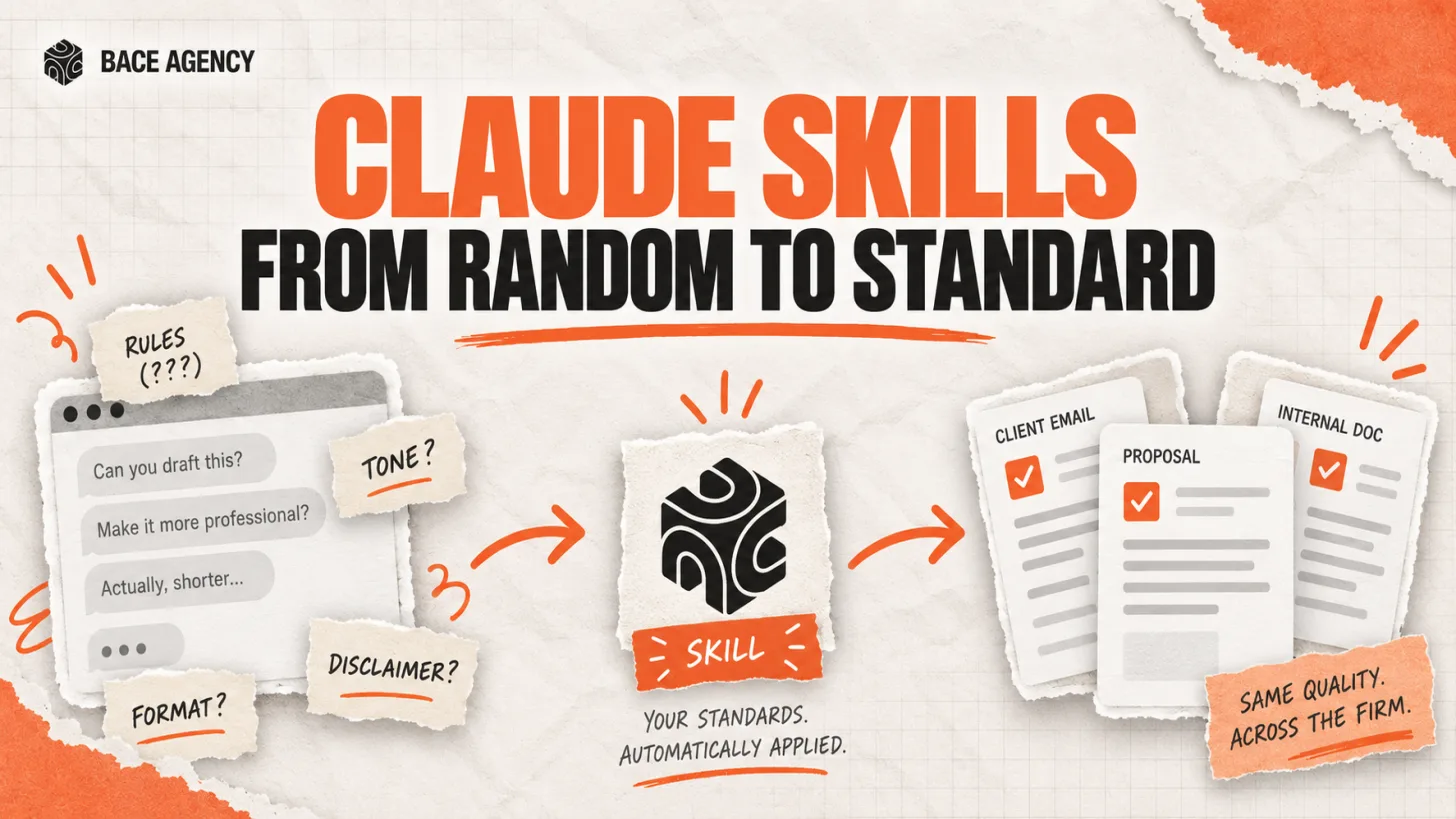
Claude Skills Give a Law Firm One AI Standard
One associate gets sharp drafts, another gets generic filler from the same tool. A Claude Skill turns one person's rules into a standard the whole firm can rely on.
Let AI Agents Handle Intake at Evanston Law Firms
Most Evanston firms still run intake on a phone and a Word template. The firms pulling ahead hand the whole new-matter pipeline to an agent, then review its work before anything reaches the client.

Oregon Federal Court Fines Lawyers $110,000 Over AI
Two lawyers were fined $110,000 for filing AI-invented case citations. The lesson is not to avoid AI. It is to verify it. Here is the workflow that prevents it.
About the author

Written by
Michael Pavlovskyi
Founder, Bace Agency
Michael builds custom Claude and GPT workflows for insurance agencies, law firms, and PE firms on Chicago's North Shore. Speaker at Northwestern and Lake Forest College on practical AI adoption for professional services.
Connect on LinkedInSee it in your firm
Book an audit.
A free 30-minute AI audit. No obligation, no pitch deck.
Book a free AI audit