
Oregon Federal Court Fines Lawyers $110,000 Over AI
An Oregon court handed down the largest AI hallucination penalty in U.S. legal history. The lesson is not to avoid AI. It is to verify it.


Key Takeaways
- ✓ An Oregon federal magistrate judge imposed $110,000 in fines and fees on two lawyers after their filings cited 23 fabricated cases and 8 false quotations generated by AI.
- ✓ This is not a one-off. Courts across the country have been sanctioning lawyers for filing AI-invented citations, and the penalties are climbing.
- ✓ The duty is already clear. Under the ABA's first ethics opinion on AI, a lawyer who relies on AI output without independent verification can violate the duty of competence.
- ✓ The fix is a workflow, not a ban. Restrict where AI touches court filings, verify every citation against a real database, and keep a short record of who checked what.
Two lawyers were ordered to pay $110,000 after they filed court documents built on cases that did not exist. According to the ABA Journal, a federal magistrate judge in Oregon found that three filings in a family dispute over a winery contained 23 fabricated legal citations and 8 false quotations, all generated by artificial intelligence and none caught before they reached the court.
It is described as the largest AI hallucination penalty in American legal history. It will not be the last. The pattern is now common enough that Fortune ran the obvious question on its cover: would you hire the lawyer who just got sanctioned for using AI?
I work with law firms across the North Shore, and the reaction I hear most is the wrong one. Partners read a story like this and conclude that AI is too risky to touch. That is the wrong lesson. The lawyers were not sanctioned for using AI. They were sanctioned for filing its output without checking it.
What Actually Happened
The facts are not complicated. A lawyer used a general AI tool to help write briefs. The tool produced confident, properly formatted citations to cases that were never decided, complete with quotations that were never written. The filings went to the court. Opposing counsel and the judge checked the citations. They were fake.
This is what people mean by a hallucination. A general AI model predicts text that looks right. It does not know the difference between a real case and a plausible-sounding one, and it will invent a citation with the same confidence it uses for a true one. The term itself describes output that is fluent and wrong at the same time.
The court did not care that a machine produced the error. The signature on the filing belonged to a lawyer, and so did the responsibility. That is the part every firm owner needs to sit with.
"The lawyers were not punished for using AI. They were punished for filing its work as their own without reading it. Those are different mistakes, and only one of them is about technology."
Michael Pavlovskyi, Bace AgencyWhy This Reaches Small North Shore Firms
It is tempting to read this as a big-litigation problem. It is not. The exposure is arguably worse at a small firm, where one busy associate or solo partner is drafting, checking, and filing without a second set of eyes. The Oregon case involved exactly that kind of thin coverage.
The professional duty does not scale with firm size. The ABA's first ethics guidance on AI tools is direct: lawyers must understand the limits of the technology they use, and uncritical reliance on AI output without independent verification can violate the duty of competence under Model Rule 1.1. Your duty of candor to the court under Model Rule 3.3 does not soften because a tool made the mistake.
Imagine a small Lake Forest litigation practice using a consumer AI tool to speed up brief writing. Hypothetically, the same shortcut that saves an hour on Tuesday produces a fabricated citation on Friday. Without a verification step, nobody catches it before it is filed. The savings were never the problem. The missing checkpoint was.
The Workflow That Prevents It
The answer is not to ban AI and lose the time it saves. It is to put a verification layer between the AI and the court. This is the kind of workflow automation that fits a firm of any size, and it comes down to three rules.
Restrict
Decide where AI is allowed to touch a filing and where it is not. Drafting argument structure, summarizing a deposition, or tightening prose is low risk. Generating case citations from memory is the high risk task that produced the Oregon sanctions. Keep AI out of that step.
Verify
Every citation in a filing gets checked against a real legal database before it goes out. Not skimmed. Opened. A person or a connected research tool confirms the case exists, says what the brief claims, and is still good law. No citation ships unverified.
Log
Keep a short record of who verified the citations and when. It takes a minute and it is the difference between a clean answer and an exposed one if a filing is ever questioned. A documented check is a defense. A vague assurance is not.
You can test the spirit of step two right now. Take any AI-drafted paragraph with a citation in it, strip anything confidential, and run the prompt below before you trust a single case name.
SAMPLE CLAUDE PROMPT
"Below is a paragraph from a draft legal brief. List every case citation, statute, and quotation it contains in a numbered table. For each one, mark it UNVERIFIED and write the exact step a person must take to confirm it: the database to search, the citation to look up, and the specific claim in the brief that the source must support. Do not tell me whether the cases are real. Do not add new citations. Your only job is to produce the checklist a human will use to verify each source by hand."
Notice what the prompt does not do. It does not ask the AI to confirm the cases, because that is the exact step the model cannot be trusted with. It produces a checklist for a human. That is the right division of labor: the machine drafts and organizes, the lawyer verifies and signs.
What This Does Not Mean
It does not mean AI has no place in a law firm. The same firms reading about this sanction are still buried in document review, intake, and research that AI handles well when it is scoped correctly. Throwing the tool out over a verification failure is an overcorrection that just hands the time savings to competitors who learned the lesson.
It also does not mean you need to become a technologist. It means your team needs to know the one rule that matters: AI can draft, but a person verifies anything that carries your signature. That is a training and process question more than a software question, which is why we treat team AI training as part of any rollout, not an afterthought.
How to Start
Pick the one place AI already touches your court work, usually brief drafting or legal research, and add the verification step there first. Write the rule down. Make it boring and non-negotiable: no citation leaves the building unopened. Then widen it to the rest of your filings.
If you want a quick read on where your firm stands before changing anything, the AI readiness quiz takes about five minutes, or a short AI consulting conversation will map where AI is safe in your workflow and where it needs a human gate.
When you are ready to build that gate into how your firm actually works, a free 30-minute AI audit is available in person on the North Shore or by video. No obligation. You leave with a one-page plan your team can act on inside a quarter, whether you work with me or not.
Frequently Asked Questions
Does this case mean my firm should stop using AI? +
No. The lawyers were sanctioned for filing AI output without checking it, not for using AI. Used with a verification step, AI is safe for drafting, summarizing, and research. The mistake in Oregon was a missing checkpoint, not the tool itself.
Why does AI invent fake legal cases? +
A general AI model predicts text that looks correct. It does not know whether a case is real, so it can produce a confident, well-formatted citation to a decision that was never written. That is why every citation has to be checked against a real legal database before it is filed.
Whose fault is it if AI produces a bad citation? +
The lawyer's. The signature on the filing carries the responsibility, and the duty of candor to the court does not change because a tool made the error. ABA guidance is clear that uncritical reliance on AI can violate the duty of competence under Model Rule 1.1.
How do I let staff use AI without this risk? +
Set one rule and train to it: AI can draft, but a person verifies anything that carries the firm's signature. Restrict AI from generating citations, verify every source against a real database, and keep a short record of who checked what. It is a process, not a ban.
Is a private or firm-controlled AI setup safer for this? +
A controlled setup helps with data security and lets you connect verified research sources, but it does not remove the need for human review. No setup makes citations self-verifying. The verification step stays, regardless of which tool or infrastructure you use.
Related Articles
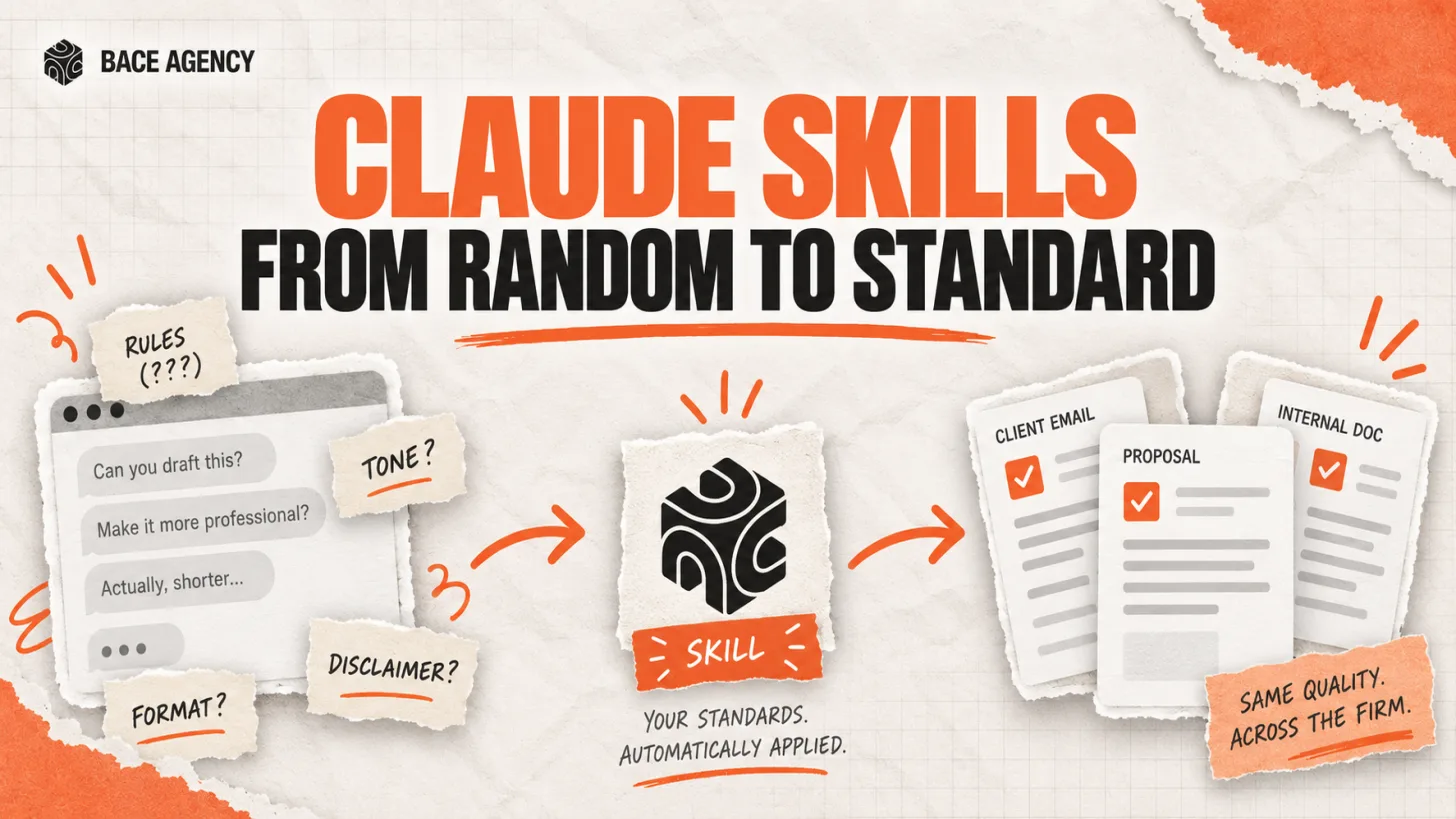
Claude Skills Give a Law Firm One AI Standard
One associate gets sharp drafts, another gets generic filler from the same tool. A Claude Skill turns one person's rules into a standard the whole firm can rely on.
Let AI Agents Handle Intake at Evanston Law Firms
Most Evanston firms still run intake on a phone and a Word template. The firms pulling ahead hand the whole new-matter pipeline to an agent, then review its work before anything reaches the client.
Legal Workflow Software Is Not a Workflow
Most law firms buy Clio or MyCase and call it workflow automation. The software is the container. The actual workflow, the sequence of decisions that moves a matter forward, still lives in a partner's head. Here is why that matters and what AI actually fixes.
About the author

Written by
Michael Pavlovskyi
Founder, Bace Agency
Michael builds custom Claude and GPT workflows for insurance agencies, law firms, and PE firms on Chicago's North Shore. Speaker at Northwestern and Lake Forest College on practical AI adoption for professional services.
Connect on LinkedInSee it in your firm
Book an audit.
A free 30-minute AI audit. No obligation, no pitch deck.
Book a free AI audit