
AI Compliance Drafts Still Need Your Signature
Recordkeeping and marketing rule violations still land on the adviser named on Form ADV, no matter who drafted the language.


Key Takeaways
- ✓ AI can draft and organize routine SEC compliance paperwork, but the adviser named on Form ADV stays personally responsible for its accuracy.
- ✓ SEC recordkeeping rules require most adviser records to survive for at least 5 years, and Claude can help keep that file current instead of assembled once a year.
- ✓ A dated human sign-off log, noting who reviewed each AI-drafted document and what changed, is the cheapest protection a small advisory firm can build into the workflow.
- ✓ Start with one recurring document, like the annual policy review, before expanding AI-assisted drafting across the full compliance file.
If your Lake Forest advisory firm still builds its annual compliance file by hand every December, retyping last year's policies and hoping nothing changed, you are treating documentation as a scramble instead of a system. Financial advisors from Winnetka to Lake Bluff are starting to hand Claude the first draft of that paperwork. The advisor still signs it. That distinction is the whole article.
AI tools like Claude can draft and organize the routine paperwork behind SEC compliance: marketing rule disclosures, recordkeeping logs, and annual policy reviews. The adviser named on Form ADV stays personally responsible for accuracy, so a human reviewer still has to sign off before any AI-drafted document goes out the door.
What Is AI Compliance Documentation for Financial Advisors?
AI compliance documentation is the use of AI tools to draft, organize, and keep current the written policies, disclosures, and records that securities regulators require an investment adviser to maintain. That includes the compliance manual, the Form ADV narrative sections, the marketing and advertising file, and the log of client correspondence your firm has to produce on request.
The obligation itself is old. The Investment Advisers Act of 1940 set the baseline: if you give investment advice for a fee, you register, and you keep records proving you followed your own rules. What has changed is the volume. A small North Shore RIA now generates more written client communication in a month, emails, texts, portal messages, than a much larger firm did a decade ago. Somebody still has to review all of it.
Claude reads that volume without getting tired. Hand it last year's compliance manual, the current SEC guidance, and a sample of your firm's actual client files, and it can draft the updated sections, flag where your policy language has drifted from what your team actually does, and summarize a batch of correspondence into a reviewable log. It cannot decide the policy is correct. That is still your job.
The Recordkeeping Rules Your Firm Cannot Skip
Two rules do most of the work in an SEC exam. The recordkeeping rule spells out what an adviser has to keep on file, from trade confirmations to advertising, and for how long. The marketing rule, which took effect for advisers in November 2022, governs what your firm can say in an advertisement and what you have to be able to prove about any claim you make. According to the SEC's recordkeeping guidance, most adviser records need to stay on file for a minimum of 5 years, the first two in an easily accessible place at the adviser's principal office.
None of this is static. Guidance updates. Your fee schedule changes. You add a new share class or a new referral arrangement, and every one of those changes has to ripple through the compliance manual, the ADV, and the marketing file at the same time. Missing one is how a routine exam turns into a deficiency letter.
"The knowledge worker cannot be supervised closely or in detail. He can only be helped. But he must direct himself, and he must direct himself toward performance and contribution."
Peter Drucker, The Effective ExecutiveThat is the right way to think about where Claude fits. It helps your compliance officer direct their own attention toward the parts of the file that need judgment, instead of losing a Friday afternoon reformatting a manual that has not substantively changed.
Where Claude Actually Saves Your Team Time
Three tasks eat the most hours on a small advisory firm's compliance calendar: the annual policy review, correspondence surveillance, and Form ADV narrative updates. Claude handles the first pass on all three.
Feed it last year's compliance manual next to this year's SEC guidance and your firm's current practices, and it drafts the redlines. Your compliance officer reviews the draft against the rule text and signs off, instead of starting from a blank page every December.
SAMPLE CLAUDE PROMPT
"Attached is our firm's current compliance manual and the SEC's most recent guidance on the marketing rule. Compare the two and flag every section of our manual that is outdated, missing required disclosure language, or inconsistent with how our advisors actually communicate with clients today. Do not rewrite the whole document. List the specific sections that need attorney review and explain why."
Claude, per Anthropic's product documentation, can hold roughly 200,000 tokens of context in a single conversation, enough to load a full compliance manual, a year of guidance updates, and a sample of client correspondence at once. That matters more than any single clever prompt. The model can compare the whole file against the whole rule, not just a paragraph you copy and paste.
Correspondence surveillance is the second place this pays off. Instead of sampling a fraction of client emails by hand each month, your compliance officer can point Claude at a full mailbox export and ask it to flag anything that reads like a guarantee of return, an unapproved testimonial, or language a state examiner would circle. A human still reads every flag. The model just tells you where to look first.
| Compliance Task | Manual Process | AI-Assisted Process |
|---|---|---|
| Annual policy review | Compliance officer rewrites each section from a blank page every year | Claude drafts the redlines against new guidance, officer reviews and signs off |
| Correspondence surveillance | Officer samples a fraction of client emails by hand | Claude flags outlier language across the full mailbox for officer review |
| Form ADV narrative updates | Officer retypes disclosure language line by line | Claude drafts the revised narrative, officer verifies against the rule text |
If you are not sure whether your team's current process could handle a change like this, our free AI readiness quiz takes about 10 minutes and tells you exactly where to start.
Why the Human Review Step Cannot Disappear
"Risk comes from not knowing what you're doing."
Warren Buffett, on the cost of delegating without understandingHand Claude a compliance draft and never read it yourself, and you have manufactured exactly that risk. Models make mistakes. One might misread a rule that changed last quarter, draft language that sounds right and is not, or carry forward an old policy that no longer matches what your firm actually does. None of that shows up until an examiner asks you to explain it.
My own background is in building AI for exactly this kind of regulated environment. I helped build fraud-detection AI that Blue Cross Blue Shield used across North Carolina, South Carolina, California, and Florida. Every flag the model raised had to hold up to a human auditor before anyone acted on it. Same lesson here. The model finds the pattern. A named person decides what it means.
The NIST AI Risk Management Framework makes the same point in more formal language: govern, map, measure, manage. Translated for a five-person RIA, that means someone at your firm owns the AI-drafted file, knows exactly which sections a model wrote, and can explain the reasoning behind every disclosure choice to an examiner. The framework does not ask you to avoid AI. It asks you to be able to account for what it did.
Build the review step into the workflow, not around it. This is the same principle behind the AI adoption work we do with North Shore firms: the tool drafts, a named person owns the result. A dated sign-off log, noting who reviewed the AI draft, what changed, and when, is worth more to an examiner than a perfectly worded policy nobody on staff can explain. It is also the cheapest insurance you will buy all year. It costs 15 minutes a document, and it is the difference between "our process caught this" and "we did not notice."
How Much Does AI Compliance Documentation Cost to Set Up?
Less than most advisors assume, and the pricing model matters more than the sticker price. A flat consumer or business Claude plan, according to Anthropic's published pricing, covers the drafting and summarizing work described above for a fraction of what a compliance consultant bills for the same first-pass work. You are not replacing your compliance attorney. You are giving them a faster first draft to start from.
The bigger cost is usually time, not software. Someone has to load the current compliance manual, a sample of client files, and the latest guidance into the workflow once, then keep it current. That is the part worth getting outside help with. For a closer look at how a similar documentation challenge plays out for a North Shore firm, see our family office case study.
Start smaller than a full compliance overhaul. Pick one recurring document, the annual policy review is usually the best candidate, and run it through Claude alongside your compliance officer's existing process for one cycle. Compare the draft to what your officer would have written from scratch. If it holds up, expand from there. If it does not, you have lost an afternoon, not a filing deadline.
For firms ready to see what this looks like with their own compliance file, a free 30-minute AI audit is available, in person on the North Shore or by video. No pitch. You leave with a one-page plan you can hand your compliance officer this week.
Frequently Asked Questions
What counts as AI compliance documentation for a financial advisor? +
AI compliance documentation covers the drafting, organizing, and updating of an adviser's written policies, disclosures, and records, including the compliance manual, Form ADV narrative sections, marketing files, and correspondence logs, using AI tools like Claude for the first draft and a human compliance officer for final review.
Can Claude access my firm's compliance files directly? +
Claude works with whatever documents you upload or connect to it in a given session, such as your compliance manual or a set of client emails. It does not have standing access to your firm's systems on its own, so your firm controls exactly what it sees and when.
Does the SEC allow AI-drafted compliance documents? +
The SEC does not prohibit using AI to draft compliance documents. What it requires, reinforced by frameworks like the NIST AI Risk Management Framework, is that a named person at the firm reviews, understands, and takes responsibility for the final content before it is filed or delivered to a client.
How long do RIAs have to keep compliance records? +
Under SEC recordkeeping requirements, most adviser records need to stay on file for a minimum of 5 years, with the first two years kept in an easily accessible place at the adviser's principal office.
What is the fastest way to start using AI for compliance documentation? +
Pick one recurring document, such as the annual policy review, and run it through Claude alongside your compliance officer's existing process for a single cycle. Compare the AI draft to what your officer would have written from scratch before deciding whether to expand its use.
Related Articles
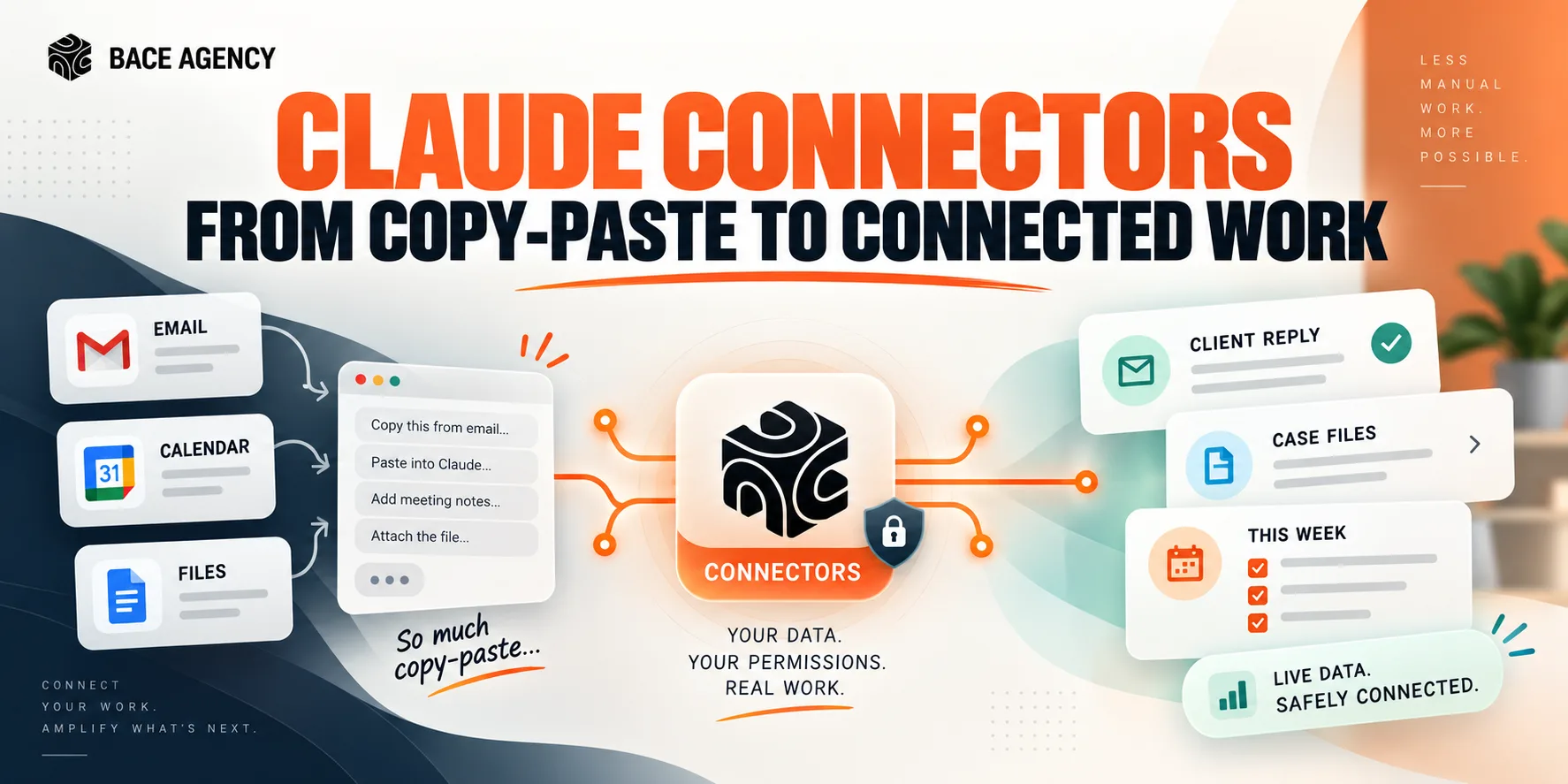
Claude Connectors for Winnetka Accounting Firms
AI stays a clever assistant until it can see your real email, files, and calendar. Connectors are that bridge, and the win depends on connecting narrowly and keeping the writes on approval.
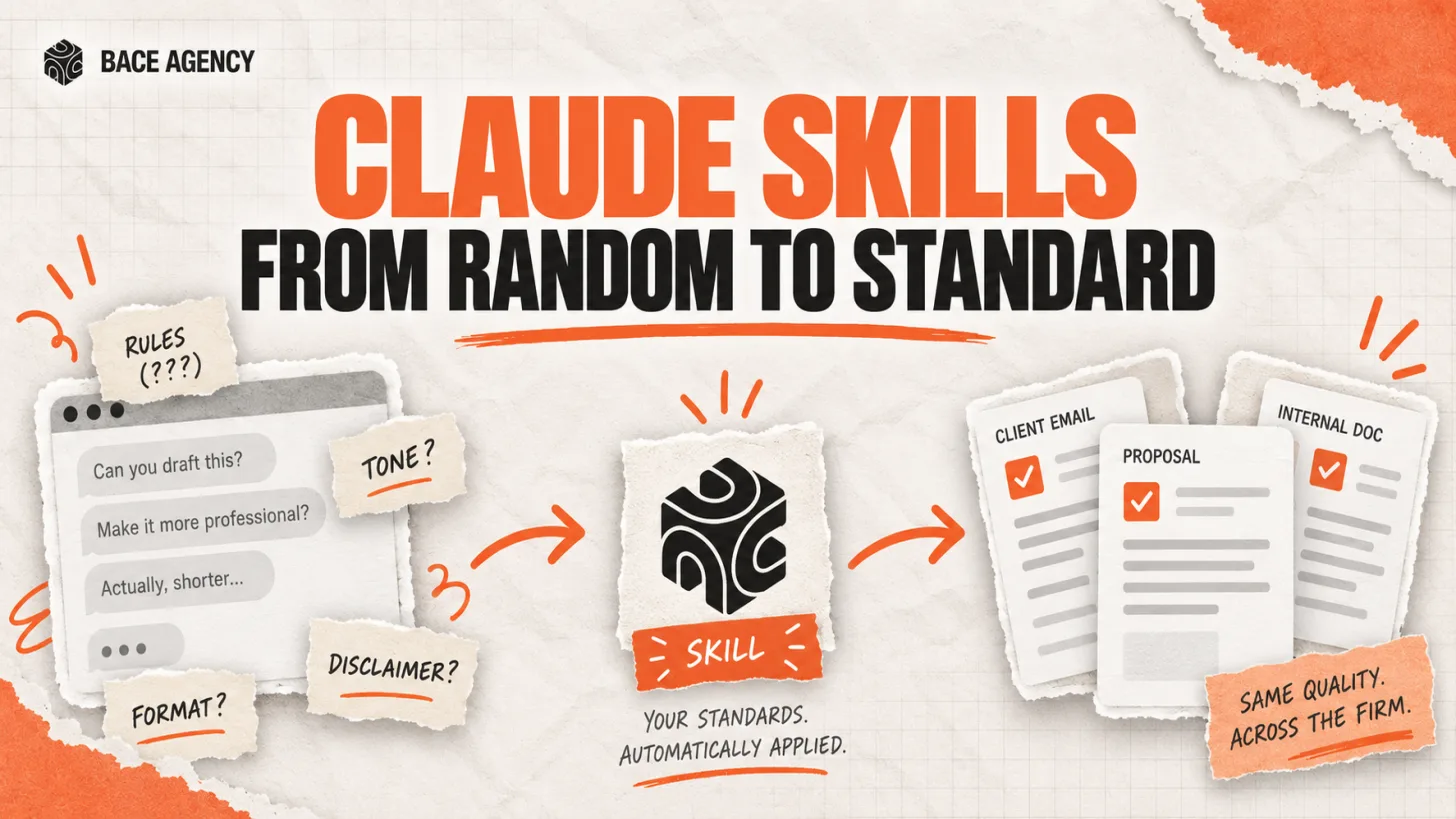
Claude Skills Give a Law Firm One AI Standard
One associate gets sharp drafts, another gets generic filler from the same tool. A Claude Skill turns one person's rules into a standard the whole firm can rely on.

Small North Shore Firms Are Beating Big Ones to AI
While a national firm spends a year debating AI strategy, the small practice down the street already answers clients faster. The gap compounds every week.
About the author

Written by
Michael Pavlovskyi
Founder, Bace Agency
Michael builds custom Claude and GPT workflows for insurance agencies, law firms, and PE firms on Chicago's North Shore. Speaker at Northwestern and Lake Forest College on practical AI adoption for professional services.
Connect on LinkedInSee it in your firm
Book an audit.
A free 30-minute AI audit. No obligation, no pitch deck.
Book a free AI audit