
Small North Shore Firms Are Beating Big Ones to AI
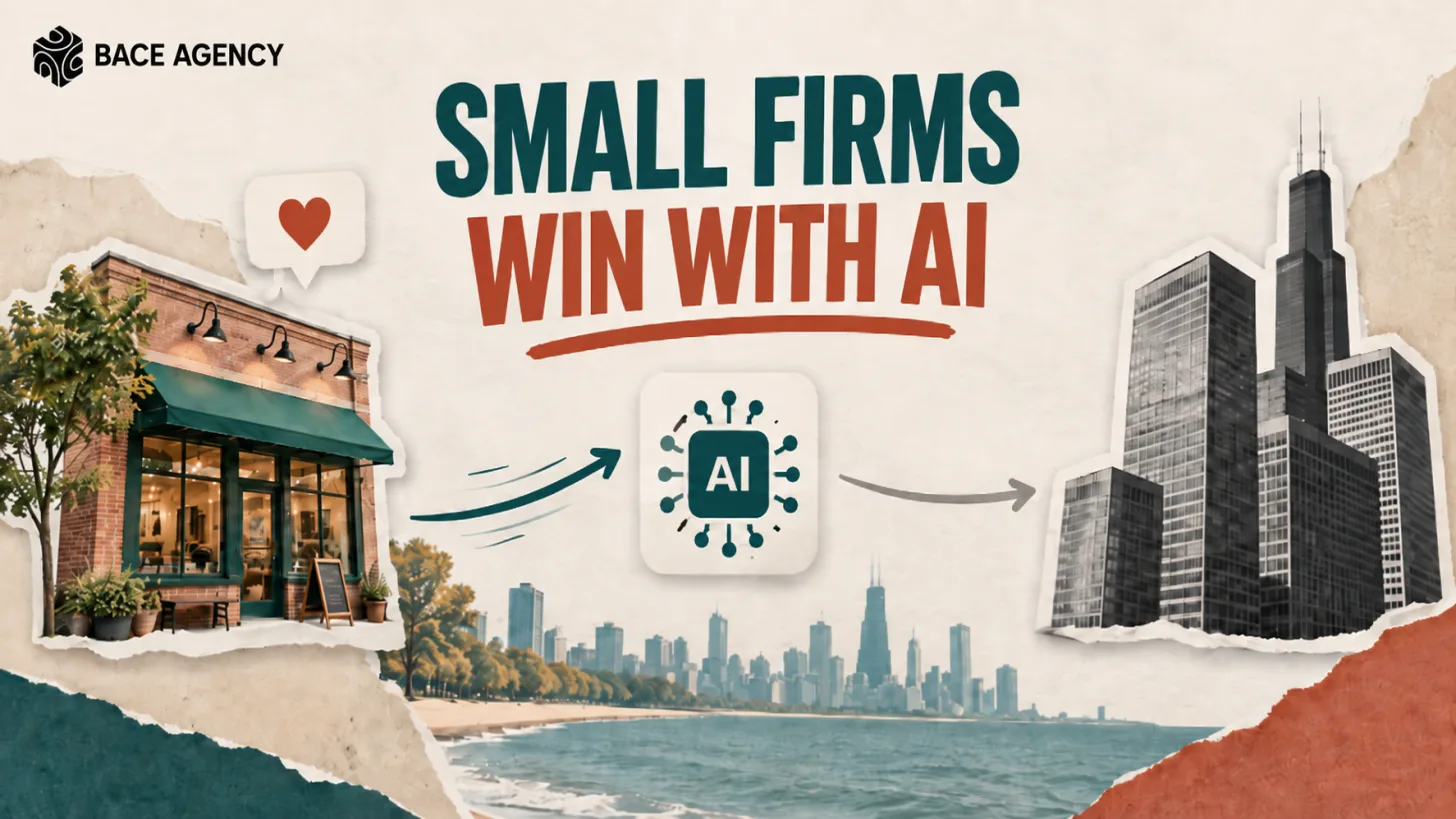
While a national firm spends a year debating AI strategy, the small practice down the street already answers clients faster. In 2026 that gap compounds every week.

Key Takeaways
- ✓ Small firms are adopting AI faster than large ones because they can decide in a day, not a year. Speed of adoption, not budget, is the real advantage on the North Shore.
- ✓ AI used well amplifies personal service rather than replacing it. It removes the routine that keeps a small team from its clients, so people have more time for people.
- ✓ The three administrative loads to hand a machine first are client intake, document processing, and follow-up. Each one leaks time a licensed professional should never spend.
- ✓ Most firms have not started yet, so the window is still open. If a competitor adopts AI and you wait, the gap widens every week.
Small business on the North Shore is beating bigger competitors to AI, and it is not close. While a national firm spends a year forming an AI committee, the insurance agency, law practice, or family office down the street in Lake Forest is already answering clients faster. In Chicago in 2026, AI at North Shore small businesses has stopped being a novelty and become a competitive gap that widens every week.
The pattern is consistent. The firms pulling ahead are not the ones with the biggest technology budgets. They are the ones using AI to do more with less, and most of them are small. This piece lays out what is actually happening, why a North Shore firm is unusually well placed to win, and the three administrative loads worth handing a machine first.
What Is Actually Happening in Chicago's Small Businesses?
Small firms are adopting AI faster than large ones, because they can. A 2025 report from the U.S. Chamber of Commerce found 58 percent of small businesses already using generative AI, nearly double the 40 percent of a year earlier. The direction is not in doubt, and the speed is the real story.
A small firm has no committee to convince and no legacy system to migrate. The owner decides on a Monday and the team is using the tool by Friday. A large competitor is still scheduling the kickoff meeting. That is why the companies pulling ahead in Chicago are not the corporations with the biggest budgets, they are small local firms, from downtown offices to the North Shore suburbs. The uncomfortable, honest point is the one every owner already senses: if a competitor starts using AI and you do not, the distance between you grows every week.
Does AI Make a Small Firm Less Personal?
No. Used well, it does the opposite. The common fear is that AI depersonalizes a business built on relationships, and North Shore firms are built on exactly that. In practice, AI removes the routine that keeps a small team from its clients. Anthropic's first Economic Index report (March 2025), drawn from real usage data, found that 57 percent of measured AI work augments a person rather than replacing them. Firms that adopt it are not shedding staff either: 82 percent of small businesses using AI grew their workforce over the past year. The machine takes the routine so people have more time for people.
A firm that answers every inquiry within minutes and never lets a client go cold does not win through technology for its own sake. It wins because no opportunity slips through. The personal contact that makes a small firm worth choosing stays human. What changes is that a partner is no longer buried in intake forms at nine at night.
"The winner is not the firm with the bigger budget. It is the one that freed its best people sooner from work a human should not be doing at all."
Michael Pavlovskyi, Bace AgencyWhy the North Shore Has a Special Edge
North Shore firms hold something a national competitor cannot buy: trust and reputation built over years of personal relationships in a small, dense community. In Lake Forest, Highland Park, and the neighboring towns, an insurance agency or family office still wins on a personal referral and a name known for years, not on a national ad budget. AI does not replace that. It removes the administrative load, intake, document processing, and follow-up, that suffocates small teams and pulls time away from the client.
The proof is in the work. A North Shore insurance agency Bace worked with cut data entry by 22 hours a week and dropped its error rate from 6.1 percent to 0.3 percent, detailed in our insurance case study. None of that touched the client relationship. It protected it, by giving the team back the hours that relationship actually needs. For the fuller picture of which paperwork to move first, we wrote a companion piece on what firms should leave to a person.
| On the race to AI | Large national firm | Small North Shore firm |
|---|---|---|
| Decision speed | Committee, quarters | Owner decides in a day |
| Legacy systems | Years of migration | Little to unwind |
| Client relationship | Distant, transactional | Personal, referral-based |
| Real advantage | Budget | Speed and trust |
Use Case 1: Client Intake That Never Goes Cold
Answer every new inquiry in minutes, not the next business day.
Most lost business is not lost to a better competitor. It is lost to a slow reply. A firm could route every inbound inquiry through an AI assistant that acknowledges it at once, gathers the basics, and drafts a first response for a person to approve. The client feels attended to immediately, and the partner reviews a ready draft instead of starting from a blank page. Our breakdown of AI document processing shows how the same intake data then feeds the file without rekeying.
SAMPLE CLAUDE PROMPT
"A new client inquiry just arrived by email, pasted below. Summarize what they need in three bullets, list the two questions we must ask before quoting, and draft a warm two-paragraph reply in a professional tone. Flag anything that needs a licensed professional to decide."
Use Case 2: Document Processing Without the Rekeying
Pull the fields that matter out of long files, with a human check.
Contracts, policies, and statements arrive as long documents, and a small team reads every page by hand. An operator could have AI extract the specific fields a task needs, the named parties, the dates, the limits, the exclusions, into a structured summary a person verifies. The reading time collapses and the professional spends the saved hour on the judgment call, not the transcription.
SAMPLE CLAUDE PROMPT
"From this policy document, extract the named insured, effective dates, coverage limits, and every exclusion into a table. Quote the exact clause for each exclusion so I can verify it. Do not summarize the exclusions in your own words."
Use Case 3: Follow-Up That Actually Happens
Close the loop on every open item before it becomes a lost client.
Follow-up is the first thing a busy team drops and the last thing a client forgives. A firm could have AI track open items across conversations and draft the next touch at the right moment, a renewal reminder, a missing document request, a check-in after a review. A person still sends it, and it still sounds like the firm, but nothing goes quiet by accident.
SAMPLE CLAUDE PROMPT
"Here are notes from my last five client meetings. For each one, list the open action items, who owns them, and the date they are due. Draft a short, friendly follow-up message for any item where the ball is in our court."
How to Get Started
Pick the one load that leaks the most time
Choose intake, documents, or follow-up, whichever costs your team the most hours this month. One workflow done well beats five half-built ones.
Build it once, with a person in the loop
Write the steps down so the whole team gets the same result, and keep a human approving anything that reaches a client. Run confidential files on an approved business account where your data is not used for training. Our workflow automation work is exactly this.
Measure the hours you got back in 30 days
Count the time returned and the errors avoided, then move to the next load. Momentum comes from a visible win, not a grand plan.
What This Does Not Replace
AI does not replace the licensed judgment a client pays for, the relationship a referral is built on, or the final review before anything leaves the firm. It drafts, extracts, and reminds. A person decides, signs, and speaks to the client. A firm that hands the judgment to a machine has misread the whole point, which is to give the professional more room to do the part only they can do. Speed without a human check is not an edge, it is a liability.
The window is still open because most firms have not started. That will not last. The first small firm in a North Shore town to answer faster and follow up without fail sets a standard the others have to meet. If you want to see where your paperwork is leaking time, a free 30-minute AI audit, in person on the North Shore or by video, is the quickest way to find your first load to lift.
Frequently Asked Questions
Are small businesses really adopting AI faster than large companies? +
Yes. A 2025 U.S. Chamber of Commerce report found 58 percent of small businesses already using generative AI, nearly double the 40 percent of a year earlier. Small firms move faster because they have no committee to convince and no legacy system to migrate: the owner decides and the team adopts within a week.
Will AI make my firm feel less personal to clients? +
Used well, it does the opposite. Anthropic's first Economic Index report (March 2025) found that 57 percent of measured AI use augments a person rather than replacing them. AI takes over routine intake, document handling, and follow-up so your team has more time for the client conversations that actually build the relationship. A human still signs off on anything a client sees.
What should a North Shore firm automate first? +
Start with the three administrative loads that leak the most time: client intake, document processing, and follow-up. Pick the single one that costs your team the most hours this month, build that workflow with a person in the loop, and measure the hours returned in 30 days before moving to the next.
Do I need a big budget to start using AI? +
No. The advantage small firms hold is speed of adoption, not spending. A focused first workflow on one administrative load costs far less than the hours it returns, and it does not require new software or a large team. The real cost of an AI project is the thinking and the setup, not a large licensing bill.
Is my client data safe if I use AI? +
It can be, if you set it up correctly. Run confidential files on an approved business account where your data is not used to train the model, keep a human reviewing anything that reaches a client, and for the most sensitive work consider an on-premise deployment that keeps files in house. Safe use is a matter of workflow, not luck.
Related Articles

What North Shore Firms Should Not Automate
Most AI consultants will automate anything you point at. Here is the short list I tell clients to leave alone.

What Anthropic's Valuation Means for Small Firms
Anthropic just became the most valuable AI startup at a $965 billion valuation. The fad question is closed. The useful question is where AI fits in your firm, and where it does not.
One AI Stack Beats Tool Sprawl
Tool sprawl is not a sign your North Shore firm is ahead on AI. Here is how to pick one anchor platform, set a retirement date for the rest, and make adoption actually stick.
About the author

Written by
Michael Pavlovskyi
Founder, Bace Agency
Michael builds custom Claude and GPT workflows for insurance agencies, law firms, and PE firms on Chicago's North Shore. Speaker at Northwestern and Lake Forest College on practical AI adoption for professional services.
Connect on LinkedInSee it in your firm
Book an audit.
A free 30-minute AI audit. No obligation, no pitch deck.
Book a free AI audit