
Why AI Confidently Invents Facts, and What It Costs
A model will state a made-up code section in the same steady voice it uses for a real one. For a firm that answers for errors in money or a license, that steadiness is the whole danger.

Key Takeaways
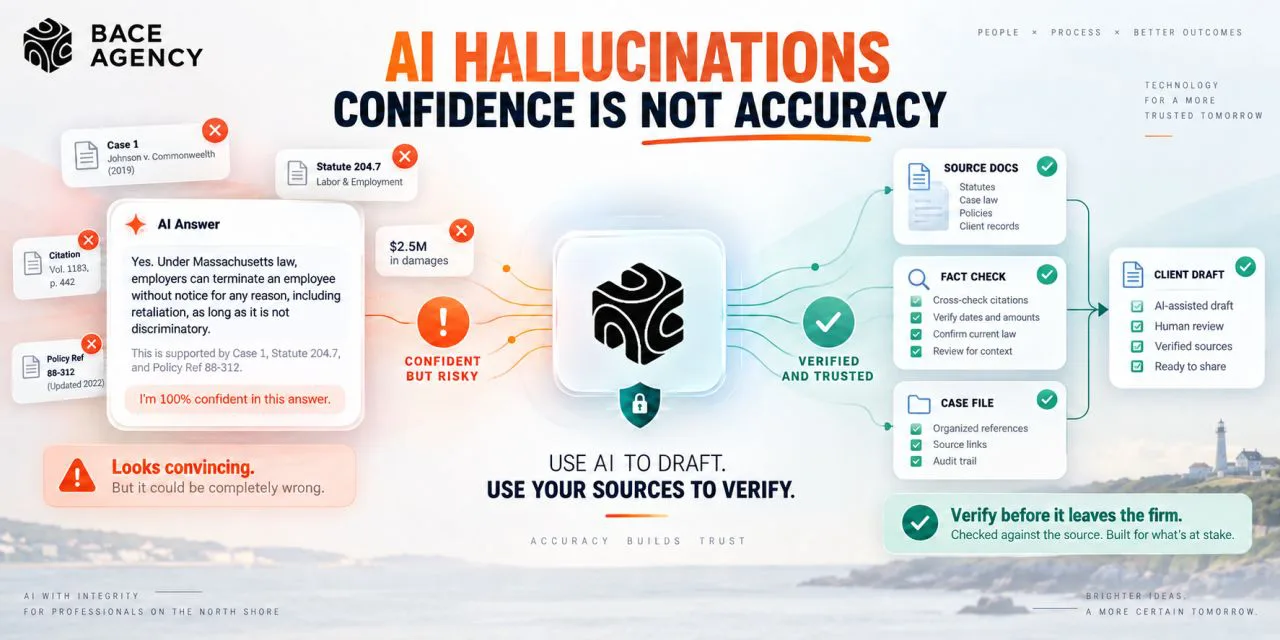
- ✓ An AI hallucination is a false answer delivered in the same confident tone as a correct one. The confidence, not the error, is what fools a busy professional.
- ✓ It happens because a model predicts the most likely next words, not stored facts. When it does not know, it does not stop, it fills the gap with something plausible.
- ✓ For a firm, the exposure can be a made-up code section, a wrong figure, or a fabricated deadline that reaches a client's return. Every AI-stated fact needs a human check.
- ✓ The risk drops sharply when AI works from your verified documents and each fact is checked against the source. That is the difference between a liability and an advantage.
An AI assistant may name a tax code section that does not exist, and it will do it in the same calm, certain voice it uses for a real one. For a firm in Highland Park, where a mistake is answered for in money or a license, that is the part worth understanding. The reason a tool that saves you an hour on a first draft can also hand you a fabricated figure has a name, an AI hallucination, and the cost can run far past the hour it saved.
The trap is the confidence. People are trained to trust a source that answers firmly and to the point, and AI answers everything that way, whether it is right or not. This piece explains what a hallucination actually is, why the mechanism guarantees it, where a business practice is most exposed, and how a proper setup turns the risk into a real advantage rather than a reason to avoid the technology.
What Is an AI Hallucination?
An AI hallucination is a plausible but false answer delivered with the same confidence as a correct one. The model is not lying and it is not broken. It does not store facts the way a reference book stores a card you pull and read back. It predicts the most likely next words, one after another, from the enormous body of text it was trained on. Most of the time the most likely continuation is also the true one, which is why it usually sounds right and often is.
The problem is what happens when it does not know. It does not stop and say "I cannot find that." It builds the most likely-looking answer anyway, and the result is smooth, specific, and entirely made up: a case number, a statute, a figure, a date. This is not a rare glitch. A 2024 Stanford study on legal hallucinations in large language models found general-purpose models produced false information on 58 to 88 percent of specific legal questions. The best measurements come from legal research, the domain studied most closely, but the mechanism is identical whether the fabricated detail is a case citation or an Internal Revenue Code section.
Why This Matters for Accounting Firms in Highland Park
An accounting practice runs on exactly the details a model is most tempted to invent: code sections, revenue procedures, filing deadlines, and figures. A Highland Park accounting firm that lets an unchecked AI answer reach a return is not risking a typo, it is risking a confident, specific, wrong number that looks like it was researched. The most dangerous errors are the plausible ones, the ones that look solid and go unnoticed.
The clearest warning came from the law, not accounting, but it applies to any licensed professional. In 2023 a New York attorney filed a brief with six court decisions that did not exist, all supplied by an AI tool that confirmed they were real when asked. The court sanctioned the lawyer and his firm in the Mata v. Avianca decision, and hundreds of similar filings have surfaced since. Swap "case citation" for "code section" and the same story writes itself in a tax practice. For the profession-specific version of the checking discipline, our piece on how firms check AI output for errors lays out the workflow step by step.
"The scary error is not the one that looks wrong. It is the one that looks perfectly researched and is completely made up. That is the one that reaches the client."
Michael Pavlovskyi, Bace AgencyWhere a Hallucination Is Most Likely to Show Up
Three places account for most of the risk, and each one has a way to work that lowers it. The rule underneath all three is the same: treat every fact the model states as unverified until you have checked it against a source.
Citing a rule that sounds real and is not.
Ask a model for the tax treatment of something and it may return a specific code section with total confidence. Made to quote its source, it has to expose whether the citation actually exists, which is where the fabrication shows.
SAMPLE CLAUDE PROMPT
"Draft a short memo on the tax treatment of this item. For every rule you cite, give the exact Internal Revenue Code section and quote the sentence you are relying on. If you are not certain a citation is real, say so instead of guessing."
Producing a figure it cannot trace.
A model asked to summarize a statement may present a total that reads right but was never in the document. Constrain it to quote each number from the source and it can no longer smooth over a gap with an invented figure.
SAMPLE CLAUDE PROMPT
"From this brokerage statement, list the realized gains in a table and quote the exact figure from the document for each row. Do not calculate, infer, or fill in any number I cannot find in the source. Flag anything the statement does not show."
Answering from general training instead of your files.
When a model reaches into general knowledge from the open internet, it is at its most likely to invent. Point it at your own verified documents and the fabrication rate falls, though it never reaches zero. Even purpose-built legal tools with retrieval on curated sources still hallucinated 17 to 33 percent of the time in a 2024 Stanford study, so a person still checks.
SAMPLE CLAUDE PROMPT
"Answer only from the documents I have provided. If the answer is not in them, tell me it is not there rather than answering from general knowledge. Cite the file and section for every point."
| Setup | What it is | Measured hallucination risk |
|---|---|---|
| General model, open questions | Ask the AI and take its word | 58 to 88 percent on specialist questions (Stanford) |
| Purpose-built retrieval tool | AI answers from a curated source library | 17 to 33 percent, lower but not zero (Stanford) |
| Your verified documents plus a human check | AI drafts, a person verifies every fact | Lowest, because the last line is a professional, not the model |
How to Get Started
Adopt the assume-unverified rule
Treat every name, date, code section, and figure the AI states as unverified until a person checks it against a source. Make it a standing rule, not a case-by-case judgment call.
Feed it your documents, not the open internet
Give the model the firm's verified files and sources to work from, and require it to cite the file and section for every claim. Our piece on giving AI the context of your firm shows how that setup works in practice.
Keep the human check where the risk is
Use AI to speed the rough draft, then have a professional verify every fact before it reaches a client. A North Shore insurance agency Bace worked with cut its error rate from 6.1 percent to 0.3 percent with exactly this discipline, detailed in our insurance case study.
What This Does Not Replace
AI does not replace the licensed judgment a client pays for, and it does not remove the professional's responsibility for what leaves the firm. It drafts, extracts, and speeds the routine. A person still decides, verifies, and signs. Setting the work up well lowers the hallucination rate, it does not zero it out, which is why the human check is the one step you never automate away. A firm that hands the final judgment to a model has misread the point, which is to give the accountant more room for the part only a professional can do. For the wider line on what to keep with people, we wrote a companion piece on what North Shore firms should not automate.
The next model will be more fluent than this one, and fluency is exactly what makes a confident wrong answer harder to catch, not easier. The firms that win with AI are not the ones that trust it more, they are the ones that built a process where it helps while the facts stay under control. If you want to see where a hallucination could reach your work and how to close that gap, book a free 30-minute AI audit in person on the North Shore or by video.
Frequently Asked Questions
What is an AI hallucination, in plain terms? +
An AI hallucination is a plausible but false answer delivered as confidently as a correct one. The model predicts the most likely next words rather than looking up stored facts, so when it does not know, it fills the gap with something that sounds right, such as a code section or figure that does not exist.
Why is this a bigger deal for an accounting firm? +
Because an accounting firm answers for its errors in money or a license. A hallucinated code section, deadline, or figure that reaches a client's return is not a harmless typo. The 2023 Mata v. Avianca case, where a lawyer was sanctioned for filing six AI-invented cases, shows how a single unchecked answer becomes a professional problem.
Can I stop AI from making things up? +
You can lower the rate sharply, but not to zero. Having AI work from your verified documents rather than general knowledge, and requiring it to quote its source for every fact, cuts fabrication significantly. Even purpose-built tools with retrieval still hallucinated 17 to 33 percent of the time in Stanford's testing, so a human check stays essential.
Does this mean an accounting firm should avoid AI? +
No. Avoiding AI gives up a real advantage on drafting and routine work. The answer is to set it up properly: feed it verified documents, require sourced answers, and keep a professional verifying every fact before it reaches a client. Used that way, the risk becomes manageable and the time savings are real.
Which AI mistakes are the most dangerous? +
The plausible ones. An obvious error is easy to catch and correct. The dangerous hallucination is the specific, confident, well-formatted answer that reads as researched and slips through unquestioned. That is why the safeguard is a rule that every stated fact is verified against a source, not a reliance on spotting the ones that look wrong.
Related Articles
Small North Shore Firms Are Beating Big Ones to AI
While a national firm spends a year debating AI strategy, the small practice down the street already answers clients faster. The gap compounds every week.

What North Shore Firms Should Not Automate
Most AI consultants will automate anything you point at. Here is the short list I tell clients to leave alone.

What Anthropic's Valuation Means for Small Firms
Anthropic just became the most valuable AI startup at a $965 billion valuation. The fad question is closed. The useful question is where AI fits in your firm, and where it does not.
About the author

Written by
Michael Pavlovskyi
Founder, Bace Agency
Michael builds custom Claude and GPT workflows for insurance agencies, law firms, and PE firms on Chicago's North Shore. Speaker at Northwestern and Lake Forest College on practical AI adoption for professional services.
Connect on LinkedInSee it in your firm
Book an audit.
A free 30-minute AI audit. No obligation, no pitch deck.
Book a free AI audit