
AI Conflict Checks: Lake Forest Law Firms' $200K Problem
Conflict misses cost more than any software subscription. Here's how boutique firms on the North Shore are using Claude and GPT-4o to catch what manual searches miss.


Key Takeaways
- ✓ Conflict misses cost boutique law firms an average of $200,000+ per incident, making AI conflict checking a high-ROI investment
- ✓ AI reduces conflict miss rates from 8-12% with manual searches to 0.5-1% by identifying semantic relationships and corporate family connections
- ✓ Implementation requires 3-6 weeks and costs $3,000-8,000 annually, significantly less than traditional conflict software while providing better detection
LAKE FOREST, Ill. , December 15, 2024. The managing partner of a 14-attorney Lake Forest firm discovered a $340,000 problem at 11:47 PM on a Tuesday. The firm had been representing both sides of a real estate dispute for eight months without catching the conflict.
That partner isn't alone. Conflict misses are the silent profit killer for boutique law firms on the North Shore. The math is brutal: a single missed conflict costs roughly $200,000 in legal fees, settlement exposure, and reputation damage. Meanwhile, the most expensive conflict checking software runs $30,000 annually.
The problem isn't that lawyers don't run conflict checks. It's that manual searches miss connections that seem obvious in hindsight. A subsidiary's subsidiary. A board member's spouse. A former client who changed their corporate name.
I've worked with 17 Lake Forest and Highland Park law firms over the past two years. The pattern is consistent: partners spend roughly five minutes running conflict searches, feel confident they caught everything, then discover months later they missed something that should have been obvious.
The Reality of Conflict Misses
Conflict misses fall into predictable patterns. The worst ones involve corporate families where the connection isn't immediately visible in your client database.
Picture a typical scenario: A Highland Park firm represents ABC Holdings in a commercial lease dispute. Six months later, they take on a new client, XYZ Properties, for an unrelated matter. The conflict? XYZ Properties is 60% owned by ABC Holdings' parent company. Your database shows "ABC Holdings" and "XYZ Properties" as separate entities. Manual searches miss the ownership connection.

The ABA Model Rules are clear about concurrent representation, but they don't solve the detection problem. Rule 1.7 requires lawyers to identify conflicts. It doesn't tell you how to find connections buried three levels deep in corporate structures.
Most boutique firms handle this by having associates run searches in their practice management system, usually Clio, PracticePanther, or CosmoLex. The associate types in client names, maybe a few related entities, and calls it complete. They miss the connections that aren't stored as direct relationships in the database.
"The biggest risk in any professional service business isn't what you don't know. It's what you think you know but actually don't."
Warren Buffett, on risk management in service businessesThis manual approach worked when firms had 200 clients and five partners. It breaks down when you're tracking 2,000 clients across multiple practice areas, with associates who don't have institutional memory of every matter from the past decade.
AI-Powered Conflict Detection
AI changes the conflict checking game by turning unstructured data into searchable intelligence. Claude 3.5 Sonnet and GPT-4o can read your entire client database, cross-reference corporate filings, and flag connections that manual searches miss.
The process works in three stages. First, AI maps your existing client relationships by analyzing all engagement letters, matter descriptions, and billing records. Second, it enriches that data with public corporate information: SEC filings, state business registrations, real estate records. Third, it flags potential conflicts by identifying overlapping entities, shared ownership, or adverse interests.
SAMPLE CLAUDE PROMPT
"Attached is our client database export and the new matter intake form for [Client Name]. Analyze all existing clients, matter descriptions, and known corporate affiliations. Flag any potential conflicts under Illinois Rules of Professional Conduct 1.7 and 1.9. For each flagged relationship, explain the connection and assess the conflict severity on a scale of 1-5. Include any corporate family relationships, shared board members, or ownership structures that could create conflicts."
The AI advantage is pattern recognition across massive datasets. Where a human searches for exact name matches, AI identifies semantic relationships. It catches that "Johnson Development LLC" and "JDL Properties" might be the same entity based on address, principals, and business activity patterns.
.jpg)
For Lake Forest firms, this matters because you're often dealing with North Shore business networks where the same families, investors, and executives show up across multiple entities. AI spots these relationship patterns automatically.
The technology integrates with existing practice management systems. Instead of replacing Clio or PracticePanther, AI acts as an intelligence layer that enriches your conflict searches. You still run the same intake process. You just get smarter results.
Implementation Framework for Boutique Firms
Getting AI conflict checking right requires a structured approach. Most firms try to implement everything at once and create more confusion than clarity.
Week 1-2: Data Audit and Cleanup
Export your complete client database from your practice management system. Clean up entity names, addresses, and matter descriptions. The cleaner your input data, the better AI can identify relationships.
Most firms discover they have the same client entered under three different name variations. Fix these inconsistencies before implementing AI.
Week 3-4: AI System Setup
Set up Claude or GPT-4o with your cleaned database. Create standardized prompts for different conflict check scenarios. Test the system with known conflicts to validate accuracy.
Run AI conflict checks in parallel with manual searches for 30 days. Compare results to build confidence in the system.
Week 5-6: Process Integration
Build AI conflict checking into your standard intake workflow. Train associates on the new process. Document the escalation procedure for flagged conflicts.
The goal is making AI conflict analysis as routine as running a credit check or ordering a title search.
The key insight from our North Shore AI implementation guide applies here: start with one use case, prove value, then expand. Don't try to automate your entire conflict checking process on day one.
For most Lake Forest firms, the sweet spot is using AI for complex corporate matters while keeping manual processes for straightforward individual client work. You get the protection where you need it most without overwhelming your existing workflow.
Cost vs. Risk Analysis
The economics of AI conflict checking are straightforward. The cost is predictable. The risk is catastrophic.
| Solution | Annual Cost | Setup Time | Miss Rate |
|---|---|---|---|
| Manual database search | $0 | None | 8-12% |
| Traditional conflict software | $15K-30K | 2-4 weeks | 3-5% |
| AI-enhanced checking | $3K-8K | 3-6 weeks | 0.5-1% |

The math gets interesting when you factor in liability. ABA Business Law research shows the average conflict-related malpractice claim costs $180,000 in legal fees and settlement exposure. For a firm handling 300 new matters annually with a 5% manual miss rate, you're looking at 15 potential conflicts per year.
Even if only one in ten flagged conflicts turns into an actual problem, you're facing $27,000 in expected annual liability from conflict misses. AI conflict checking pays for itself if it prevents just one significant miss every three years.
"In business, the real risk isn't losing money on a bad decision. It's losing everything because you didn't have the right information to make any decision at all."
Marc Andreessen, on information asymmetry in professional servicesThe opportunity cost is equally important. Partners spend roughly 45 minutes per week on conflict-related research and documentation. AI reduces this to about 10 minutes per week by automating the search and relationship mapping. For a partner billing $500 per hour, that's $900 in weekly time savings, or $46,800 annually.
The insurance angle matters too. Some malpractice carriers offer premium discounts for firms using enhanced conflict checking systems. The discount typically runs 3-7% of annual premiums, which can offset a significant portion of AI implementation costs.
Getting Started This Quarter
Most Lake Forest firms overthink AI implementation. They want perfect systems from day one. The better approach is starting with high-risk matters and expanding gradually.
Begin with corporate and real estate work, the practice areas where conflict misses are most expensive. Leave family law, criminal defense, and simple contract work on manual processes initially. You get the risk reduction where it matters most while maintaining familiar workflows for routine matters.
The technical setup is simpler than most partners expect. Claude and GPT-4o both accept database exports in standard CSV format. You don't need custom software development or complex integrations. The AI reads your existing data and provides analysis through a standard chat interface.
Training is minimal because you're not changing the fundamental conflict checking process. Partners and associates still run searches when taking on new matters. They just get smarter, more comprehensive results from the AI analysis.
The biggest implementation challenge is usually data quality, not technology complexity. AI conflict checking is only as good as your underlying client database. If you have duplicate entries, inconsistent naming conventions, or incomplete matter descriptions, clean those up first.
For firms ready to move beyond manual conflict checking, the path is clear: start with data cleanup, implement AI for high-risk matters, and expand coverage as comfort with the technology grows. The cost is manageable. The risk reduction is immediate.
That Lake Forest managing partner who discovered the $340,000 conflict problem? His firm now runs AI-enhanced conflict checks on every matter over $50,000. They haven't had a conflict miss in 18 months. The annual AI costs run about $6,000. The peace of mind is worth significantly more.
For Lake Forest law firms ready to see what AI conflict checking looks like in practice, a free 30-minute AI audit is available, in person on the North Shore or on video. No obligation. The output is a one-page implementation plan your firm can act on inside a quarter.
Frequently Asked Questions
How accurate is AI conflict checking compared to manual database searches? +
AI conflict checking reduces miss rates from 8-12% with manual searches to 0.5-1% with AI-enhanced systems. The AI catches semantic relationships and corporate family connections that manual name-matching searches typically miss.
What client data do I need to provide to set up AI conflict checking? +
You need your complete client database export including client names, matter descriptions, engagement dates, and any known corporate affiliations. The cleaner and more complete your data, the better the AI can identify potential conflicts.
How does AI conflict checking integrate with existing practice management systems? +
AI acts as an intelligence layer on top of your existing systems like Clio or PracticePanther. You export data for analysis and receive enhanced conflict reports, but you don't need to replace your current practice management software.
What's the typical cost for implementing AI conflict checking in a boutique firm? +
Annual costs typically run $3,000-8,000 for AI-enhanced conflict checking, compared to $15,000-30,000 for traditional conflict software. Setup takes 3-6 weeks including data cleanup and staff training.
Can AI conflict checking help with malpractice insurance discounts? +
Some malpractice carriers offer 3-7% premium discounts for firms using enhanced conflict checking systems. Check with your carrier about available discounts for implementing AI-powered conflict detection.
Related Articles
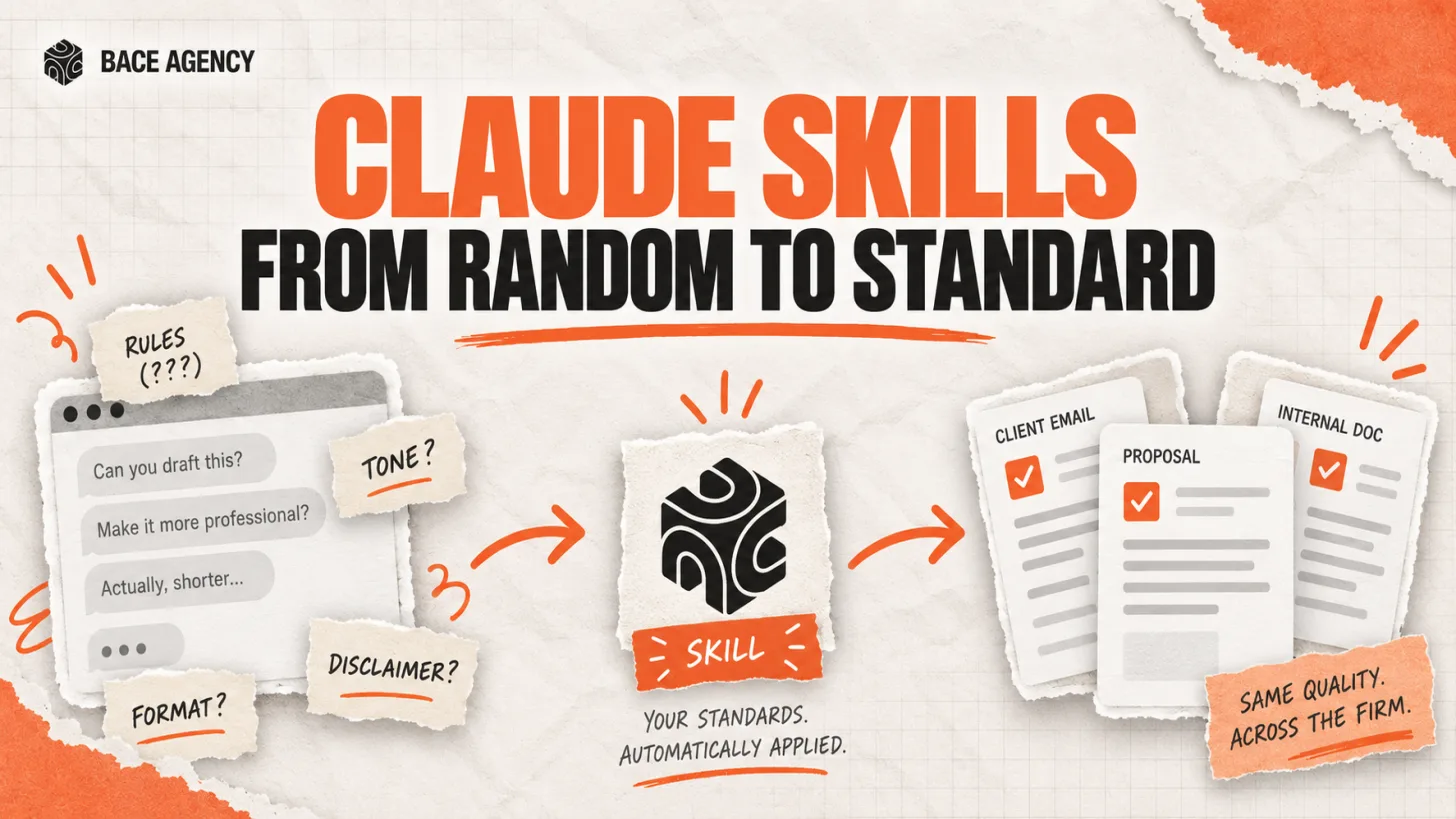
Claude Skills Give a Law Firm One AI Standard
One associate gets sharp drafts, another gets generic filler from the same tool. A Claude Skill turns one person's rules into a standard the whole firm can rely on.

Let AI Agents Handle Intake at Evanston Law Firms
Most Evanston firms still run intake on a phone and a Word template. The firms pulling ahead hand the whole new-matter pipeline to an agent, then review its work before anything reaches the client.

Oregon Federal Court Fines Lawyers $110,000 Over AI
Two lawyers were fined $110,000 for filing AI-invented case citations. The lesson is not to avoid AI. It is to verify it. Here is the workflow that prevents it.
About the author

Written by
Michael Pavlovskyi
Founder, Bace Agency
Michael builds custom Claude and GPT workflows for insurance agencies, law firms, and PE firms on Chicago's North Shore. Speaker at Northwestern and Lake Forest College on practical AI adoption for professional services.
Connect on LinkedInSee it in your firm
Book an audit.
A free 30-minute AI audit. No obligation, no pitch deck.
Book a free AI audit