
AI Loss Run Analysis Finally Works
North Shore P&C agencies that hand Claude the full claims history are turning days of renewal prep into a single sitting.


Key Takeaways
- ✓ A loss run is a carrier-issued claims history report, and most commercial underwriters want three to five years of it before quoting a renewal.
- ✓ Claude reads scanned and handwritten loss runs directly, and its larger models hold roughly a million tokens of context, enough for years of multi-carrier claims history in one pass.
- ✓ AI-assisted loss run review does not replace underwriting judgment. It replaces the manual re-keying that delays the judgment call.
- ✓ Most North Shore agencies already pay for the core tool through an existing Claude subscription. The real cost has been the specialty per-document vendors a flat plan can replace.
If your Lake Forest or Northfield P&C agency still prints a five-year loss run before every renewal meeting, you already know the real cost is not the paper. It is the CSR afternoon lost to re-keying claim numbers into a spreadsheet. Only then can an underwriter actually use the file.
AI loss run analysis is the use of a large language model such as Claude to read a carrier-issued claims history report and turn it into structured, comparable data in minutes instead of hours. For a North Shore P&C agency, that means less time re-keying claim lines by hand and more time on the renewal conversation that actually keeps the account.
What Is a Loss Run, and Why Does It Take an Afternoon to Read?
A loss run is a carrier-issued report that lists every claim filed on a policy: the date, the cause of loss, the reserve, the amount paid, and whether the file is open or closed. Commercial underwriters typically want three to five years of them before they will quote a renewal.
The problem is not that one loss run is hard to read. It is that a real submission arrives in four or five different carrier formats, some clean PDFs and some a scanned fax from 2019 with a coffee ring on it. A CSR working a habitational or contractor account on the North Shore might be stitching together loss runs from four prior carriers, each with its own column order and claim-type shorthand, before an underwriter ever sees the file.
That stitching is hours of copy-and-paste work on a task where a transposed number or a missed subrogation note changes the account's real loss history. Applied Epic and the other agency management systems most North Shore agencies run store the policy. Almost none of them read the loss run for you.
How AI Loss Run Analysis Actually Works
Feed Claude a scanned loss run and it does not need to be converted to a spreadsheet first. According to Anthropic's Claude documentation, the model reads PDFs and images directly, including tables and handwritten adjuster notes, and its newer models hold roughly a million tokens of context in a single conversation. That is enough room to load five years of claims history from three or four carriers at once and ask it to reconcile all of them against a single account.
I built fraud-detection AI used by Blue Cross Blue Shield across North Carolina, South Carolina, California, and Florida before starting Bace Agency. The job there was the same shape as this one: find the pattern buried in years of claims data that a reviewer working one file at a time will not catch. A repeat water-damage claim on a habitational account. A claim reopened twice. A large loss that never shows up in the summary letter a carrier sends. Claude will not replace an underwriter's judgment, but it puts every one of those details in front of the underwriter instead of leaving them on page forty of a PDF nobody finished reading.
SAMPLE CLAUDE PROMPT
"Attached are five years of loss runs for this account from three different carriers. Extract every claim into a single table with date of loss, cause of loss, reserve, paid amount, and status. Flag any claim that appears more than once, any claim reopened after being marked closed, and any total incurred loss above $50,000. Note anything that looks inconsistent between the carriers' formats."
What This Means for Your Renewals
If your book runs habitational, trucking, or contractor risk anywhere from Highland Park to Lake Bluff, the accounts most likely to get non-renewed are the ones where nobody caught the pattern early enough to fix it. A repeat slip-and-fall at the same property, a fleet with three at-fault accidents in one year: carriers see these before you do if your own review is slower than theirs.
"What gets measured gets managed."
Peter Drucker, on why the data you actually track shapes the decisions you makeThis is a measurement problem, not a renewal one. An agency that sees its book's real loss pattern six weeks before a renewal, instead of six days before, has time to fix the account: raise the deductible, add loss control, or shop it to a market that will still take the risk. An agency that sees the pattern the night before the renewal call has none of those options left. I covered a related version of this shift, moving a full workflow onto AI rather than just one task, in our North Shore insurance case study.
| Task | Manual Review | AI-Assisted Review |
|---|---|---|
| Reading a 5-year, multi-carrier loss run | A full afternoon, longer with more carriers | One sitting, carriers reconciled together |
| Consistency across staff | Varies by which CSR pulls the file | Same extraction method every time |
| Catching a repeat loss buried in the file | Easy to miss on page forty | Flagged automatically before the review is done |
How Much Does AI Loss Run Analysis Cost?
Most agencies already own the tool. A Claude subscription, per Anthropic's pricing page, runs as a flat monthly fee per seat, not a per-document or per-page charge the way some legacy claims-extraction vendors bill. That kind of tool overlap, a flat subscription already covering what a specialty vendor charges by the page, is exactly what we look for first in our AI consulting work with North Shore firms.
The larger cost has never really been software. It is the standardization problem across carriers. Verisk Analytics is the data and analytics company that owns ISO, the organization most property and casualty carriers use to standardize policy and claims reporting language. Even with that standard in place, loss run layouts vary enough between carriers that a CSR still has to think through what each column means. Claude handles that variation the way a sharp CSR does, by reading the header and the surrounding context, except it does it the same way every single time.
McKinsey's research on the insurance industry has pointed to underwriting and claims as two of the functions AI reshapes first, because both run on exactly this kind of structured document work. That shift is already available to a two-person North Shore agency, not just to a carrier with its own data science team.
How to Start Using AI on Your Loss Runs This Week
You do not need a new system to test this. You need one renewal file and an hour.
This Week: Run One Real Loss Run Through Claude
Pick your messiest renewal, the one with three carriers and a scanned file with a coffee ring on it. Upload it to Claude and ask for a single table of every claim, with date, cause, reserve, paid amount, and status. Compare it against what your CSR already built by hand.
If it matches, you have a process worth keeping. If it catches something your CSR missed, you have a reason to make it standard.
Before Your Next Renewal: Write One Standard Prompt
Turn the prompt from step one into a template your whole team uses, not something each CSR reinvents. Add the flags that matter most to your book: repeat losses, reopened claims, incurred losses above whatever dollar threshold you set.
Save it somewhere every renewal handler can find it, not in one person's inbox.
This Quarter: Put a Human Check in the Workflow
Decide who reviews Claude's extraction before it reaches underwriting, and what exactly they are checking for. Treat the output as a first draft, not a final answer, and set a rule for how unusual claim types get handled.
NIST's AI Risk Management Framework is a reasonable place to start if you want a written policy for how AI-assisted review fits into your compliance file.
The agencies pulling ahead are not buying new software. They tested this on one messy loss run this month. Then they took a real AI readiness assessment instead of guessing where to start. Watch Anthropic's next model release for a still larger context window. Then decide whether it is worth feeding Claude your full expiring book at once, not one file at a time.
For agencies ready to see this on their own loss runs, a free 30-minute AI audit is available, in person on the North Shore or on video. No obligation. The output is a one-page plan your team can act on before your next renewal cycle.
Frequently Asked Questions
What is a loss run in property and casualty insurance? +
A loss run is a carrier-issued report listing every claim filed on a policy, including the date, cause of loss, reserve amount, amount paid, and current status. Underwriters use it to price a renewal, and most ask for three to five years of history before quoting a commercial account.
Can AI read a scanned or handwritten loss run? +
Yes. Claude can read PDFs and images directly, including tables and handwritten adjuster notes, without a separate scanning conversion step, according to Anthropic's Claude documentation. A faxed or scanned loss run from an older carrier system works the same way a clean digital PDF does.
Is it safe for an insurance agency to upload client loss runs to Claude? +
Treat a loss run the same way you treat any client file with personal or financial information: check your agency's data handling policy and Anthropic's terms before uploading production data, and consider a written AI use policy modeled on a framework such as NIST's AI Risk Management Framework. Most agencies start by testing on a file with limited sensitive detail before rolling the process out further.
How much does AI loss run analysis cost for a small agency? +
Most of the cost is already covered by an existing Claude subscription, which Anthropic prices as a flat monthly fee per seat rather than a per-document charge. The bigger recurring cost is usually a specialty claims-extraction vendor billing by the page, which a flat subscription can often replace.
Does AI loss run analysis replace an underwriter's judgment? +
No. It replaces the manual re-keying and cross-referencing that used to eat the hours before an underwriter or CSR could evaluate the account. The judgment call on whether to renew, raise a deductible, or shop the risk still belongs to a person.
Related Articles
Put One AI Agent to Work This Quarter
Pick one repeatable workflow, renewal prep is the easiest start, and hand it to Claude with a clear human checkpoint. Here is the exact setup, step by step, for this quarter.
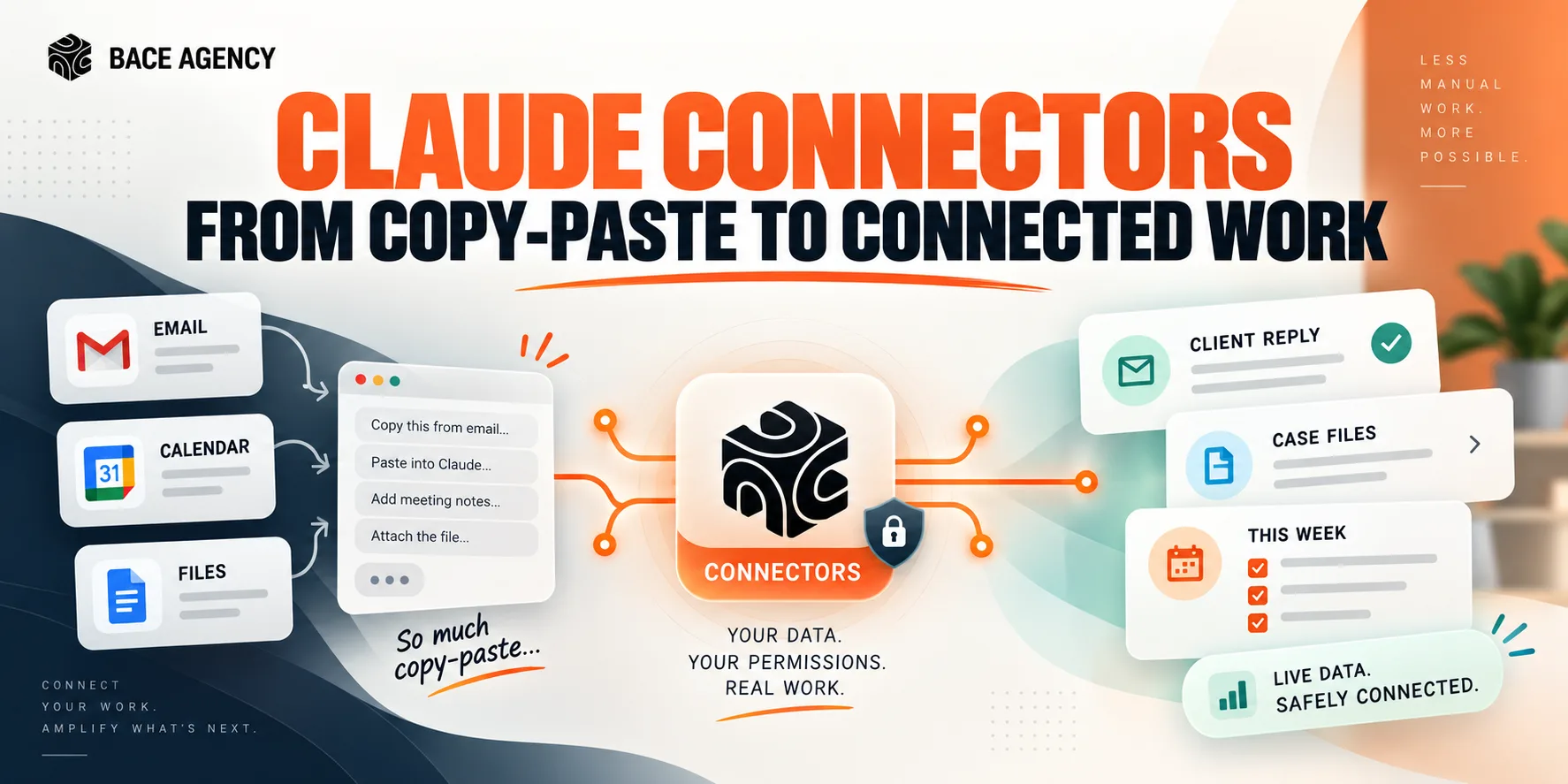
Claude Connectors for Winnetka Accounting Firms
AI stays a clever assistant until it can see your real email, files, and calendar. Connectors are that bridge, and the win depends on connecting narrowly and keeping the writes on approval.
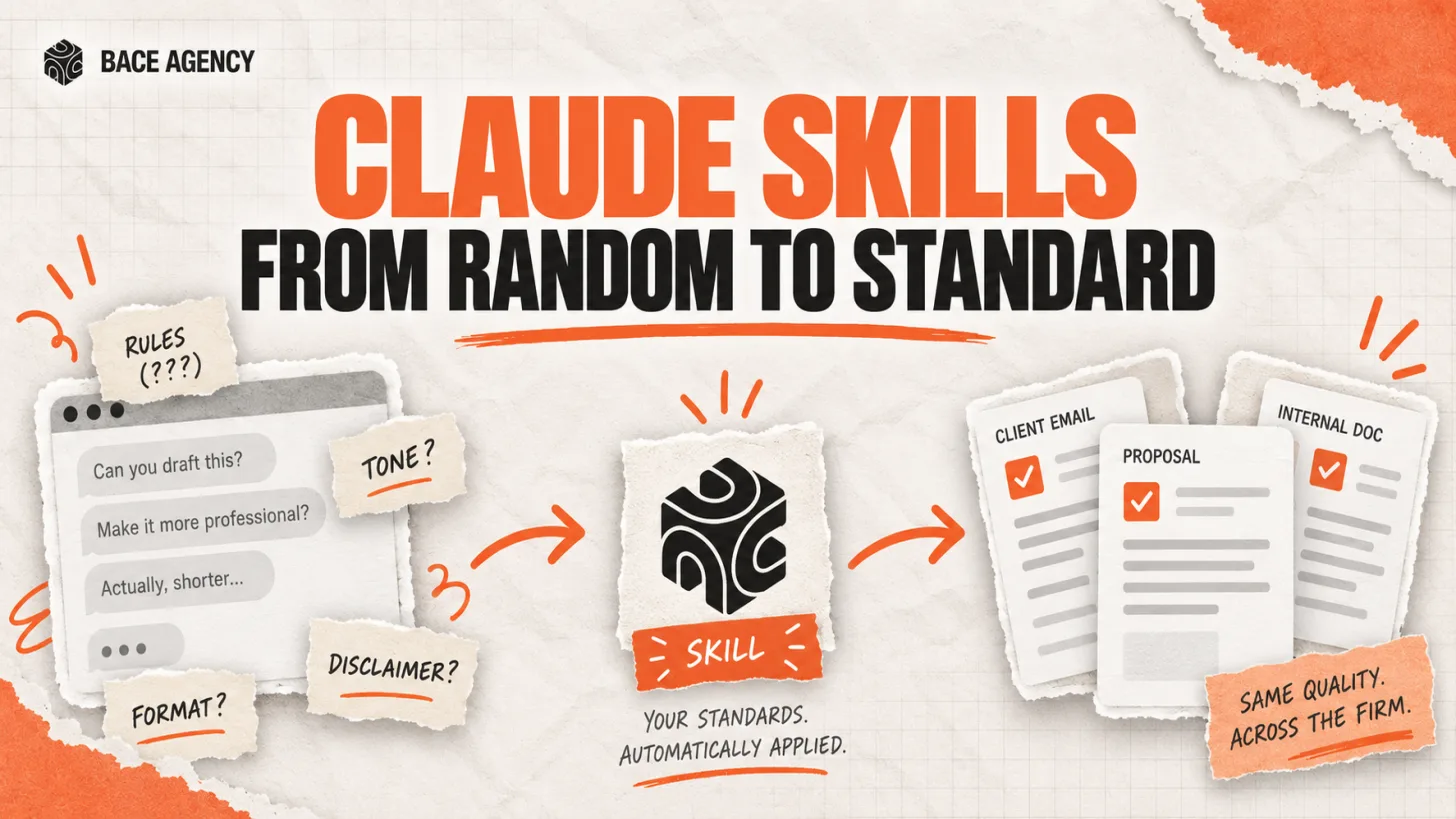
Claude Skills Give a Law Firm One AI Standard
One associate gets sharp drafts, another gets generic filler from the same tool. A Claude Skill turns one person's rules into a standard the whole firm can rely on.
About the author

Written by
Michael Pavlovskyi
Founder, Bace Agency
Michael builds custom Claude and GPT workflows for insurance agencies, law firms, and PE firms on Chicago's North Shore. Speaker at Northwestern and Lake Forest College on practical AI adoption for professional services.
Connect on LinkedInSee it in your firm
Book an audit.
A free 30-minute AI audit. No obligation, no pitch deck.
Book a free AI audit