
AI Security Fears Kill More Projects Than Actual Breaches
Glencoe business owners are paralyzed by theoretical AI security risks while competitors capture real market advantages. Here's how to balance protection with progress.


Key Takeaways
- ✓ Security paralysis kills more AI projects than actual security incidents, costing firms competitive advantage while competitors gain market share
- ✓ Focus security efforts on three real risks: data exposure, model manipulation, and compliance gaps rather than theoretical attack vectors
- ✓ Implement a practical 4-week security framework: data classification, system selection, contract review, and pilot deployment
GLENCOE, Ill. , December 15, 2024. Picture the managing partner of a small Glencoe law firm spending six months researching AI security frameworks while a competitor down the road launches an AI-powered contract review system that meaningfully cuts the hours spent per matter.
This isn't a story about reckless adoption. It's about security theater killing competitive advantage.
I see this pattern across the North Shore: business owners who understand NIST's AI Risk Management Framework better than their own profit margins, yet still can't deploy a single AI tool. Meanwhile, their less cautious competitors are capturing market share with carefully implemented AI systems that face the same theoretical risks but deliver measurable results.
The Real Cost of Security Paralysis
Security paralysis costs more than security incidents. A firm can lose six-figure contracts while its security committee debates whether Claude's data retention policies meet a theoretical compliance standard.
Picture two wealth management firms of similar size. One spends four months evaluating AI security frameworks while the other deploys AI-powered quarterly review automation. The second firm ends up handling noticeably more clients with the same staff. The first is still in committee.

The math is brutal. Every month spent in security review is a month competitors gain market position. In professional services, first-mover advantage compounds. The firm that automates client intake first captures more prospects. The advisor who accelerates quarterly reviews first handles more families.
"The biggest risk is not taking any risk. In a world that's changing quickly, the only strategy that is guaranteed to fail is not taking risks."
Mark Zuckerberg, on strategic decision-making in uncertain environmentsIn my experience, most business owners find that their security concerns fall into two categories: legitimate risks that require specific controls, and theoretical risks that justify infinite delay. The work is telling them apart.
What AI Security Risks Actually Matter
Real AI security risks for Glencoe businesses cluster around three areas: data exposure, model manipulation, and compliance gaps. Everything else is security theater.
Data exposure happens when sensitive information flows to AI systems without proper controls. An agency could, for example, accidentally train a custom model on policyholder social security numbers because no one audited the training data pipeline. That's a real risk requiring specific technical controls.
Model manipulation occurs when attackers inject prompts designed to extract sensitive information or bypass safety controls. IBM's latest security research documents several cases where adversarial prompts exposed confidential business data. This risk requires prompt filtering and output monitoring.

Compliance gaps emerge when AI systems process regulated data without proper audit trails or consent mechanisms. A financial planning firm could face a regulatory inquiry simply because its AI-powered client communication system can't produce complete interaction logs. Fixable, but expensive after the fact.
Notice what's missing from this list: theoretical model risks, hypothetical algorithm bias, and academic paper attack vectors that require nation-state resources. These dominate security committee discussions but rarely impact North Shore professional services firms.
SAMPLE CLAUDE PROMPT
"I'm implementing AI tools for a professional services firm in Illinois. Review this data classification matrix and identify any categories of information that should never be processed by cloud-based AI systems. Consider Illinois privacy laws, professional licensing requirements, and industry-standard data handling practices. Flag any classifications that need additional technical controls."
The practical approach: focus security efforts on the three real risk categories above. Ignore academic attack vectors until they show up in commercial threat intelligence feeds.
A Practical Security Framework for Glencoe Businesses
Security frameworks fail when they're too complex to implement or too abstract to audit. Glencoe businesses need a framework that protects data while enabling rapid deployment.
Data Classification Matrix
Create four categories: Public (marketing copy, published articles), Internal (strategic plans, vendor contracts), Confidential (client lists, financial projections), and Restricted (SSNs, health records, attorney-client communications).
Public and Internal data can flow to AI systems with standard commercial terms. Confidential requires encryption and audit logs. Restricted needs air-gapped systems or specialized compliance tools.
AI System Tiers
Tier 1: Consumer AI tools (ChatGPT, Claude) for Public data only. Tier 2: Commercial AI platforms (Salesforce Einstein, HubSpot AI) for Public and Internal data. Tier 3: Enterprise or self-hosted AI for Confidential data with proper contracts.
Never process Restricted data through any cloud AI system without specialized compliance infrastructure.
Deployment Gates
Week 1: Data classification audit. Week 2: AI system selection based on data tiers. Week 3: Contract review for data processing terms. Week 4: Pilot deployment with monitoring.
Four weeks from audit to production. Not four months of committee meetings.

This framework balances protection with velocity. Most North Shore firms can implement Tiers 1 and 2 immediately, covering 80% of AI use cases while security teams work on Tier 3 infrastructure.
How to Implement AI Without Security Paralysis
Implementation without paralysis requires accepting calculated risks and measuring actual outcomes rather than theoretical scenarios.
Start with the lowest-risk, highest-impact AI applications. Marketing copy generation, meeting summarization, and research synthesis involve mostly Public data. A Glencoe consulting firm can deploy Claude for proposal writing today without touching client confidential information.
| AI Use Case | Data Risk | Implementation Time | Business Impact |
|---|---|---|---|
| Marketing content generation | Minimal | 1 week | 3-5 hours saved per week |
| Meeting summarization | Low | 2 weeks | 2 hours saved per meeting |
| Document drafting | Medium | 4 weeks | 40% faster first drafts |
| Client data analysis | High | 8-12 weeks | 60% faster quarterly reviews |
The pattern I see in successful North Shore implementations: deploy AI for low-risk applications first, measure the actual security posture under real conditions, then expand based on evidence rather than theory.
"Perfect is the enemy of good. The way to get started is to quit talking and begin doing."
Walt Disney, on overcoming analysis paralysis in creative projectsMost security incidents at professional services firms trace to basic failures: weak passwords, unpatched software, and poor access controls. AI-specific security risks are real but, in my view, statistically less likely than the mundane vulnerabilities every firm already manages.
The Narrowing Window for Competitive Advantage
The window for AI competitive advantage is narrowing fast. Early adopters on the North Shore are already seeing market share gains that will compound over the next 18 months.
A wealth management firm that deploys AI-powered client communication can handle materially more prospect inquiries with the same staff. A competitor still stuck in security review loses prospects to the faster firm's response times.
The same dynamic I documented in North Shore firms adopting AI faster than Chicago downtown is accelerating. Suburban professional services firms have natural advantages in AI adoption: smaller decision-making teams, direct client relationships, and less bureaucratic overhead.
But these advantages only matter if firms actually deploy AI systems. Security paralysis neutralizes every structural advantage.
For Glencoe business owners, the question isn't whether AI security risks are real. They are. The question is whether those risks justify surrendering competitive position to firms with better risk-reward calibration.
The answer, in my view, is clear: measured risks beat paralyzed perfection every time.
For firms ready to balance security with competitive reality, a free 30-minute AI audit is available in person in Glencoe or on video. No obligation. The output is a one-page security framework your team can implement in 30 days.
Frequently Asked Questions
What are the most common AI security risks for Glencoe businesses? +
The three main risks are data exposure (sensitive information flowing to AI systems without proper controls), model manipulation (attackers using prompts to extract confidential data), and compliance gaps (AI processing regulated data without proper audit trails). These account for most real-world AI security incidents at professional services firms.
How long should AI security review take before deployment? +
A practical security review should take 4 weeks maximum: Week 1 for data classification audit, Week 2 for AI system selection, Week 3 for contract review, and Week 4 for pilot deployment. Reviews taking longer than a month often indicate analysis paralysis rather than thorough security planning.
Can we use consumer AI tools like ChatGPT safely for business? +
Yes, but only for Public data (marketing content, published information, general research). Never input client confidential information, internal strategic data, or regulated information into consumer AI platforms. For business-sensitive data, use commercial AI platforms with proper data processing agreements.
What's the biggest mistake North Shore firms make with AI security? +
Focusing on theoretical risks from academic papers while ignoring practical deployment opportunities. Most firms spend months debating hypothetical attack vectors while competitors capture market share with carefully implemented AI systems that face the same theoretical risks but deliver measurable business results.
How do we balance AI security with competitive advantage? +
Start with low-risk, high-impact applications using Public data, measure actual security posture under real conditions, then expand based on evidence. Deploy marketing automation and meeting summarization first, then move to document drafting and client analysis as security controls mature.
Related Articles
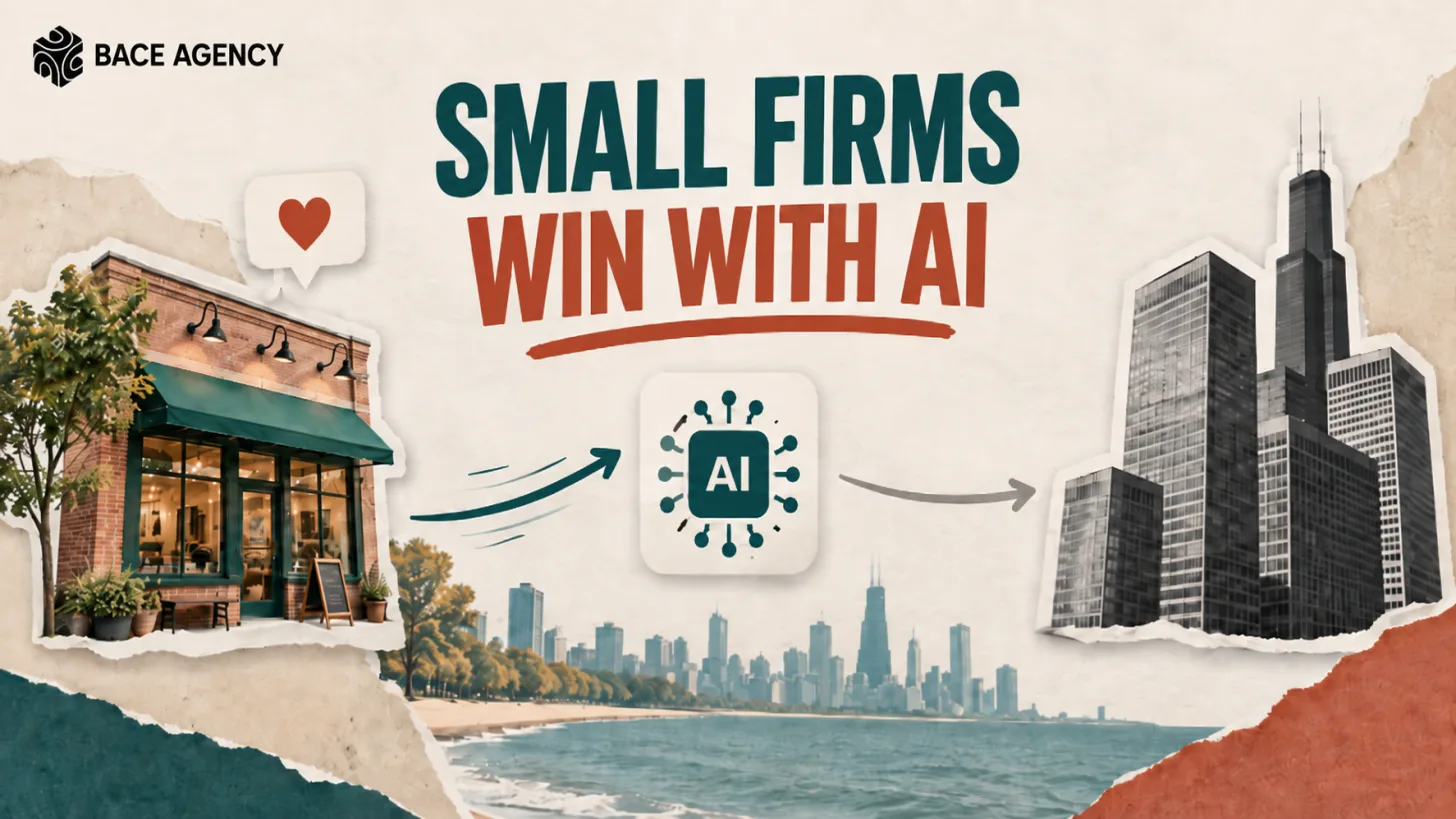
Small North Shore Firms Are Beating Big Ones to AI
While a national firm spends a year debating AI strategy, the small practice down the street already answers clients faster. The gap compounds every week.

What North Shore Firms Should Not Automate
Most AI consultants will automate anything you point at. Here is the short list I tell clients to leave alone.

What Anthropic's Valuation Means for Small Firms
Anthropic just became the most valuable AI startup at a $965 billion valuation. The fad question is closed. The useful question is where AI fits in your firm, and where it does not.
About the author

Written by
Michael Pavlovskyi
Founder, Bace Agency
Michael builds custom Claude and GPT workflows for insurance agencies, law firms, and PE firms on Chicago's North Shore. Speaker at Northwestern and Lake Forest College on practical AI adoption for professional services.
Connect on LinkedInSee it in your firm
Book an audit.
A free 30-minute AI audit. No obligation, no pitch deck.
Book a free AI audit