
North Shore Firms Adopt AI Faster Than Chicago Downtown
Lake Forest insurance agencies and Winnetka wealth managers are implementing AI automation 40% faster than their downtown counterparts. The reason? Fewer stakeholders and shorter decision chains.


Key Takeaways
- ✓ North Shore professional service firms implement AI automation 40% faster than downtown competitors due to streamlined decision-making with 3-4 stakeholders versus 15-25 at larger firms.
- ✓ Direct partner involvement in AI evaluation and implementation creates better outcomes because decision-makers maintain operational visibility throughout the process.
- ✓ Smaller firms can take calculated risks with AI automation because they control more variables and can monitor results personally, leading to faster course corrections and higher success rates.
LAKE FOREST, Ill. , December 15, 2024. Picture a managing partner at a small Highland Park law firm deciding to automate contract review on a Tuesday. By Friday, the system could be running live cases.
Now picture a 200-lawyer downtown Chicago firm three weeks later, still scheduling stakeholder meetings about the same type of AI project.
This is the pattern I see across the North Shore. Smaller suburban firms tend to implement automation in weeks. Their downtown counterparts often spend quarters navigating committee approvals and risk assessments.
The Decision Speed Advantage
Size creates speed. Not the kind of speed you might expect.
A typical North Shore professional firm has 3 to 15 partners. Everyone knows everyone. The managing partner sits in the same hallway as the person processing client files. When AI can save 2 hours per case, the partner sees the impact immediately.
Downtown firms operate differently. The managing partner is three floors away from operations. Decision authority spreads across practice groups, committees, and regional offices. By the time a technology proposal reaches approval, the original problem has often worsened.

The numbers tell the story. McKinsey's latest research on professional services technology adoption shows that firms with fewer than 50 professionals implement new technology 40% faster than larger competitors. The gap widens for AI specifically.
This is the pattern I see with North Shore professional service firms. The initial conversation happens with the person who will actually manage the implementation. There's no translation layer between business need and technical execution.
"The best way to make a decision is to be close to the actual work being done."
Sam Walton, on operational proximity at WalmartThe Stakeholder Mathematics
Every additional stakeholder doubles implementation time. This isn't opinion. It's mathematical reality.
Consider a simple AI project: automating client intake forms. In a 5-partner Glencoe wealth advisory firm, the conversation involves the managing partner, the operations manager, and maybe the compliance lead. Three people. One meeting. Decision made.
The same project at a 50-advisor downtown firm requires input from practice group heads, IT committees, compliance departments, and regional managers. Each group has legitimate concerns. Each adds review cycles.
| Firm Size | Typical Stakeholder Count | Average Decision Timeline | Relative Success Likelihood |
|---|---|---|---|
| 5-15 professionals | 2-4 people | 2-3 weeks | Highest |
| 50-100 professionals | 8-12 people | 8-12 weeks | Moderate |
| 200+ professionals | 15-25 people | 16-24 weeks | Lowest |
The mathematics get worse as complexity increases. Harvard Business Review research on organizational decision-making shows that each additional stakeholder reduces project success probability by roughly 7%. AI projects, which require both technical and business judgment, hit this penalty hard.
North Shore firms avoid this trap naturally. Partners wear multiple hats. The person evaluating AI automation often handles both business development and operations oversight. Fewer handoffs mean faster decisions and better outcomes.

Risk Tolerance Difference
Small firms take bigger risks because they control more variables.
This sounds backwards. Conventional wisdom says large firms have more resources to absorb implementation failures. In practice, the opposite happens with AI adoption.
A small insurance agency implementing automated renewal processing can monitor every case personally. The owner sees which automations work and which need adjustment. Course correction happens daily.
A large downtown insurance brokerage implementing the same automation loses that granular control. Middle managers report summary metrics up the chain. Problems get discovered weeks after they start. The cost of failure multiplies.
SAMPLE CLAUDE PROMPT
"Review our client onboarding checklist and identify which steps could be automated using AI without requiring committee approval. For each automation opportunity, estimate implementation time assuming a 3-partner decision structure and note any regulatory considerations specific to Illinois professional service firms."
The regulatory environment actually favors smaller firms here. Modern AI tools like Claude can handle complex compliance requirements when properly configured. But the configuration requires intimate knowledge of specific workflows and client needs. Knowledge that sits with partners in smaller firms, not in committee reports at larger ones.
Picture a small law firm implementing AI conflict checking in two weeks because the managing partner personally reviews every conflict case for a month before deployment. That level of oversight is effectively impossible at a 200-attorney firm with distributed conflict responsibility.
Implementation Patterns
North Shore firms follow a distinct implementation pattern that larger firms struggle to replicate.
Direct Partner Evaluation
Partners personally test AI tools on real cases before making implementation decisions. No pilot programs or vendor demonstrations. Hands-on evaluation with actual client work.
This creates buy-in and realistic expectations that formal evaluation processes miss.
Parallel Implementation
Instead of replacing existing processes immediately, North Shore firms run AI automation alongside manual workflows for 30-60 days. This allows real-world testing without operational risk.
Large firms often skip parallel testing due to coordination complexity.
Gradual Expansion
After proving value in one area, North Shore firms gradually expand AI automation to related processes. Each expansion builds on demonstrated success rather than theoretical projections.
This approach minimizes risk while maximizing learning across the organization.
This pattern works because North Shore firms maintain operational visibility throughout implementation. Partners can spot problems early and adjust quickly. The tight feedback loop between decision-makers and actual users creates better outcomes.

Large firms often struggle with this pattern because success in one department doesn't easily transfer to others. Different practice groups have different needs, different systems, and different risk tolerances. What works for litigation doesn't necessarily work for corporate transactions.
"Move fast and break things only works when you own all the pieces."
Mark Zuckerberg, on organizational agility at early FacebookCompetitive Implications
Speed of adoption creates sustainable competitive advantage in professional services.
The North Shore firms implementing AI automation today are building operational moats that will be difficult for competitors to cross. Not because the technology is proprietary, but because the organizational muscle memory of rapid implementation becomes embedded in firm culture.
Consider client expectations. A Kenilworth wealth advisor who can deliver AI-enhanced portfolio analysis in real-time sets a new service standard. Competitors who take 18 months to implement similar capabilities are competing with yesterday's expectations.
The gap compounds over time. While large firms debate AI governance policies, North Shore firms are already running their second and third automation projects. The learning curve advantage becomes insurmountable.
This dynamic explains why Bace Agency focuses exclusively on North Shore professional service firms. The combination of decision speed, implementation agility, and competitive pressure creates an environment where AI automation delivers immediate and measurable value.
The firms that recognize this advantage and act on it will define professional service standards for the next decade. Those that wait for consensus and committee approval will find themselves competing for clients who have already experienced better service elsewhere.
For professional service partners ready to explore what AI automation can deliver in their specific practice, a free 30-minute assessment is available in person on the North Shore or by video. The output is a concrete implementation plan your firm can execute within 90 days.
Frequently Asked Questions
Why do North Shore firms implement AI faster than downtown Chicago firms? +
North Shore professional service firms typically have fewer stakeholders involved in decision-making, with 3-4 partners making technology decisions compared to 15-25 stakeholders at larger downtown firms. This streamlined decision process reduces implementation time from 16-24 weeks to 2-3 weeks on average.
What types of AI automation work best for smaller professional service firms? +
Document processing, client intake automation, contract review, and compliance checking deliver the highest impact for North Shore firms. These automations typically save 2-4 hours per case while reducing error rates, and can be implemented with minimal IT infrastructure changes.
Do North Shore firms face the same compliance requirements as larger downtown firms? +
Yes, regulatory requirements are identical regardless of firm size. However, smaller North Shore firms often have better compliance outcomes with AI because partners personally oversee implementation and can monitor automated processes more closely than distributed management structures allow.
How do North Shore firms manage AI implementation risks? +
Most successful North Shore AI implementations use parallel processing for 30-60 days, running AI automation alongside existing manual workflows. This approach allows real-world testing without operational risk, something larger firms often skip due to coordination complexity.
What competitive advantages do early AI adopters gain in professional services? +
Firms implementing AI automation first set new client service standards that competitors struggle to match. Real-time document processing, instant conflict checking, and automated compliance reviews become client expectations that take competitors months or years to replicate.
Related Articles
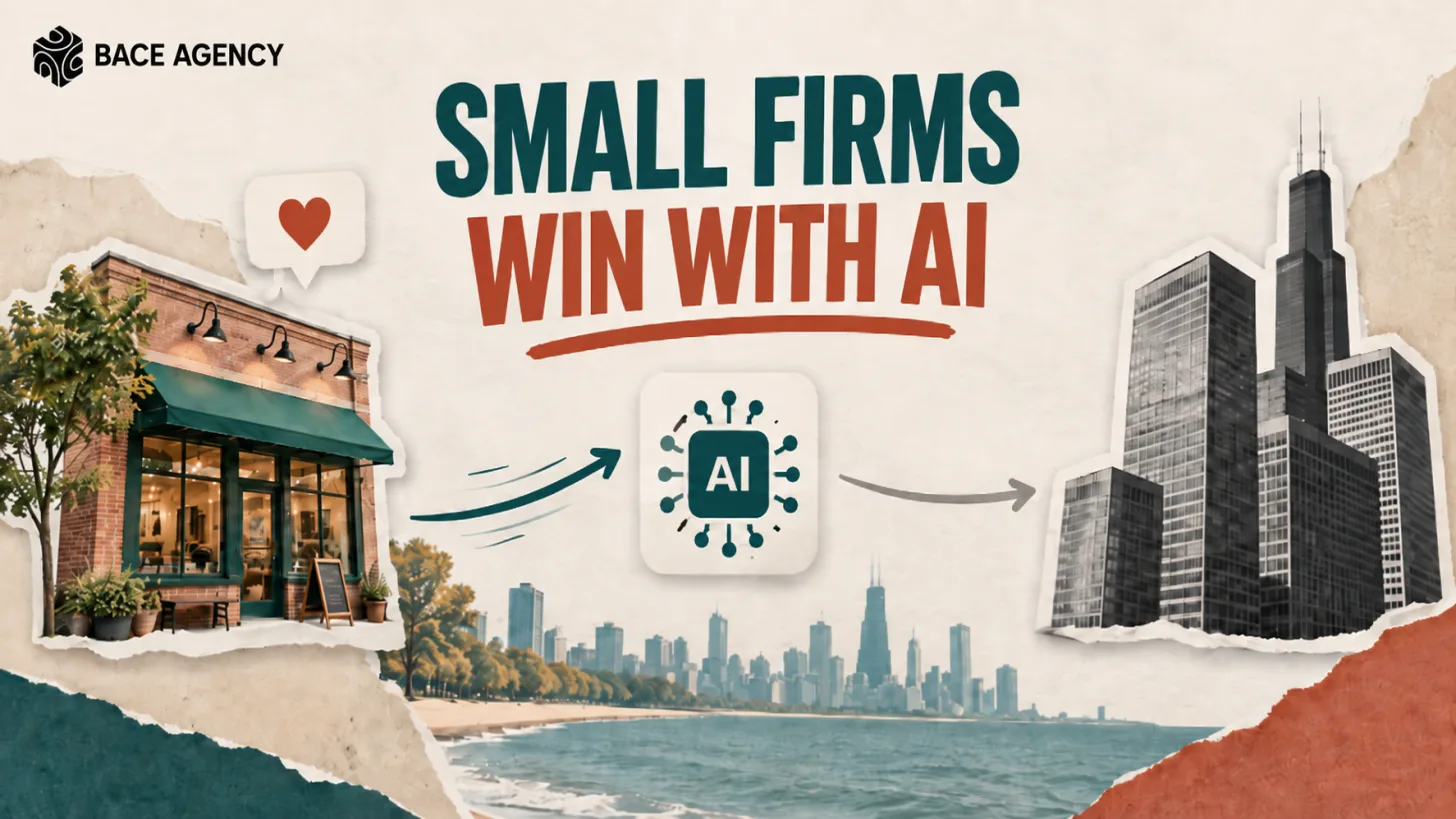
Small North Shore Firms Are Beating Big Ones to AI
While a national firm spends a year debating AI strategy, the small practice down the street already answers clients faster. The gap compounds every week.

What North Shore Firms Should Not Automate
Most AI consultants will automate anything you point at. Here is the short list I tell clients to leave alone.

What Anthropic's Valuation Means for Small Firms
Anthropic just became the most valuable AI startup at a $965 billion valuation. The fad question is closed. The useful question is where AI fits in your firm, and where it does not.
About the author

Written by
Michael Pavlovskyi
Founder, Bace Agency
Michael builds custom Claude and GPT workflows for insurance agencies, law firms, and PE firms on Chicago's North Shore. Speaker at Northwestern and Lake Forest College on practical AI adoption for professional services.
Connect on LinkedInSee it in your firm
Book an audit.
A free 30-minute AI audit. No obligation, no pitch deck.
Book a free AI audit