
An AI Course Built for Your Business
Generic training gives your team a certificate. A course built on your firm's actual workflows gives them the prompts to use tomorrow.

Key Takeaways
- ✓ Generic AI courses teach employees to use AI tools in the abstract. A course built for your business teaches them to handle your specific work: client letters, meeting notes, quarterly reviews, and compliance drafts.
- ✓ Financial advisors who train on their own documents and tasks reach a working level in a single day. Generic courses, without that anchor, often produce completion certificates but little change in how work actually gets done.
- ✓ The starting point is not a syllabus. It is a list of your three most repetitive tasks and a prompt built to handle each one reliably in your firm's voice.
- ✓ Anthropic, Google, and Coursera have each released structured AI learning programs since 2024. None of them know your workflows. The gap between a certificate and daily adoption is the part your business has to build itself.
If you run a financial advisory practice in Winnetka, your team probably has access to Claude, ChatGPT, or both. Whether that access produces real changes in how fast client work gets done is a different question. For most professional services firms on the North Shore, the answer is: not yet.
The reason is almost always the same. Someone signed up for a subscription, a few people tried it for a week, and usage settled into occasional email drafting. Nobody built a course around the firm's actual work. The technology is there. The training is not.
An AI course built for your business is structured training aligned to your firm's specific workflows rather than a general introduction to AI tools. The most effective programs start with your three most time-consuming tasks, build a working prompt library around each one, and get your team to a practical standard in a day or two rather than a semester.
The distinction matters more than it sounds. The World Economic Forum's Future of Jobs Report 2025 found that AI and big data literacy sit near the top of every employer's skills priority list and that a large share of core job tasks will be transformed by automation in the next five years. But literacy is a low bar. The gap between knowing what a large language model is and using one to cut your quarterly review drafting time in half is not closed by a certificate. It is closed by practice on your actual work.
McKinsey's 2024 State of AI report found that 72% of organizations had deployed AI in at least one business function, up from 55% the year before. The same report found that structured AI training programs aligned to specific job functions remained uncommon in most organizations. Most firms had broad access and general adoption but not competency anchored to the actual tasks their staff perform. That is a recipe for expensive subscriptions and modest results.
For a financial advisory firm, the stakes are specific. Your work is built on language: client letters, annual reviews, regulatory disclosures, onboarding documents, meeting summaries, compliance notes, and proposal packages. Every one of those tasks is a candidate for AI-assisted drafting. The question is whether your team knows the prompts to run, and whether those prompts are built for your firm's tone, compliance context, and client relationships. Most teams do not have them yet. That is the course you need to build.
What AI Learning Programs Have Actually Launched?
Since 2023, several well-resourced organizations have released structured AI learning programs aimed at the business market. It is worth knowing what each one covers and where each one stops.
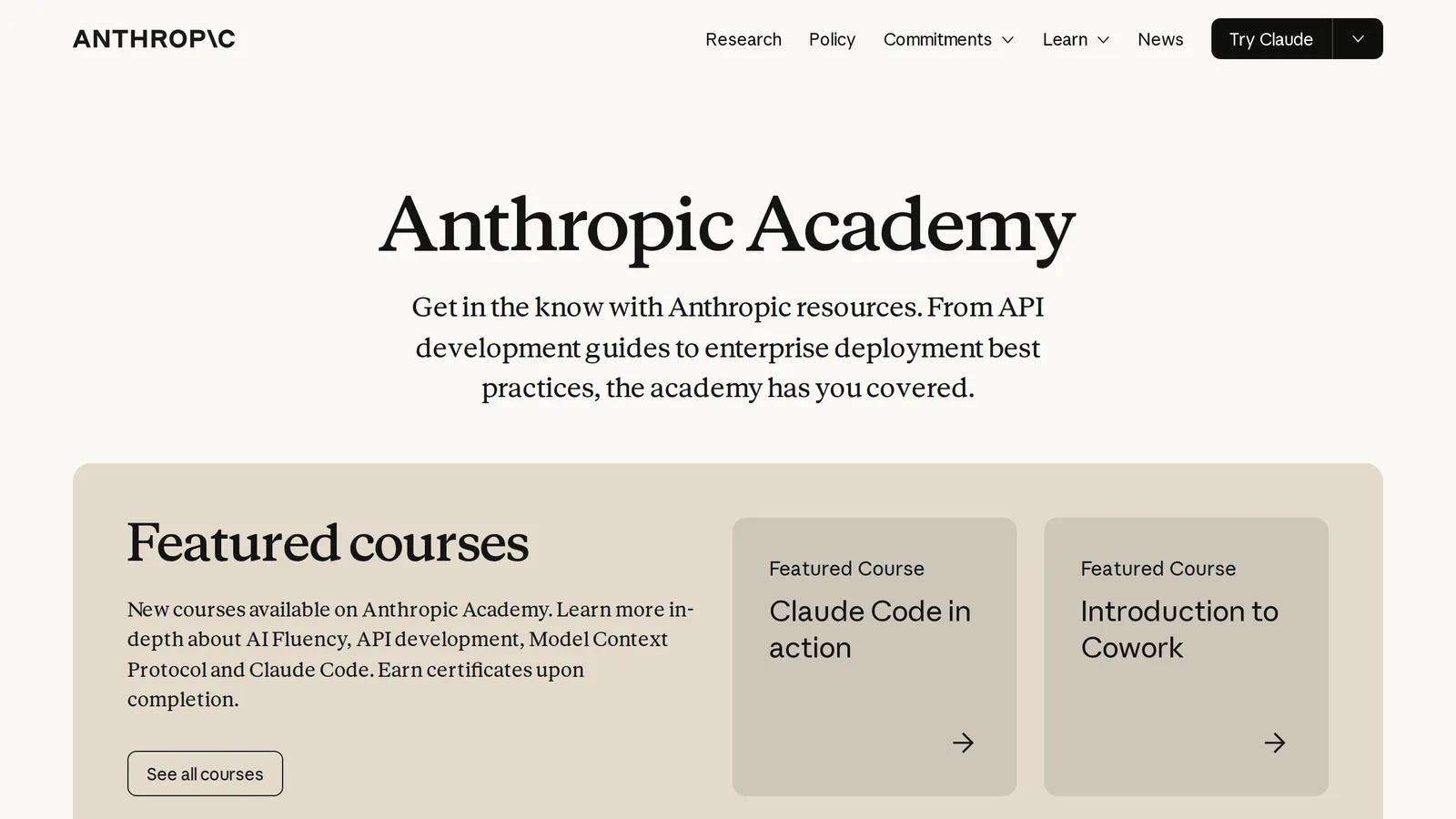
Anthropic launched anthropic.com/learn as a hub for Claude-specific learning resources covering how to write effective prompts, how to use Claude for professional tasks, and how to think about responsible AI use. The materials are clear, well-organized, and genuinely useful for someone new to Claude. They teach the tool. They do not teach how to apply the tool to a specific advisory workflow.
Google released Google AI Essentials on Coursera in 2024, a self-paced course covering AI concepts, Google Workspace AI features, and responsible use. At under 10 hours and a low price point, it is accessible to any member of your staff. It is also entirely generic. A participant who completes it understands more about AI. They do not know how to draft a Reg BI suitability disclosure faster.
Coursera's AI for business catalog now runs to dozens of courses from Wharton, deeplearning.ai, and IBM. These go deeper on strategy, functional use cases, and implementation frameworks. They are genuinely rigorous and worth the time for a principal or operations manager who wants to understand the landscape before making a budget decision.
What none of these programs do is build the prompts your team will run tomorrow for the work already on the desk. That is not a flaw in their design. It is the nature of generic education. The custom layer is yours to build, and it is the layer that determines whether any of this translates into real productivity.
A prompt library is a curated collection of tested, reusable AI prompts aligned to the specific workflows of a single business. It is the practical output a good AI course for your firm should produce, not a certificate.
| Generic AI Course | Custom Business AI Course | |
|---|---|---|
| Starting point | AI concepts and general tools | Your three most time-consuming tasks |
| Time to usefulness | Weeks or months, if ever | One to two days of focused training |
| Output | A completion certificate | A working prompt library for your firm |
| Training material | Generic examples and demos | Your actual documents and client scenarios |
| Adoption rate | Low (not tied to real daily tasks) | Higher (staff trained on work they already do) |
| Best for | Building conceptual understanding | Changing how your team works this quarter |
"The most important investment you can make is in yourself."
Warren Buffett, investor and CEO of Berkshire HathawayWhy This Matters for Financial Advisory Firms
Financial advisory work is unusually well-suited to AI assistance because it is unusually language-intensive and unusually repetitive. The same firm might produce hundreds of quarterly review letters per year, dozens of annual financial plans, and several new client onboarding packages per month. The facts in each document change. The structure, the compliance language, and the professional tone do not. That consistency is exactly the condition under which AI drafting works best.
The gap is not technical. It is pedagogical. Staff who have been through a generic AI course know how to prompt an AI assistant to write something. They do not know how to prompt it to produce a compliant, on-brand quarterly letter for a 68-year-old client in Winnetka who is preparing for retirement, in the firm's voice, with the right regulatory disclosures, in the format your compliance officer will pass on the first review. That is a specific skill built by training on your specific documents, not by a ten-hour Coursera course.
The second reason this matters is the compounding effect. An advisor who uses AI well for client communication drafting might recover three to five hours per week from that task alone. Over a year, that is 150 to 250 hours, enough to take on additional clients, deepen relationships with existing ones, or simply leave the office before seven. But none of that happens if the AI outputs require heavy editing every time because the prompts were never built for this firm's actual work. The course is the investment that determines whether the subscription fee produces a return.
There is also a service-quality argument. AI document processing is already in practice at forward-looking advisory firms. Clients are beginning to notice which advisors respond faster, communicate more clearly, and produce better-organized review materials. That is not an AI story. It is a service quality story, and AI is the production method behind it.
Training Use Case 1: Drafting Client Communications
The highest-volume writing task in most advisory practices, and the one that benefits most from a firm-specific prompt library.
Client letters, quarterly review summaries, and annual plan updates account for more writing hours in a typical advisory practice than any other single task. The drafting itself is not the hard part. The hard part is producing something that reads like your firm wrote it, contains the right information in the right order, passes compliance review on the first submission, and does not require a half-hour of editing to feel like a person wrote it.
A generic prompt like "write a quarterly review letter for a client" produces something that needs significant rewriting before it is usable. A prompt built for your firm, tested against your actual review letters, seeded with your firm's tone guidelines and compliance requirements, and calibrated on a sample of your real client profiles produces something a staff member can send after one careful read.
The difference is specificity in the prompt. A well-built advisory communication prompt specifies the client's age and life stage, the key portfolio changes from the quarter, the market context to reference, the tone the firm uses, the compliance language that must appear, and the format the letter should take. That is not a generic prompt. It is a firm asset, and it belongs in your prompt library.
SAMPLE CLAUDE PROMPT
"You are a financial advisor at a registered investment advisory firm in Winnetka, Illinois. Write a quarterly review letter for the following client profile:
Client: [name], age [age], retired / approaching retirement / accumulating
Key facts this quarter: [portfolio return, major allocation changes, any notable events]
Market context to acknowledge: [brief note on market conditions]
Firm tone: professional but approachable, not overly formal
Required compliance note: This letter is for informational purposes only and does not constitute investment advice. Past performance does not guarantee future results.
The letter should be under 350 words, acknowledge the client's goals, summarize the quarter honestly, and close with a clear next step. Do not use jargon. Do not include any figures I have not provided."
Training Use Case 2: Meeting Preparation and Follow-Up
Advisors spend significant time before and after every client meeting. Both tasks are strong candidates for AI assistance.
A typical advisor meeting involves preparation time before the session and documentation time after. Before the meeting, the advisor pulls recent account data, reviews the last meeting notes, checks on any outstanding action items, and prepares talking points for topics the client raised in the last conversation. After the meeting, the advisor summarizes what was discussed, records any commitments made, and often drafts follow-up communications.
Both tasks follow predictable structures. The pre-meeting preparation follows the same checklist for almost every client. The post-meeting summary follows the same format. These are not creative tasks. They are documentation tasks, and documentation tasks are where AI performs most consistently.
A firm that trains its team on a pre-meeting prep prompt and a post-meeting summary prompt can recover meaningful time per client per quarter. Multiply that across a book of several hundred clients and the math changes what an advisor can serve. This is not about replacing the meeting. It is about freeing the advisor's attention for the meeting itself rather than for the paperwork that surrounds it.
SAMPLE CLAUDE PROMPT
"You are preparing an advisor for an annual review meeting with the following client. Given this information, produce: (1) a one-page pre-meeting brief with key facts, open action items, and three talking points the advisor should raise; (2) a post-meeting summary template the advisor can fill in during or immediately after the meeting, with fields for decisions made, new action items, and topics to revisit next quarter.
Client profile: [paste summary]
Last meeting notes: [paste notes or describe]
Current portfolio status: [paste relevant figures]
Any known life events since last meeting: [list if applicable]
Keep the pre-meeting brief to one page. The post-meeting template should take under five minutes to complete."
What Does a Working Prompt Library for an Advisory Firm Look Like?
The practical output of a well-run AI course is not a certificate. It is a set of tested, reusable prompts your team can pull from on any working day.
A workflow-specific AI course is training that uses your firm's own documents, tasks, and client scenarios as the material rather than abstract examples. The output of that training is a prompt library: a shared document, a folder in your firm's Google Drive, or a set of saved Claude projects where tested prompts live and can be pulled up by any staff member without writing them from scratch each time.
A prompt library for a financial advisory firm on the North Shore might contain ten to twenty prompts across the following categories:
- Client communications: quarterly letters, annual review summaries, onboarding welcome messages, policy change notices.
- Meeting support: pre-meeting prep briefs, post-meeting summaries, follow-up email drafts.
- Research and analysis: summarizing financial news for a client's context, comparing fund options in plain language, drafting a rebalancing rationale.
- Compliance drafting: disclosure language, suitability documentation, ADV amendment summaries.
- Internal operations: drafting staff communications, summarizing vendor proposals, preparing board or partner meeting materials.
Not every firm needs all of these. The point of building the course around your firm is to start with the three categories where your team spends the most hours today and build outward from there. The course teaches the underlying skill: the testing and refinement of a prompt. The prompt library is the institutional memory of that skill.
The difference between firms that get real returns from their AI tools and firms that pay for subscriptions and see little change is almost always the presence or absence of this document. Building that library for a professional services firm is the core of what a practical AI engagement looks like.
SAMPLE CLAUDE PROMPT
"I run a financial advisory firm in the Chicago area. Help me build a prompt library for my team.
First, ask me: which three tasks consume the most writing or research time in our practice per week?
Then for each task: (1) draft a reusable Claude prompt that handles it well; (2) list what inputs the user needs to provide each time; (3) note any compliance or tone constraints I should build into the prompt; (4) describe how to test it on a real example before adding it to the firm library.
Produce one complete prompt per task. Keep the instructions simple enough that any staff member can use them without prior AI training."
How to Get Started
The right sequence for building an AI course for your firm is not starting with the technology. It is starting with the work, then building backward to the training.
List your three most repetitive writing or research tasks
Before touching any AI tool, have your team spend a week noting which tasks they do repeatedly that involve writing, summarizing, or analyzing information. Client letters, meeting notes, research summaries, compliance drafts, and proposal documents are the most common answers for advisory firms. Pick the three that consume the most combined hours per week. Those are your starting points. Everything else comes later.
Build and test one prompt per task before training anyone
For each of the three tasks, write a Claude prompt and test it on five real examples from your recent work. If the output needs consistent editing in the same places, add those instructions to the prompt until it passes. This testing phase is the course design work. When you get a prompt that produces a usable first draft on at least four out of five real examples, you have a prompt worth training your team on. Add it to a shared document. That document is the beginning of your prompt library.
Run the training as a working session, not a lecture
Bring your team together for a half-day working session. Do not present slides about AI. Instead, open the prompts you built, explain what each one does, and have every staff member run each prompt on a real task from their own queue while you watch. Fix anything that breaks in real use. Answer every question in the session rather than later. By the end, every person on your team has run each prompt at least once on their own work. The AI readiness quiz can help you gauge where your firm is starting before that session.
What This Does Not Replace
An AI course for your business, no matter how well it is built, does not replace the judgment at the center of advisory work.
It does not replace the advisor's read of the client. The right financial recommendation for a specific person in a specific life situation requires knowing that person in a way no AI tool can replicate from a prompt. The drafting of the letter that explains that recommendation can be assisted by AI. The decision behind it cannot.
It does not replace compliance review. A prompt can be built to include required disclosure language automatically, but a human compliance officer still needs to read the output before it reaches a client. The prompt library makes compliance review faster and more consistent. It does not make it optional.
It does not replace the relationship. Clients choose advisors in part because of how they feel heard and understood. An AI-drafted letter that reads in the firm's voice and accurately captures the quarter's events can strengthen that relationship by arriving promptly and clearly. But the relationship itself is built in meetings, in phone calls, and in the small moments of genuine attention that no prompt produces.
And it does not replace the need to check what the AI produces. Every output requires a human read before it goes to a client. The standard to aim for: a well-built prompt should produce output that passes in one careful reading, not after five minutes of heavy editing. If your team is regularly spending twenty minutes editing an AI output that should take three, the prompt needs more work, not less use.
If you run a financial advisory practice anywhere from Winnetka to Chicago and want to find the three workflows where a prompt library would make the most difference, a free 30-minute AI audit is where I start every engagement. It is available in person on the North Shore or by video, with no obligation. The output is a plain list of the highest-value tasks to train on first.
Frequently Asked Questions
What is an AI course built for your business, and how is it different from a generic AI course? +
A generic AI course teaches general concepts and tool mechanics. An AI course built for your business uses your firm's actual documents, tasks, and workflows as the training material. The output is a working prompt library, not a certificate. Staff leave trained on the specific tasks they will do tomorrow, not on abstract examples. For a financial advisory firm, that means prompts for client letters, meeting notes, and compliance drafts that work in the firm's voice and pass compliance review on the first read.
How long does it take to build an AI course for a small professional services firm? +
The task identification and prompt-building phase takes one to two weeks for a principal who is also running the practice. The training session itself is a half-day. Total elapsed time from starting to having the whole team trained and using a prompt library is typically two to three weeks. The constraint is almost never the AI tool. It is the time required to gather real examples, test the prompts against them, and refine until the output is usable without heavy editing.
Are the AI courses from Anthropic, Google, and Coursera worth taking before building a custom program? +
Yes, with a specific purpose in mind. Anthropic's resources at anthropic.com/learn are the most relevant starting point if your firm uses Claude, because they explain how the tool works and what effective prompts look like. Google AI Essentials and Coursera's AI for Business catalog are worth a few hours to build conceptual understanding. None of them, however, cover your firm's workflows. Treat them as orientation, not training.
What does a prompt library for a financial advisory firm actually contain? +
A prompt library for an advisory firm typically contains ten to twenty reusable prompts organized by workflow category. The most common categories are client communications (quarterly letters, annual reviews, onboarding messages), meeting support (pre-meeting briefs, post-meeting summaries, follow-up drafts), research tasks (fund summaries, market updates, rebalancing rationales), compliance drafting (disclosure language, suitability notes), and internal operations (vendor summaries, staff communications). Each prompt specifies the inputs needed, the format expected, and any compliance language that must appear.
What is the biggest mistake firms make when trying to train staff on AI? +
Treating access as adoption. Most firms that buy a Claude or ChatGPT subscription expect staff to figure out their own workflows. Some do. Most do not, because using a general-purpose tool well for a specific professional task requires knowing what to ask. Without tested prompts and a brief working session to train on them, most staff default to occasional use on low-stakes tasks rather than integrating AI into the work that actually matters. The training is what converts the subscription into a return.
Does a custom AI course require a large budget or a dedicated training team? +
No. The core investment is time, not technology. An AI tool subscription at the professional tier and a few weeks of the principal's time to build and test three to five prompts is enough to run a half-day training session that changes how the whole team works. A larger firm might engage an outside consultant to accelerate the prompt-building phase and run the training session, but even that is a one-time cost that pays back quickly if the workflows are well-chosen.
Related Articles

Small North Shore Firms Are Beating Big Ones to AI
While a national firm spends a year debating AI strategy, the small practice down the street already answers clients faster. The gap compounds every week.

What North Shore Firms Should Not Automate
Most AI consultants will automate anything you point at. Here is the short list I tell clients to leave alone.

What Anthropic's Valuation Means for Small Firms
Anthropic just became the most valuable AI startup at a $965 billion valuation. The fad question is closed. The useful question is where AI fits in your firm, and where it does not.
About the author

Written by
Michael Pavlovskyi
Founder, Bace Agency
Michael builds custom Claude and GPT workflows for insurance agencies, law firms, and PE firms on Chicago's North Shore. Speaker at Northwestern and Lake Forest College on practical AI adoption for professional services.
Connect on LinkedInSee it in your firm
Book an audit.
A free 30-minute AI audit. No obligation, no pitch deck.
Book a free AI audit