
AI Contract Review for Construction Counsel
Change orders and indemnification clauses hide in plain sight until a model reads the whole file at once.


Key Takeaways
- ✓ Feed Claude the whole contract file, not just the disputed clause, so it can catch where a rider contradicts the base AIA or ConsensusDocs form.
- ✓ Construction's productivity problem predates AI. McKinsey Global Institute puts industry-wide labor productivity growth at roughly 1 percent a year over two decades.
- ✓ The 2023 Mata v. Avianca sanctions are the standing warning: never file anything AI drafted, including a contract clause interpretation, without checking it yourself.
- ✓ AIA and ConsensusDocs allocate risk differently on the same clause types, so tell the model which family of forms it is reviewing before you trust its flags.
- ✓ A repeatable AI contract review workflow, not a one-off test, is what actually reduces monthly document review hours.
If your Lake Forest firm still reviews every AIA A201 rider and change order line by line before it goes to redline, you are billing hours for work a model can triage first. Most construction counsel on the North Shore, if they use AI at all, treat it like a faster search box for old contract language. The lawyers pulling ahead use it to read the whole file at once, spot the clause that fights itself, and get to the real negotiating points sooner.
AI construction contract review means feeding a builder's full contract file, the AIA or ConsensusDocs base form plus every exhibit, rider, and change order, into a model such as Claude so it flags clauses that conflict, especially indemnification, retainage, and dispute-resolution terms. It shortens the first read. It does not replace the licensed attorney who signs off on the file.
What Does AI Construction Contract Review Actually Catch?
AI construction contract review is the practice of feeding a builder's complete contract file, not just the disputed page, into a large language model so it can flag internal conflicts across the whole document at once. That is the actual shift. A junior associate reading page by page loses track of a defined term by page 40. A model working inside Claude's current context window holds the base AIA or ConsensusDocs form, every exhibit, every change order, and the certificate of insurance side by side, and it will tell you the moment the indemnification clause on page 12 asks for coverage the certificate on page 61 does not provide.
That is the specific value for North Shore builders' counsel: catching where a rider contradicts the base form, where a notice deadline for a claim got shortened in a change order nobody flagged, or where a pay-if-paid clause survived into a subcontract it was never meant to touch. None of that requires legal judgment to spot. It requires patience and a good memory across hundreds of pages, which is exactly what a model does well and an exhausted associate at 9 p.m. does not.
This is not a replacement for a licensed attorney's judgment. It is the narrow use case underneath the AI adoption consulting I do with North Shore firms, a first-pass read that surfaces the ten clauses worth a partner's attention out of the four hundred that are boilerplate.
How Much Time Does AI Save on a Construction Contract?
Construction has a productivity problem that predates AI by decades. McKinsey Global Institute's research on the industry found that labor productivity in construction grew by roughly 1 percent a year over two decades, well behind the broader economy. Paper-heavy contract review is a piece of that drag, and it is one of the few pieces a North Shore firm can fix without waiting on the rest of the industry to change.
I will not hand you a made-up percentage for how much faster your firm's specific review gets, because I have not measured your firm. That would be guessing. What I can tell you honestly: a model reading a 150-page contract set takes minutes, not the hour or two a first-year associate spends flagging inconsistencies by hand. The time saved shows up less in the read itself and more in what a partner does with the extra hour, whether that is a client call, a redline session, or leaving the office at a reasonable time during a busy closing season.
Where AI Still Needs a Lawyer's Eye
The clearest warning for anyone tempted to skip the manual check came in 2023, when a federal judge sanctioned two New York attorneys after a brief they filed cited cases that did not exist. The New York Times reported that the lawyers had used ChatGPT to research the filing and never checked whether the citations were real. I wrote about what that case actually means for firms adopting AI in a separate breakdown of the sanctions, and the lesson carries straight into construction practice: a model can misstate what a clause in a contract means just as confidently as it can invent a case.
"Risk comes from not knowing what you're doing."
Warren Buffett, on why an unverified read is worse than no read at allApply that here. A model reading your AIA A201 rider will tell you, with total confidence, what it thinks a clause means. If the clause references a defined term buried in an exhibit the model was never given, or if a local Illinois mechanics lien statute overrides the contract language, a model that was never asked to check state law will not flag it. That is not a reason to skip AI. It is the reason every flagged clause needs a lawyer's sign-off before it reaches a client, the same discipline I laid out for checking AI output on any legal document.
AIA vs ConsensusDocs: What Changes When AI Reviews Both
AIA Contract Documents, drafted by the American Institute of Architects, is the form most North Shore developers and design-build teams start from. ConsensusDocs, drafted by a coalition of construction industry associations that includes contractor and subcontractor groups, is the alternative that often shows up when a general contractor's counsel pushes back on the base form. AI review handles both, but you get more out of it if you tell the model which family of forms it is looking at, since the two allocate risk differently on some of the same clauses.
| Feature | AIA Contract Documents | ConsensusDocs |
|---|---|---|
| Drafted by | American Institute of Architects | Coalition of construction industry associations |
| Typical lean on indemnification | Toward the owner and design professional | Often more balanced toward the contractor |
| Access | Licensed per use through AIA's contract software | Available by membership or per document purchase |
Neither table cell is legal advice for your project. It is the baseline a model needs before it can tell you which clause departs from the norm for that family of forms, which is the whole point of feeding it the base document alongside the rider.
How to Build an AI Contract Review Workflow This Month
Peter Drucker's rule applies directly here. A one-off use of Claude on a single contract is a curiosity. A repeatable workflow is what actually changes how many hours your associates bill on document review each month.
"What gets measured gets managed."
Peter Drucker, on building systems instead of one-off winsWeek 1: Build Your Contract Library
Pull your firm's last 15 to 20 signed construction contracts along with the current AIA A201 and ConsensusDocs base forms into one folder. Feed that set to Claude once as reference context before you ask it to review anything live.
By the end of the week you have a model that knows your firm's typical redline patterns, not just the generic form.
Week 2: Run a Parallel Review
Pick one active contract already in redline. Run it through Claude the same day your associate reviews it by hand, then compare the two lists of flagged clauses in a short meeting.
You will usually find the model catches cross references a tired reader misses, and the associate catches context about the client relationship the model never had.
Week 3: Set the Verification Rule
Write down one firm rule and post it where every associate can see it: no AI-flagged clause, and no AI-drafted case citation, leaves the file without a named attorney checking the primary source first.
That rule is what keeps this workflow out of the next Avianca-style sanctions story.
SAMPLE CLAUDE PROMPT
"Attached is the base AIA A201 form and the project specific rider. Acting as construction counsel reviewing this for a general contractor client, flag every clause where the rider conflicts with the base form, list every notice deadline for change orders and claims with the specific day count, and flag any pay if paid or indemnification language that shifts more risk onto the contractor than a standard form would. Do not draft final legal conclusions, only flag what needs my review."
If you are not sure whether your firm is ready to build this into a standing process rather than a one-off experiment, the AI readiness quiz takes ten minutes and gives you a starting point specific to a law firm's document volume.
For construction counsel ready to see what a real workflow looks like on an actual contract, a free 30-minute AI audit is available, in person on the North Shore or over video. No obligation. The output is one page you can act on before the next contract lands on your desk.
Frequently Asked Questions
What is AI construction contract review? +
AI construction contract review is the practice of feeding a builder's complete contract file, including the AIA or ConsensusDocs base form, riders, and change orders, into a model such as Claude so it can flag clauses that conflict with each other across the whole document. It speeds up the first read. A licensed attorney still has to verify every flag before it reaches a client.
Can AI replace a construction attorney's contract review? +
No. AI can surface where a rider contradicts the base form or where a deadline changed between drafts, but it cannot check state specific mechanics lien law on its own, and it can misstate what a clause means with the same confidence it uses for a correct answer. The 2023 sanctions in Mata v. Avianca, where a court penalized lawyers for citing AI generated cases that did not exist, are the clearest reminder that every AI flag needs a lawyer's sign off.
What is the biggest risk of using AI on a construction contract? +
The biggest risk is trusting an AI generated clause interpretation or citation without checking the primary source. A model can misread a defined term buried in an exhibit it was never given, or apply general contract logic where a local Illinois statute actually controls. Treat every flag as a starting point for review, not a final answer.
Should North Shore builders' counsel use AIA or ConsensusDocs forms with AI? +
Either works with AI review, but tell the model which family of forms it is looking at first. AIA Contract Documents and ConsensusDocs allocate risk differently on similar clauses, especially indemnification, so a model that knows which base form it is reviewing will flag departures from that form's norm more accurately.
How much does it cost to add AI contract review to a small law firm? +
A flat monthly Claude plan from Anthropic costs far less than a single hour of associate document review, though firms handling privileged client files at scale often need a business or API based plan instead of a consumer one. Check Anthropic's current pricing page before committing, since plan tiers and limits change.
Related Articles

Small Law Firms Finally Have an AI Budget
A flat Claude subscription now gives solo and small North Shore law firms the same drafting and research power as much larger firms, if they build the review habit to use it safely.
AI Legal Research Tools for North Shore Firms
Mid-size North Shore practices are fielding demos from every AI legal research vendor. Here is how the leading tools actually compare on the tasks your associates run every day.
Claude Connectors for Winnetka Accounting Firms
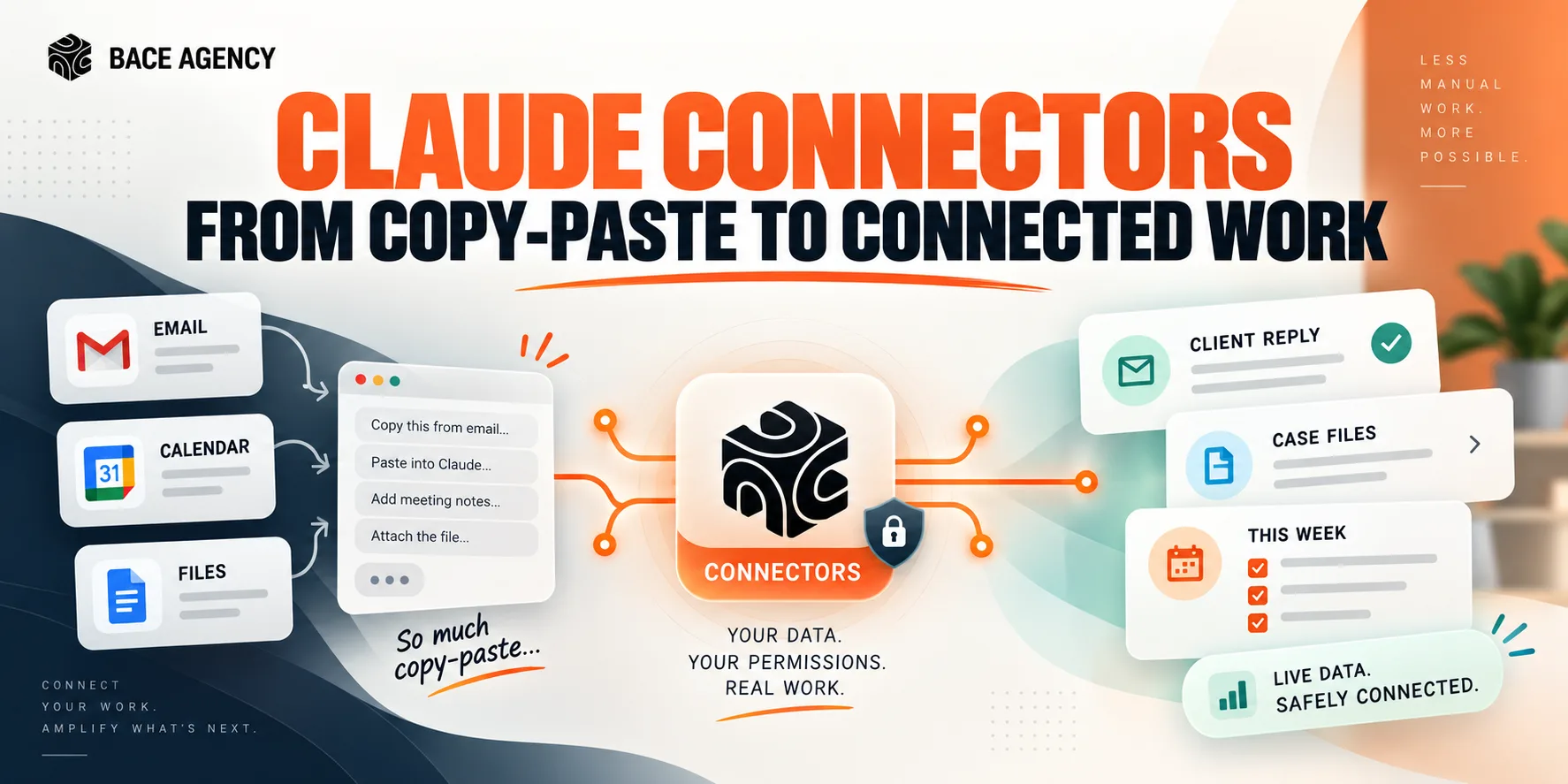
AI stays a clever assistant until it can see your real email, files, and calendar. Connectors are that bridge, and the win depends on connecting narrowly and keeping the writes on approval.
About the author

Written by
Michael Pavlovskyi
Founder, Bace Agency
Michael builds custom Claude and GPT workflows for insurance agencies, law firms, and PE firms on Chicago's North Shore. Speaker at Northwestern and Lake Forest College on practical AI adoption for professional services.
Connect on LinkedInSee it in your firm
Book an audit.
A free 30-minute AI audit. No obligation, no pitch deck.
Book a free AI audit