
How North Shore Firms Cut Contract Review Time
AI handles first-pass clause reading and extraction so your attorneys can spend their time on judgment, not rereading the same patterns.


Key Takeaways
- ✓ Over 90% of legal professionals now use at least one AI tool daily, and the North Shore firms not using AI for first-pass contract review are spending attorney hours on work AI can handle in minutes.
- ✓ Claude reads full contracts in context and can extract key provisions, flag deviations from your standard positions, and summarize terms in plain English before an attorney touches the file.
- ✓ You do not need a developer or IT build to start. A current Claude plan and a clear prompt gets you first-pass review on most routine commercial contracts today.
- ✓ AI-assisted contract review shifts attorney value from reading and extracting to judging and advising, which strengthens both service quality and your ability to offer fixed-fee arrangements.
If your Wilmette or Evanston law firm still runs first-pass contract review the way you did five years ago, you are spending attorney hours on work AI can do in minutes. A large portion of that first pass (spotting missing indemnification clauses, flagging non-standard payment terms, pulling out key dates and obligations) is exactly the kind of structured pattern-matching that current AI models handle well.
According to the 2026 Wolters Kluwer Future Ready Lawyer Survey, over 90% of legal professionals now use at least one AI tool in their daily workflow. The shift is already underway. The question for your practice is not whether this is coming. It is whether you are ahead of it or catching up to firms that already are.
The Real Time Cost of Contract Review
Contract review is not just slow. It is expensive. A senior associate at a Wilmette firm billing at $350 to $400 per hour who spends two to three hours on a routine supply agreement is generating over $1,000 in billable time on a task that is mostly about recognizing familiar patterns in unfamiliar arrangements. Multiply that across a week of incoming agreements and the number gets meaningful fast.
The Wolters Kluwer analysis of legal AI adoption and time savings describes what firm leaders call an "80/20 reversal": before AI, lawyers spent roughly 80% of their time gathering and reading information and 20% on analysis. With AI handling the reading and extraction, those ratios can flip. Attorneys spend more time advising and less time reading.
"Efficiency is doing things right; effectiveness is doing the right things."
Peter Drucker, management theoristContract review, as most North Shore firms still do it, is efficient in Drucker's first sense. Attorneys work carefully and thoroughly. But it is not effective in his second sense when senior attorneys spend hours on first-pass extraction that AI can do in minutes. AI handles the reading so your attorneys can focus on the judgment.
What Claude Actually Does With a Contract
Claude's current context window is large enough to hold a full commercial contract in a single prompt pass. A 40-page commercial lease, a 60-page software licensing agreement, a 30-page vendor services contract: Claude reads the full document and can answer specific questions, extract provisions, flag deviations from a template, or summarize the document in plain English for a non-lawyer.
Here is what your Evanston or Wilmette firm can ask Claude to do with a contract today:
- Extract the parties, governing law, and key dates into a structured table
- Compare the document against your standard contract positions and list every deviation
- Flag unusual liability caps, non-standard indemnification language, or IP assignment clauses
- Summarize the contract in plain English for a client or a non-lawyer reviewer
- Identify missing standard clauses that your firm's form typically includes
Claude explains its analysis and cites the specific contract language behind each finding. The output is reviewable. An attorney reads the AI summary and decides what to do with it. This is not a black box replacing judgment. It is a well-organized first pass that gets the attorney to the judgment call faster.
I covered the agent infrastructure behind multi-step contract workflows in my piece on Claude Managed Agents for Wilmette law practices. The short version: you do not need a custom build to start. A current Claude plan and a structured prompt handles routine first-pass review today.
Three Practical Uses for North Shore Firms
NDA and Standard Agreement Review
For routine NDAs and standard commercial agreements, create a Claude prompt that includes your firm's standard positions and asks Claude to flag any deviation. Upload the contract, run the prompt, review the output. First-pass review for a standard NDA that used to take 45 minutes can be done in under ten.
Best for: real estate practices in Evanston handling commercial lease reviews, corporate practices reviewing vendor agreements, and employment practices reviewing restrictive covenants.
Vendor Contract Intake and Extraction
Many firms receive vendor contracts from clients who need a quick read before signing. Build a prompt that extracts parties and term length, governing law, payment terms, termination provisions, IP ownership, and any unusual clauses. Claude returns a structured summary your attorney reviews in five minutes instead of thirty.
This works well for small-business clients who need fast turnaround on software and service agreements from national vendors.
Client Agreement Baseline Audit
For firms that want to audit their own standard agreements, upload your current client engagement letter or service agreement and ask Claude to identify anything missing compared to current best practice for your jurisdiction and practice area. This is a sound annual exercise for any North Shore firm that has not updated its agreements recently.
Combine with proactive agent workflows to get alerts when new court decisions affect standard clauses you use regularly.
SAMPLE CLAUDE PROMPT
"I am attaching a vendor services agreement my client received. Please do the following: (1) Extract the parties, governing law, contract term, and any automatic renewal provisions into a table. (2) Identify any clauses that deviate from standard positions, specifically around liability caps, indemnification, IP ownership, and data privacy. (3) Flag any missing clauses that a client-protective agreement in this category would typically include. (4) Provide a plain-English summary of the top three issues my client should raise before signing. Cite the specific contract language for each point."
How to Get Started This Week
You do not need a developer, an IT buildout, or a new software subscription to start using AI for contract review. You need a Claude plan, a structured prompt, and the discipline to run it consistently.
| Task | Manual Review | AI-Assisted Review |
|---|---|---|
| First-pass clause read | 45 to 90 minutes | 5 to 10 minutes (review AI output) |
| Key terms extraction | 20 to 30 minutes | Under 2 minutes |
| Deviation from standard | Depends on attorney memory | Compared against uploaded template |
| Client plain-English summary | 15 to 20 minutes | Included in initial output |
| Setup cost | None | One prompt, one Claude plan |
Start with one contract type. Pick your highest-volume routine agreement: the one your attorneys see at least once a week. Write a prompt specifically for it. Include your firm's standard positions. Run three contracts through it and compare the AI output to what your attorneys would have flagged manually. Adjust the prompt until you are satisfied with the coverage. Then roll it out to your team.
If you are not sure where to start with AI readiness across your practice, the Bace Agency AI Readiness Quiz gives you a quick snapshot of where your firm sits today and what to address first.
What the Shift Means for Your Billing Model
If AI cuts review time, what happens to your billing? This is worth addressing directly because the answer shapes how you think about adopting AI inside a firm that still bills by the hour.
The Wolters Kluwer survey found that 62% of legal departments believe AI will significantly reduce the prevalence of the billable hour. That shift is already visible in the in-house market, where teams with AI review are moving toward fixed-fee arrangements for routine contract work. For a North Shore firm, the smarter frame is that AI moves your value proposition up the stack.
You are no longer billing for reading. You are billing for judgment. An attorney who spends 20 minutes reviewing a well-organized AI analysis and makes three strategic recommendations is delivering more client value per hour, not less. Fixed-fee arrangements become more viable when your cost to do routine work drops. That is a genuine competitive advantage in a market where business clients increasingly expect price predictability.
This is the same argument behind our AI consulting practice: firms that move to AI-assisted workflows are not cutting corners. They are delivering the same quality output with more attorney attention on the parts that require an attorney.
For firms ready to see what this looks like in practice, a free 30-minute AI audit is available, in person on the North Shore or on video. No obligation. The output is a one-page plan your team can act on inside a quarter.
Frequently Asked Questions
Can AI review contracts accurately enough for legal use? +
Current AI models like Claude can reliably extract parties, key dates, and standard clauses from commercial contracts and flag deviations from a template you provide. The appropriate role for AI today is first-pass review and structured extraction, not final sign-off. An attorney reviews the AI output and makes the judgment call. This human-in-the-loop model keeps the quality bar where it belongs while recovering significant attorney time on routine review tasks.
What types of contracts work best for AI review? +
AI contract review works best on high-volume, relatively standard agreement types: NDAs, vendor service agreements, commercial leases, employment offer letters, and software licensing agreements. The more standardized the contract type, the more accurately AI can flag deviations from your firm's standard positions. Highly negotiated, one-of-a-kind deal documents still benefit from AI extraction and summarization, but the deviation-flagging step requires a more carefully crafted prompt that includes your typical starting positions.
Do I need an IT department or developer to use AI for contract review? +
No. A current Claude plan and a well-structured prompt is enough to start. You upload the contract, run the prompt, and review the output. No API integration, no custom build, no developer required. Most North Shore firms can run their first AI contract review in under an hour of setup time. The main investment is writing a good prompt for your specific contract type, which you can refine over the first few uses.
How do I protect client confidentiality when using AI for contract review? +
Review your AI provider's data retention and privacy policies before uploading client documents. Anthropic's business and enterprise Claude plans include data-handling terms appropriate for professional services use. For highly sensitive matters, consider redacting party names and identifying information before running a contract through AI review, then applying the findings back to the original. Your firm's professional responsibility rules apply to AI tool selection just as they do to any other vendor relationship.
Will AI contract review replace attorneys at North Shore firms? +
No. AI handles the first pass: reading, extracting, flagging, and summarizing. Attorneys handle the judgment: deciding what the deviations mean, advising the client on risk, and negotiating the terms. The firms that will feel the most pressure are those that bill primarily for reading time without adding analysis on top of it. For practices that lead with judgment and advice, AI strengthens the offering by giving attorneys more time to do exactly that.
Related Articles
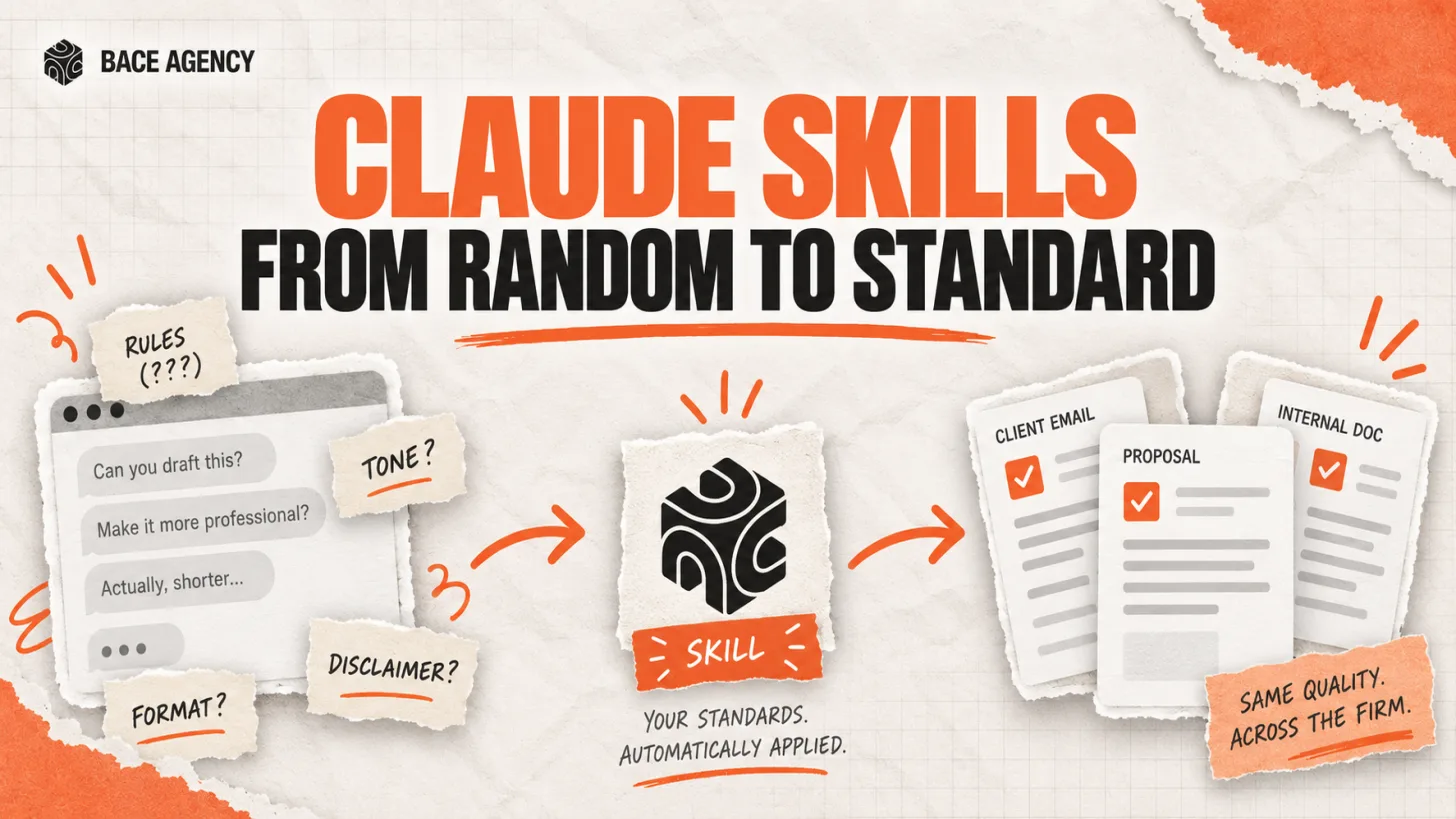
Claude Skills Give a Law Firm One AI Standard
One associate gets sharp drafts, another gets generic filler from the same tool. A Claude Skill turns one person's rules into a standard the whole firm can rely on.
Let AI Agents Handle Intake at Evanston Law Firms
Most Evanston firms still run intake on a phone and a Word template. The firms pulling ahead hand the whole new-matter pipeline to an agent, then review its work before anything reaches the client.

Oregon Federal Court Fines Lawyers $110,000 Over AI
Two lawyers were fined $110,000 for filing AI-invented case citations. The lesson is not to avoid AI. It is to verify it. Here is the workflow that prevents it.
About the author

Written by
Michael Pavlovskyi
Founder, Bace Agency
Michael builds custom Claude and GPT workflows for insurance agencies, law firms, and PE firms on Chicago's North Shore. Speaker at Northwestern and Lake Forest College on practical AI adoption for professional services.
Connect on LinkedInSee it in your firm
Book an audit.
A free 30-minute AI audit. No obligation, no pitch deck.
Book a free AI audit