
AI Is Private Equity's New Return Engine
Easy multiple expansion is over. The next decade of private equity and search fund returns will be won on EBITDA growth, and AI is now the fastest way to produce it.


Key Takeaways
- ✓ Private equity returns come from two things: growing a company's profit and selling it at a higher multiple. The easy part, buying low and riding rising prices, is gone.
- ✓ With multiple expansion off the table, returns now have to be earned through EBITDA growth. AI is the cheapest, fastest lever a firm has to grow it.
- ✓ The largest firms have already moved. Blackstone, KKR, Apollo, and Anthropic are pouring money into exactly this thesis. A North Shore or Chicago fund does not need their budget to copy the idea.
- ✓ For search funds, the math is even better. A searcher buys a small business at a low multiple, grows the earnings with AI, and sells into a higher multiple. That is multiple arbitrage with a tailwind.
If you run a private equity fund or a search fund anywhere from Lake Forest to the Chicago Loop, the way you make money is about to change. For two decades, the private equity model rewarded two things at once: growing a company's earnings, and selling that company for a higher multiple than you paid. AI now sits underneath both, and most firms on the North Shore have not yet priced that in.
I want to make a specific argument in this piece, not a vague one. The argument is that the next decade of private equity and search fund returns will be won on EBITDA growth, that operational improvement is the only return lever still fully in your control, and that AI is the cheapest and fastest way to produce that improvement. This is not a story about a chatbot. It is a story about the return engine itself.
Where Private Equity Returns Actually Come From
Strip away the language and the model is simple. A fund buys a company for a multiple of its profit, usually measured as EBITDA, which is earnings before interest, taxes, depreciation, and amortization. The fund holds the company, grows the profit, pays down debt, and sells. The sale price is the new, larger EBITDA times whatever multiple the next buyer will pay.
Two numbers drive the outcome: the EBITDA, and the multiple. Take the example every dealmaker carries in their head. A company earns two million dollars of EBITDA and sells at ten times, so it is worth twenty million. A few years later that same company earns five million and sells at twelve times. Now it is worth sixty million. The profit grew two and a half times, but the value grew three times. The extra turn came from the multiple. That gap, buying at a lower multiple and selling at a higher one, is what the industry calls multiple arbitrage, and it has quietly done a great deal of the heavy lifting in private equity returns for years.
Here is the problem. That free lift is gone for now. In its Global Private Equity Report 2026, Bain & Company describes purchase multiples that "remain in record territory yet largely stagnant." When prices are already high and not climbing, you cannot count on the next buyer paying more than you did. Bain puts a sharp number on it. A decade ago, a typical deal needed only about 5% annual EBITDA growth to hit a 2.5x return. Today, with less cheap debt and no multiple tailwind, the same expensive deal "only pencils out if you assume much larger increases in EBITDA, something closer to 10% to 12%." Bain's own shorthand for this new world is blunt: twelve is the new five.
If the bar for EBITDA growth has more than doubled, the question every general partner should be asking is where that growth comes from. The data is clear. Gain.pro studied more than 10,000 global private equity investments and found that revenue growth accounted for 54% of value creation, multiple expansion 32%, and margin improvement just 14%. Blue Ridge Partners reaches a similar conclusion and adds a detail that ties the whole thesis together: fast-growing companies command 30% to 50% higher multiples at exit. Grow the business well, and you do not just earn a bigger EBITDA. You earn a better multiple on it too. The arbitrage did not disappear. It moved. It now has to be manufactured through operations rather than handed to you by the market.
There is one more piece of math that makes this urgent, and it is the size premium. Small companies trade at lower multiples than large ones, full stop. A business with a couple hundred thousand dollars of EBITDA might change hands at three to five times earnings. A business earning ten million or more can command eight times or more, because bigger companies look safer to buyers and attract more of them. First Page Sage and Raincatcher both document this gap between small and large company multiples across industries, and the pattern holds by size band. So when you grow a company's EBITDA, you often climb into a higher multiple at the same time. That is the engine. EBITDA up, multiple up, value up twice over. The only question left is how you grow the EBITDA, and that is where AI enters.
What the Big Firms Are Already Doing
I do not ask you to take my word for the thesis. The largest and most sophisticated capital allocators in the world have already bet on it, in public, with real money.
Start with the structural firms. KKR runs an operating unit called Capstone, which, by the firm's own description, has grown to roughly 100 full-time operating professionals who work side by side with portfolio companies to design and execute operational improvements. That unit exists for one reason: to grow EBITDA after the deal closes. It is the institutional admission that the returns are made in the holding period, not at the purchase.
Apollo built the same muscle and pointed it at AI. In a June 2025 case study, MIT Sloan Management Review documented how Apollo's data, digital, and AI team identified what it calls value pools across its portfolio and put AI to work inside operating companies. The results are the part that should stop a North Shore fund manager cold. At the publisher Cengage, MIT Sloan reports costs down 40% in select content production processes, 15% to 20% in lead generation through automation, 15% in customer care, and 10% to 15% in software development. At another Apollo company, Barnes Group, the magazine reports a five-times return on the AI investment in its first year. Those are not slideware projections. They are reported operating results, and they flow straight to EBITDA.
The firms closest to software are the most blunt about it. Orlando Bravo, who runs the software-focused buyout firm Thoma Bravo, told CNBC at an industry conference in June 2026 that AI is "an enormous tailwind for software companies" and said that roughly half of his portfolio's new revenue is now AI or agentic revenue. That is a fund owner describing AI not as a cost to manage but as a growth line on the income statement.
On the sourcing side, EQT has run a proprietary AI platform called Motherbrain since 2016, using data and algorithms to help find and evaluate companies across the investment lifecycle. The point is not the brand name. The point is that a major firm decided, a decade ago, that machine intelligence belonged in the deal process, and built it.
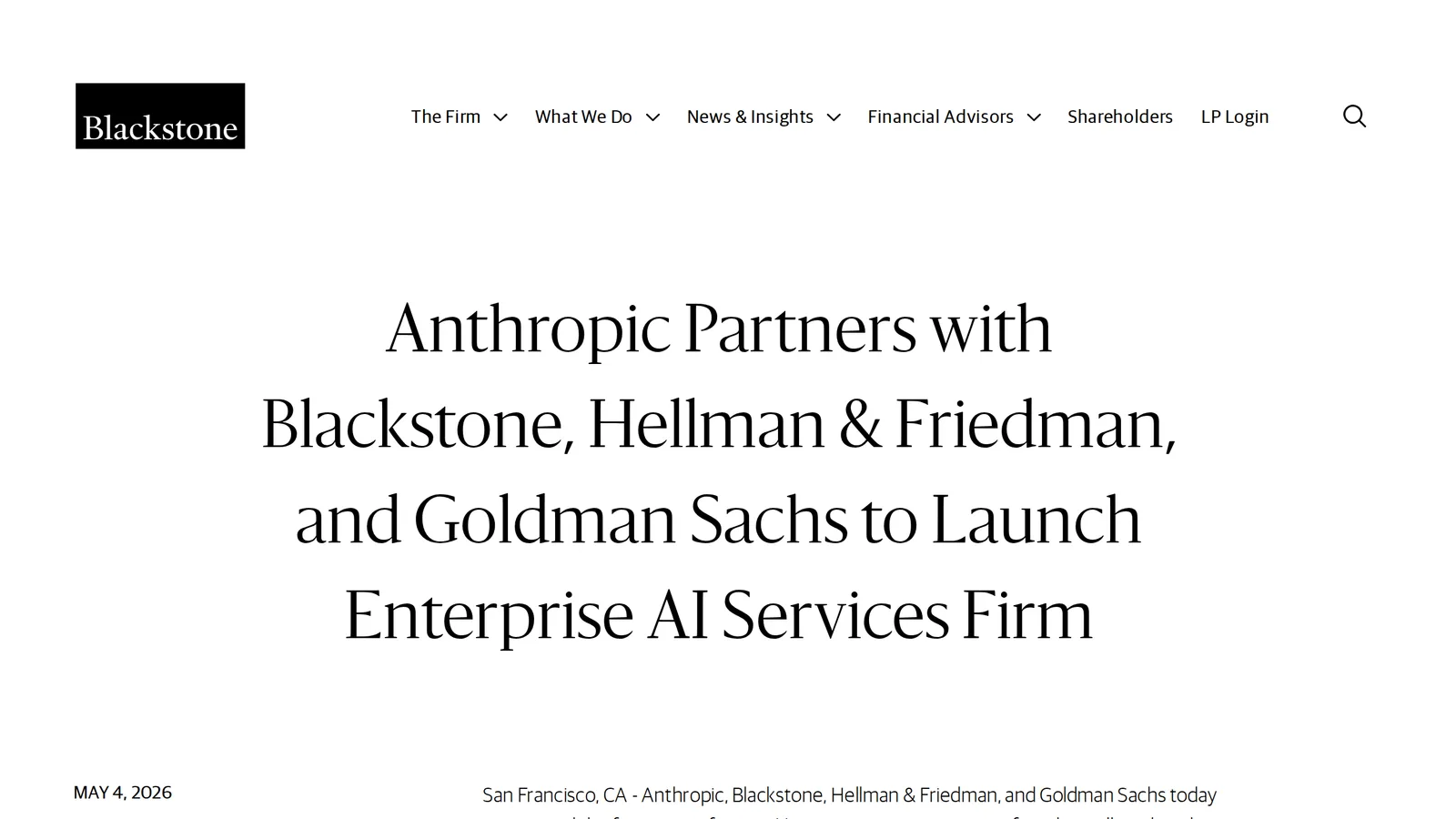
Then came the signal that moved this from trend to thesis. On May 4, 2026, Anthropic, the maker of Claude, announced a roughly 1.5 billion dollar joint venture with Blackstone, Hellman & Friedman, and Goldman Sachs to build an AI-native services firm that embeds Claude inside the operations of portfolio companies, per Blackstone's announcement. The backing list reads like a who's who of private capital: General Atlantic, Leonard Green, Apollo, GIC, and Sequoia all joined, according to CNBC's coverage. When the world's largest alternative asset managers and a frontier AI lab pool more than a billion dollars to put AI inside the companies they own, the strategic question is settled. The only open question is execution, and execution does not require their balance sheet.
"We intend to build a scaled, world-class company to deploy Anthropic's incredible technology."
Jon Gray, President and Chief Operating Officer, BlackstoneWhy This Matters for a North Shore or Chicago Firm
Here is the part that excites me most, and it is the reason I think this moment favors the small firm more than the large one. The best targets for AI-driven EBITDA growth are exactly the kind of businesses that the North Shore and the broader Chicago market are full of: profitable, durable companies with a real moat that have never used AI at all.
Think about what a moat actually is. It is a reason customers stay: a brand, a location, a license, a sticky contract, a relationship built over thirty years. That moat protects the revenue. What it does not do is make the back office efficient. So you find a heating and cooling distributor in the suburbs, or a specialty manufacturer in Chicago, or a regional insurance brokerage, that has commanding market share and a quoting process that runs on a fax machine and three people's memory. The moat is doing its job. The operations are leaving money on the floor.
That is the ideal AI target, because the gap between how the company runs today and how it could run is enormous, and the moat means you can capture that gap without losing customers while you do it. You teach a workforce that has never touched AI to use it well, and the same revenue suddenly carries a much lower cost to produce. Margins widen. EBITDA grows. And because you grew it, the multiple at exit can climb too. A business that was a sleepy three-times-earnings asset becomes a fast-growing, well-run company that a strategic buyer or a larger fund will pay a real premium for. That is the whole thesis in one company.
The leverage is operational, not financial. The work splits into three places, and AI moves all three.
Cost out. This is the most direct path to EBITDA. The repetitive, rules-based work inside any company, processing invoices, drafting routine documents, answering common customer questions, reconciling reports, summarizing contracts, can be handled or accelerated by AI tools your team already has access to. The Cengage numbers above are the proof of scale. You do not need a forty percent cut to change a deal. A small fund holding a company with two million dollars of EBITDA and a million dollars of addressable back-office cost can move the EBITDA needle by a meaningful fraction in a single year, and that fraction compounds at the exit multiple.
Revenue up. Remember that revenue growth, not cost-cutting, is the largest driver of value creation. AI helps here by giving a small commercial team the reach of a much larger one: faster lead qualification, better follow-up, sharper pricing, quicker proposals. The Apollo case study reports 15% to 20% gains in lead generation through automation at one company. For a moaty business that has simply never marketed or sold systematically, the upside is larger, not smaller.
Diligence faster. Before you even own the company, AI compresses the front of the deal. Reading a data room, summarizing contracts, building comparable-company sets, drafting the investment committee pre-read: this is work that used to consume an associate for a week and now takes an afternoon, with a human checking every claim. Thomson Reuters reports that AI can cut document review time in due diligence by up to 70%. Lower diligence cost means you can look at more deals, kill the bad ones faster, and spend your scarce judgment on the few that matter.
None of this requires a custom software build or a data science hire. It requires picking the right workflow, putting a capable model behind it, and teaching the team to use it. That is the work, and it is the work I do.
SAMPLE CLAUDE PROMPT
"You are an operating advisor to a private equity firm that just bought a profitable, family-run distribution business with 2 million dollars of EBITDA. The company has never used AI.
1) Ask me about its core workflows, headcount by function, and where staff spend the most repetitive hours.
2) Map the three workflows where AI would add the most to EBITDA in the first year, separating cost reduction from revenue growth.
3) For each, estimate the order of magnitude of the impact and the change-management risk.
4) Flag anything that should stay fully human.
Give me a one-page plan I can take to the management team next week."
The Search Fund Angle
Everything above applies to private equity at any size. But there is one corner of this market where the thesis is even sharper, and it is one I think Chicago and the North Shore are well suited for: search funds, also called entrepreneurship through acquisition, or ETA.
A search fund is a single operator, usually a recent MBA or an experienced manager, who raises a small amount of capital to find and buy one good small business, then runs it. The returns on this model are, frankly, remarkable. The 2024 Stanford Search Fund Study, which covers 681 funds formed since 1984, reports an aggregate pre-tax internal rate of return of 35.1% and a 4.5x return on invested capital as of the end of 2023. For the funds that have already exited, the numbers are higher still. Those returns are not an accident of leverage. They come from buying small and operating well.
Now layer the size premium on top. A searcher typically buys a business at three to six times EBITDA, because small businesses trade cheaply, and aims to sell a larger, more professional company into a higher multiple. That is multiple arbitrage in its purest form, and the searcher captures all of it because there is one owner, not a fund of LPs splitting the upside thinly. The entire return depends on growing the EBITDA of one company during the hold. There is no other lever.
This is why AI may matter more to a searcher than to anyone else in this article. A search fund has a team of one, maybe two, sitting on top of a business that has never been modernized. Every hour of repetitive work the operator can hand to AI is an hour returned to growth, sales, and the handful of decisions only the owner can make. The operator who teaches the existing staff to use AI well does not just trim cost. They change the trajectory of the one asset their entire return rides on. If you are a searcher in Chicago who just closed on a business, the first ninety days are the highest-leverage window you will ever have to set this up. I wrote separately about how a new ETA operator can use AI to grow revenue after closing, and the logic there sits underneath this whole piece.
How to Get Started
The thesis is only useful if it turns into action. Here is the sequence I would run for a fund or a searcher who wants the EBITDA gain without a science project.
Pick one company and one number
Do not roll AI across the portfolio at once. Choose one portfolio company, ideally one with a strong moat and tired operations, and pick the single number you want to move: a cost line, a margin, a sales-cycle length. The narrower the target, the faster the win and the cleaner the proof.
Map the work, then teach the people
Find the repetitive workflows where the team spends hours that do not require judgment. Put a capable AI tool behind those workflows, with a human review step on anything client-facing. Then spend real time training the staff. A tool nobody uses returns nothing, no matter how good it is. The training is not the overhead. It is the investment.
Measure it in EBITDA, then compound it
Track the gain where it counts, on the P&L, not in vague productivity claims. Once one company shows a real EBITDA improvement, you have a playbook. Carry it to the next portfolio company, and the next. That is exactly how KKR Capstone and Apollo's team operate: a lesson learned at one company travels to the rest.
What This Does Not Replace
I would be doing you a disservice if I pretended AI changes everything. It does not. A few things stay exactly where they were.
It does not replace the deal or the relationship. The mid-market business sells to the buyer the owner trusts. The price negotiation, the structuring, the moment a portfolio company misses plan and someone has to be in the room: those are human jobs and will stay human jobs.
It does not replace judgment. An AI model can draft an investment committee pre-read in thirty minutes, but whether the facts in it add up to a thesis is still the partner's call. The model produces inputs. People make decisions. A firm that confuses the two will lose money, because the output of a capable model reads like the work of a smart analyst even when it is wrong. Every claim that reaches a decision-maker has to be verified by a person, not skimmed.
It does not remove the need for care with data. A fund runs on confidential, often NDA-bound information. The mitigation is not to avoid AI. It is to use enterprise-grade tools with proper data handling and a clear internal rule about what information goes where. I wrote about how firms get this right in why security fears kill more AI projects than actual breaches.
And it does not, by itself, raise your multiple. A higher multiple comes from durable, well-run, growing earnings. AI is how you produce those earnings faster and at lower cost. The multiple follows the quality of the business, as it always has.
If you run a fund or a search around Lake Forest, Highland Park, Winnetka, or anywhere in the Chicago market and you want to find the EBITDA hiding in a portfolio company, a free 30-minute AI audit is the place to start. It is available in person on the North Shore or by video, with no obligation, and the output is a plain plan for the first workflow worth automating.
Frequently Asked Questions
How does AI actually increase a portfolio company's EBITDA? +
Two ways. It lowers cost by handling repetitive back-office work such as document drafting, invoice processing, customer questions, and reporting, which cuts the cost of producing the same revenue. And it grows revenue by giving a small commercial team more reach in lead generation, follow-up, and pricing. MIT Sloan reported one Apollo portfolio company cut costs 40% in select processes and improved lead generation 15% to 20% through automation. Both effects flow straight to EBITDA.
What is multiple arbitrage, and why does AI matter to it? +
Multiple arbitrage is buying a company at a lower multiple of earnings than you sell it for. Small companies trade cheaply, often three to five times EBITDA, while larger, faster-growing companies command eight to twelve times or more. When you grow EBITDA, you often climb into a higher multiple at the same time, so the value rises twice. AI matters because, with easy market-driven multiple expansion gone, growing EBITDA through operations is now the main way to manufacture that arbitrage yourself.
Are search funds better positioned for AI than large private equity? +
In some ways, yes. A search fund is one operator running one small business whose entire return depends on growing that single company's EBITDA. There is no other lever and no LP base splitting the upside. The Stanford 2024 Search Fund Study reports a 35.1% aggregate IRR across 681 funds. AI returns the operator's scarce hours to growth and modernizes a business that has often never used it, which is exactly the high-leverage situation AI rewards most.
Do I need a custom software build or a data science team to do this? +
No. The first wave of value comes from putting capable, off-the-shelf AI tools behind your existing workflows and training the team to use them well, with a human review step on anything client-facing. Picking the right first workflow and getting staff adoption matter far more than any custom build. The build, if it ever happens, comes later, once a workflow has proven its value.
What kind of business is the best target for AI-driven EBITDA growth? +
A profitable company with a real moat, such as a brand, a location, a license, or sticky relationships, that has never used AI. The moat protects the revenue while you modernize the operations, so you can capture a large efficiency gain without losing customers. The wider the gap between how the company runs today and how it could run, the bigger the EBITDA opportunity. The North Shore and Chicago are full of exactly these businesses.
Related Articles

RoundTable Buys a Skincare Brand, and Healthcare Private Equity Meets AI
A Lake Forest firm just bought a skincare brand. The deal is a window into where healthcare private equity is heading with AI, and why it is a strategy problem first.

Lake Forest Hire: Can the Back Office Scale with AI?
Crescent Grove named a 25-year family-office veteran its growth chief. A rainmaker brings relationships. The harder question is whether the back office can scale as fast as the book.
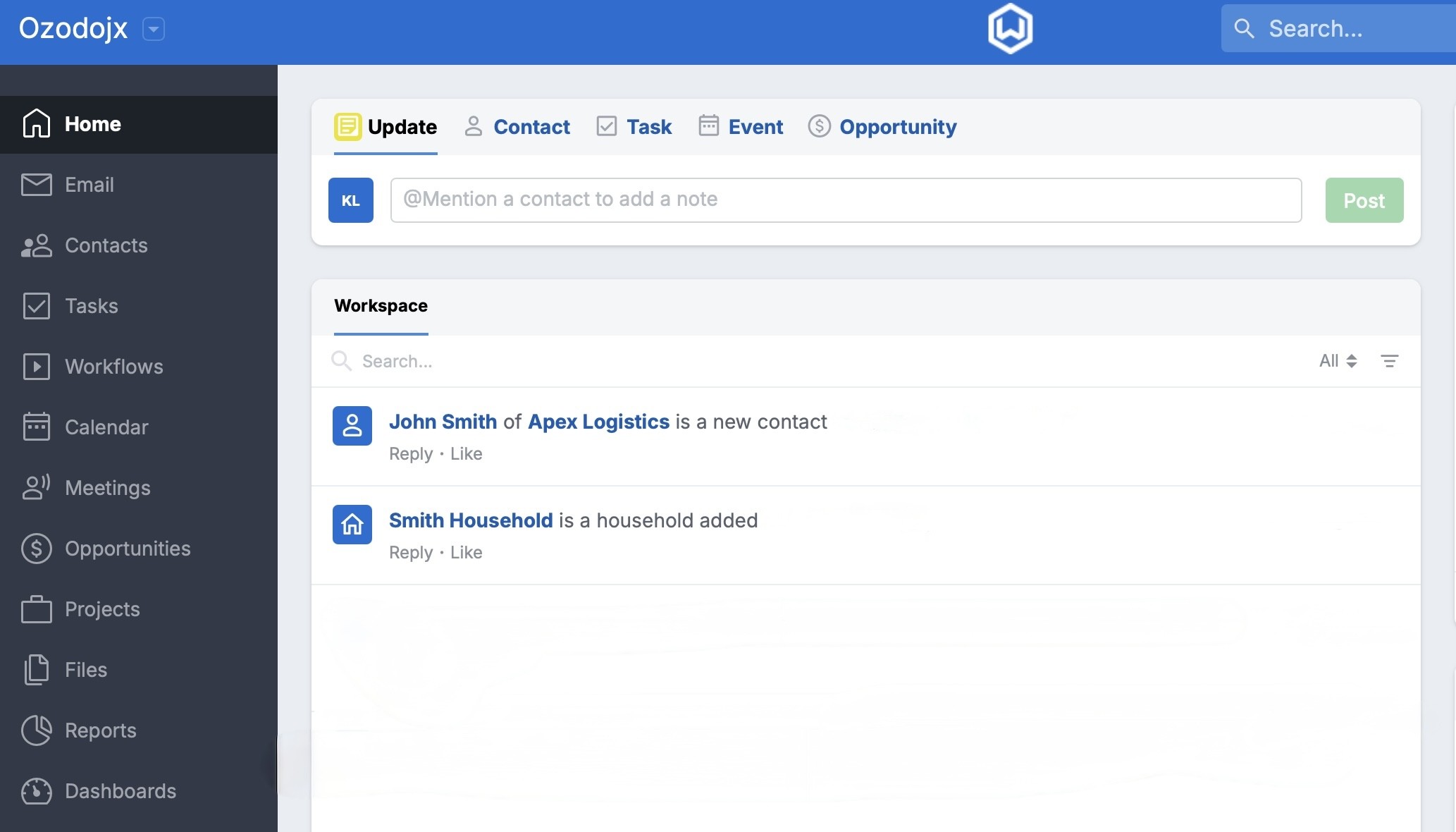
When a CRM Is Truly AI-Ready for RIAs
Every CRM demo now says AI. The question that matters is simpler: can a model read your client data and write back to it, under your control? Here are the three tests.
About the author

Written by
Michael Pavlovskyi
Founder, Bace Agency
Michael builds custom Claude and GPT workflows for insurance agencies, law firms, and PE firms on Chicago's North Shore. Speaker at Northwestern and Lake Forest College on practical AI adoption for professional services.
Connect on LinkedInSee it in your firm
Book an audit.
A free 30-minute AI audit. No obligation, no pitch deck.
Book a free AI audit