
When a CRM Is Truly AI-Ready for RIAs
The badge on the box tells you nothing. The open API, the structured data, and the audit trail tell you everything.

Key Takeaways
- ✓ An AI-ready CRM for RIAs is one a model can read from and write to through an open API, not one with an "AI" label on the box.
- ✓ The three tests are an open API, structured and exportable data, and an audit trail that logs every AI action inside your system of record.
- ✓ Built-in vendor AI helps, but it runs only inside that vendor. Open access lets you bring any model, including a private one, to your own data.
- ✓ SEC Rule 204-2 still applies. Every AI-generated client record has to be preserved, true, and complete for five years, so the CRM must log what the model did.
If you run a wealth management practice in Winnetka, you have probably sat through a CRM demo where every other slide said "AI." The question that matters is simpler than the pitch. Can a model actually read your client data and write back to it, under your control? That is what makes a CRM AI-ready for RIAs, and most of the badges you see do not answer it.
I get asked some version of this every month: which CRM should we buy if we want to do real AI work later? The honest answer is that the AI features in the demo barely matter. What matters is whether the system will let an outside model reach your data on your terms. A few do that well. Several do not, and you cannot tell from the marketing.
What Makes a CRM "AI-Ready" for an RIA?
An AI-ready CRM is a system whose client data a model can access and update through an open, permissioned connection, not just a CRM that ships its own chatbot. The difference is access. A chatbot answers questions inside the vendor's walls. An open connection lets the model you choose work directly with your records and write results back where your team already works.
Three tests separate the ready from the merely labeled. First, an open API: a documented, supported way for outside software to read and write records. Standards like Anthropic's Model Context Protocol, an open way to connect models to the systems where data lives, make this far easier than it was two years ago, but only if the CRM exposes the door. Second, structured data: clean fields you can export and feed back, not notes buried in free text. This is the same plumbing that makes AI document processing for financial advisors work at all. Third, an audit trail: a log that records what the model read, what it changed, and when.
Most CRMs pass one or two of these. The ones worth buying pass all three, because the third is what keeps you compliant when an AI workflow starts touching real client files.
Why an "AI" Badge Is Not the Same Thing
A built-in AI feature and an AI-ready CRM are not the same purchase. Built-in AI is the vendor's model doing the vendor's tasks inside the vendor's product. Wealthbox, for example, rolled out an AI notetaker in 2025 and AI agents in 2026. For basic tasks, summarizing a meeting or flagging an overdue follow-up, those built-in tools are fine, and they keep the record logged and auditable.
The catch is the ceiling. Built-in AI runs only on that vendor's model and only inside that vendor's walls. The moment you want a workflow the vendor did not build, a private model, or client data kept on hardware you own, the built-in feature cannot follow. It has quietly locked you into one company's roadmap.
This is the work Bace Agency does: connecting private, custom AI workflows to the CRM a firm already runs, without tying the firm to one vendor's roadmap. We do not replace your system of record. We build on top of it. A small RIA that wants its own repeatable playbooks, the way you can build an AI playbook with Claude Skills, needs that open door, not another badge.
"Buy the open door, not the badge. The badge ages in a year. The open door is still useful when the next model ships."
Michael Pavlovskyi, Bace AgencyThe trap is lock-in dressed up as convenience. A CRM that does AI nicely but exports nothing cleanly has made a quiet decision for you: your data works with their model and no other. For a practice that plans to do this for a decade, that is the expensive choice, even when it demos well.
Which RIA CRMs Are the Most AI-Ready?
The most-used CRMs among independent RIAs are Redtail and Wealthbox, according to the annual T3 advisor software survey. Usage is not the same as AI readiness, though. The table below scores the common options on the three tests, in general terms. Confirm the current state with each vendor before you sign, because these products change fast.
| CRM | Open API | Structured data | Audit trail | Best fit |
|---|---|---|---|---|
| Wealthbox | Modern REST API, native AI agents | Clean, exportable fields | Logged in system of record | Independent RIAs wanting AI without heavy setup |
| Salesforce Financial Services Cloud | Most open and extensible | Strong, highly configurable | Enterprise-grade | Larger firms with technical staff and budget |
| Redtail (Orion) | API available, deep integrations | Good, some legacy structure | Standard logging | Established practices already in the Orion stack |
| AdvisorEngine | API available, growing | Reasonable | Standard logging | Firms wanting CRM plus performance reporting together |
The pattern: the heavier, pricier platforms tend to be the most open, and the lighter ones are catching up fast with built-in AI. No matter which of these CRMs you run, Bace Agency builds the custom API integrations and private AI infrastructure to make it truly work for your specific practice. There is no single wrong choice in the table above. There is only the right setup for how your practice actually runs, which is the whole point of mapping what AI agents actually do for an advisory practice before you commit.
Use Case 1: Monday Meeting Prep
Turn last quarter's notes and current holdings into a one-page brief before the review.
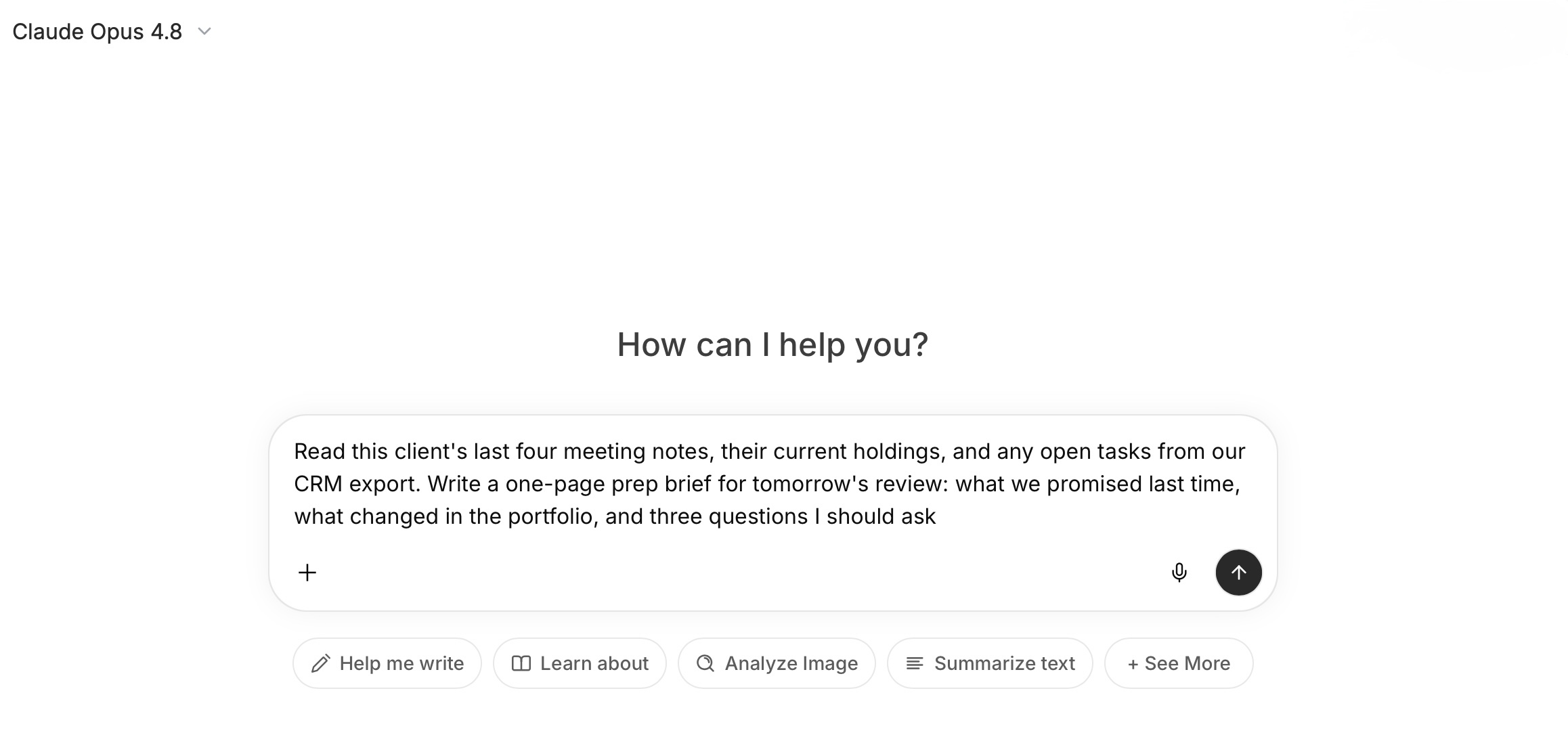
An advisor preparing for a client review could point a model at that household's recent notes, current positions, and open tasks, and get a prep brief that says what was promised last time, what changed in the portfolio, and what to ask. The work is reading and assembling, which a model does well. The judgment stays with the advisor.
SAMPLE CLAUDE PROMPT
"Read this client's last four meeting notes, their current holdings, and any open tasks from our CRM export. Write a one-page prep brief for tomorrow's review: what we promised last time, what changed in the portfolio, and three questions I should ask."
Use Case 2: Intake Into the CRM
Turn a messy prospect packet into clean fields ready for the contact record.
New prospect information arrives as forms, emails, and forwarded statements. A model can pull the household, accounts held away, stated goals, and risk notes out of that mess and format them as CRM fields, flagging what is missing. This is the same intake discipline behind a working AI client intake workflow, applied to the CRM record itself.
SAMPLE CLAUDE PROMPT
"Here is a new prospect's intake form and the email thread. Extract their name, household members, accounts held away, stated goals, and risk concerns. Format it as fields ready to paste into our CRM contact record, and flag anything missing."
Use Case 3: Compliance-Safe Follow-Up
Draft the recap email from the meeting note, with nothing invented and nothing that needs a license.
After a meeting, a model can draft the follow-up email using only the facts in the note, leave out anything that reads as investment advice, and mark what needs the advisor's review before it goes out. The draft is faster. The send is still a human decision, which is exactly where it belongs.
SAMPLE CLAUDE PROMPT
"Draft a follow-up email to this client summarizing what we discussed. Use only facts from the attached meeting note. Do not give specific investment advice. Mark anything that needs my review before it goes out."
What an AI-Ready CRM Does Not Replace
An open, AI-ready CRM moves work to the model. It does not move responsibility. The advice, the suitability call, and the relationship stay with the licensed advisor. A model can assemble a prep brief; it cannot decide what to recommend.
It also does not erase your recordkeeping duty. SEC Rule 204-2 requires RIAs to keep accurate client records, preserved against alteration and producible in full for five years. If a model is drafting notes and updating fields, those AI-touched records fall under the same rule, which is why the audit trail is not optional. Examiners are already focused on this, as we covered in our read on what the SEC actually checks on AI for investment advisers.
Here is the practical next step. Before your next CRM renewal, ask the vendor three questions in writing: Do you offer a documented API that can read and write records? Can we export our full data in structured form? Does the system log every AI action for our books and records? The written answers tell you more than any demo.
Then hand those answers to someone who builds on them for a living. Reading API documentation is not how a Winnetka advisor should spend a Tuesday, and the gap between a CRM that can support AI and one that actually does is where most firms stall. That is the work we do at Bace Agency. Start with our AI readiness quiz for a fast read, then book a free 30-minute AI audit, in person on the North Shore or by video. We will tell you exactly what your current stack can and cannot do, and what it would take to close the gap.
Frequently Asked Questions
What does "AI-ready CRM" mean for an RIA? +
An AI-ready CRM is one a model can read from and write to through an open, permissioned API, with structured data you can export and an audit trail that logs every AI action. A CRM that only ships a built-in chatbot is not the same thing, because that AI runs only inside the vendor's product.
Is Wealthbox or Salesforce better for AI? +
It depends on the firm. Wealthbox offers built-in AI agents and a modern API that suit independent RIAs wanting results without heavy setup. Salesforce Financial Services Cloud is more open and configurable but needs technical staff and a larger budget, which fits enterprise firms. Both can be made AI-ready; the right choice follows how your practice actually runs.
Does using AI with my CRM create SEC compliance problems? +
Not on its own, but the records it touches still fall under SEC Rule 204-2. Any client record a model drafts or updates must be preserved, true, complete, and producible for five years. That is why an audit trail in your system of record matters: it shows what the model did and keeps your books and records defensible in an examination.
Do I need to switch CRMs to use AI? +
Often not. If your current CRM has a documented API, clean exportable data, and proper logging, you can connect AI workflows without replacing it. Switching only makes sense when the system fails one of those three tests and the vendor has no path to fix it. Test what you own before you buy something new.
Related Articles

RoundTable Buys a Skincare Brand, and Healthcare Private Equity Meets AI
A Lake Forest firm just bought a skincare brand. The deal is a window into where healthcare private equity is heading with AI, and why it is a strategy problem first.

Lake Forest Hire: Can the Back Office Scale with AI?
Crescent Grove named a 25-year family-office veteran its growth chief. A rainmaker brings relationships. The harder question is whether the back office can scale as fast as the book.
We Spent $20,000 to Run AI Locally
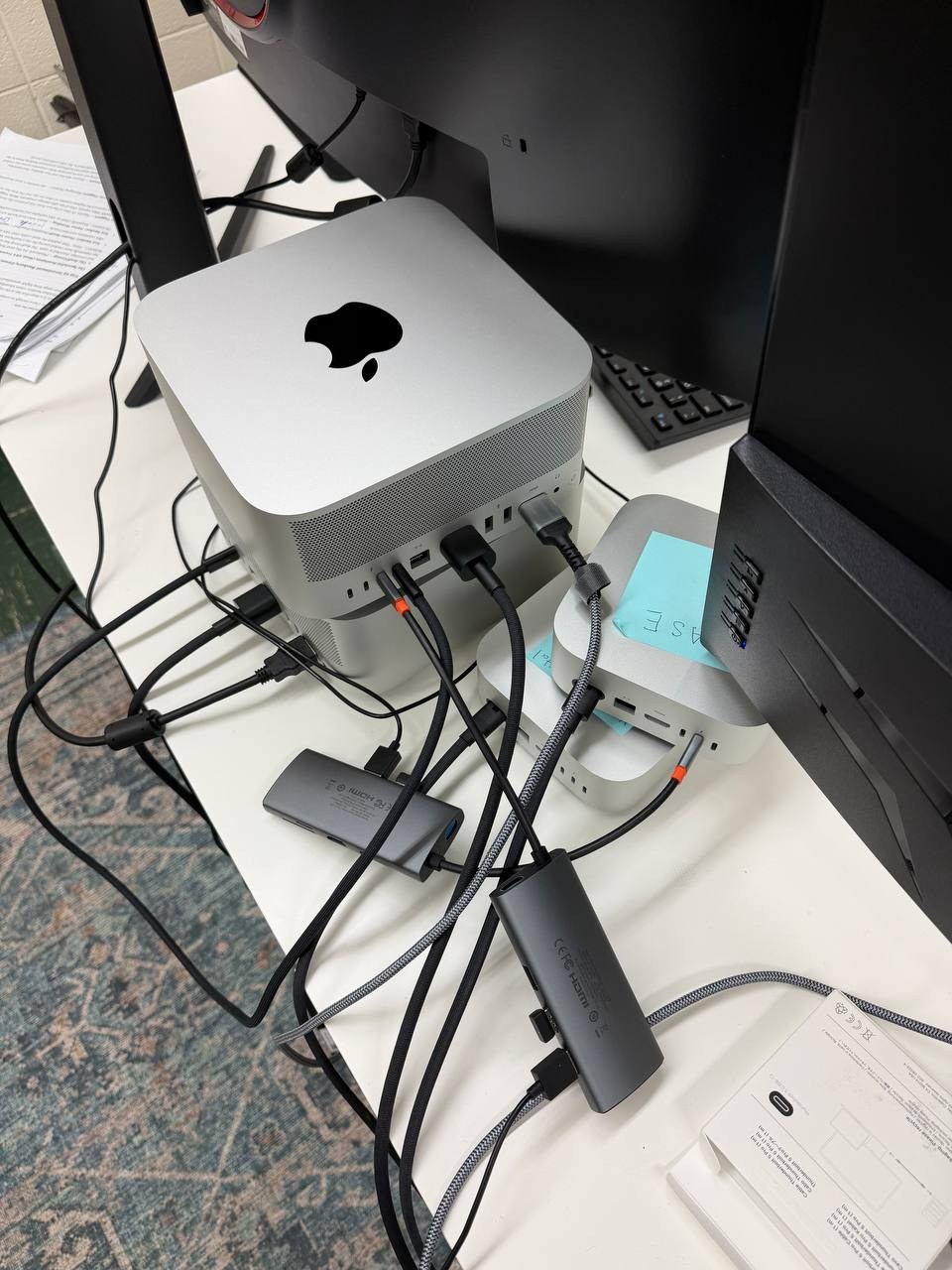
We bought two Mac Studios to run open models in house and stop renting AI by the token. The hardware worked. The economics, and the intelligence gap, did not.
About the author

Written by
Michael Pavlovskyi
Founder, Bace Agency
Michael builds custom Claude and GPT workflows for insurance agencies, law firms, and PE firms on Chicago's North Shore. Speaker at Northwestern and Lake Forest College on practical AI adoption for professional services.
Connect on LinkedInSee it in your firm
Book an audit.
A free 30-minute AI audit. No obligation, no pitch deck.
Book a free AI audit