
Legal AI Has a Mid-Market Problem
Harvey and Spellbook serve opposite ends of the legal market, leaving mid-sized North Shore firms to figure out where they fit before they spend a dollar.


Key Takeaways
- ✓ Harvey requires a 20-seat minimum and roughly $288,000 per year, making it inaccessible for most North Shore firms with fewer than 20 attorneys.
- ✓ Spellbook excels at AI contract redlining inside Microsoft Word but lacks deep legal research capability and is limited to Word-based document workflows.
- ✓ Mid-market firms should evaluate CoCounsel, Clio AI (Vincent), and Lexis+ AI first, as these tools fit smaller teams without large minimum commitments.
- ✓ Start by identifying your three most time-consuming document or research tasks, then test tools against those use cases before signing any vendor agreement.
If you run a law firm in Lake Forest, Wilmette, or Evanston with 5 to 20 attorneys, the two most-discussed legal AI vendors are probably not built for you. Harvey was designed for the Am Law 100. Spellbook was designed for contract lawyers who live in Microsoft Word. Neither one quite fits the mid-market practice that handles real estate closings, business disputes, estate plans, and employment matters under one roof. This article puts the two side by side and explains where the gap is, so you can make a faster, better-informed decision.
Harvey Is Built for Enterprise
Harvey is the most well-funded legal AI vendor in the market. The company raised $160 million in a Series F round in late 2025, led by Andreessen Horowitz, pushing its valuation to roughly $8 billion, according to TechCrunch's coverage of the round. More than 142,000 legal professionals across 1,300 organizations use the platform today, including more than 50 Am Law 100 firms. DLA Piper expanded to 5,000 licenses in early 2026.
What Harvey actually does is closer to a research and analysis layer for large, complex matters. You can ask it to analyze hundreds of documents at once, surface precedents across case law, draft complex filings, and run purpose-built agents for end-to-end legal workflows. The platform integrates with legal databases and handles multi-jurisdiction research at a scale that most boutique practices never need. According to Harvey's profile on Wikipedia, it is tailored specifically for leading law firms and Fortune 500 legal departments, not general practitioners.
The pricing reflects that positioning. A detailed Harvey pricing review at LawXY AI puts the platform at roughly $1,200 per lawyer per month, with a minimum of 20 seats and a 12-month commitment. That floor sits around $288,000 per year before any custom training or implementation fees. For a 10-attorney estate and business firm in Lake Forest, that number ends the conversation before it starts. If a vendor quotes you Harvey for a small practice, ask why you need 20 seats and what implementation looks like on your team.
Spellbook Is Built for Contracts
Spellbook takes the opposite approach. It works inside Microsoft Word, which is where most transactional lawyers already spend their day. Rather than replacing your research workflow, Spellbook focuses on making the document in front of you better, faster.
The core capability is AI redlining. Spellbook reads the contract you have open, flags missing clauses, surfaces risky terms, and suggests alternative language, all using Word's native Track Changes so nothing looks foreign to the other side. It benchmarks terms against a library of more than 2,300 contract types by sector and jurisdiction, so when a counterparty pushes unusual indemnification language, you get a fast read on whether the ask is market. The platform also handles multi-document workflows for M&A data rooms and financing packages.
More than 4,500 legal teams now use Spellbook, according to the company. It has SOC 2 Type II certification and runs on a mix of leading AI models, including GPT-5 and Claude, under the hood. Enterprise pricing is no longer publicly listed, but public reporting places it around $350 per user per month with a six-month minimum commitment. If your practice is heavy on commercial contracts, business acquisitions, or real estate documentation, Spellbook fits well. For a closer look at where Evanston attorneys lose billable time, the data suggests contract work and follow-up are the two biggest drains, which is exactly where Spellbook helps. The constraint is that it is a Word-only tool. If your work is research-heavy or litigation-focused, that boundary matters.
The Mid-Market Gap
The gap between these two tools is real and worth naming directly. Harvey prices out most firms under 20 attorneys. Spellbook covers contracts but does not do deep legal research. Neither addresses the full range of what a general practice or boutique litigation firm handles on a given day.
| Tool | Best For | Starting Price | Minimum Commitment | Core Strength | Key Limitation |
|---|---|---|---|---|---|
| Harvey | Am Law 100, large in-house teams | ~$1,200/seat/mo | 20 seats, 12 months (~$288K/yr) | Deep research, document agents, scale | Out of reach for firms under 20 attorneys |
| Spellbook | Transactional practices, contract-heavy work | ~$350/user/mo (enterprise) | 6-month commitment | AI redlining in Word, clause benchmarking | Word-only, limited legal research depth |
| CoCounsel (Thomson Reuters) | Mid-market firms, research-heavy practices | ~$225/mo | Monthly or annual, no seat floor | Legal database integration, drafting | Broader but less specialized than either above |
| Clio AI (Vincent) | Firms already on Clio for practice management | Included in select Clio plans | Existing Clio subscription | Integrated with billing and matter management | Only valuable if your firm is already on Clio |
The tools that fill the mid-market space most naturally are CoCounsel, Clio AI (Vincent), and Lexis+ AI. According to a guide on Harvey alternatives for smaller law firms, CoCounsel Core starts around $225 per month and draws on Thomson Reuters' existing legal database, so research returns actual case law rather than results trained on the general web. Lexis+ AI layers AI drafting and research onto an existing Lexis subscription, which many mid-market firms already carry. Both handle the research-heavy work that Spellbook does not.
$288K+
Harvey annual floor for a 20-seat firm
4,500+
legal teams using Spellbook globally
~$225
CoCounsel Core starting price per month
What to Do This Week
Here is where I think most firms get this wrong: they start with the vendor and work backward to the use case. Start with the use case. Write down the three most time-consuming document and research tasks in your firm. Not all legal work, just the tasks that create the most friction week after week. Then test whether the tools above handle those three things before you sign anything.
For contract-heavy practices doing commercial leasing, business acquisitions, or financing work, Spellbook is worth a seven-day trial. For firms that need deep legal research as part of daily work, CoCounsel or Lexis+ AI is the better spend. For firms already on Clio, Vincent is the logical first test because there is no new platform to learn. If you want to see how Lake Forest firms are running AI without expensive API builds, the short answer is that the consumer tools available today handle more than most attorneys expect before they try.
If you want to test AI-assisted legal drafting before committing to any vendor, here is a starting prompt worth running on a real clause from a current matter:
SAMPLE CLAUDE PROMPT
"Review the following contract clause and tell me: (1) Is this language standard for a commercial agreement in Illinois? (2) What risks does it create for my client as the party accepting these terms? (3) Suggest revised language that protects my client without being so aggressive that it kills the deal. [Paste clause here]"
Claude does not replace a specialized legal AI platform for high-volume contract work. But it is a capable first test for a firm that wants to see whether AI drafting assistance fits before paying for a dedicated product. The firms that gain the most are usually the ones that run a real matter through a free tool first, learn what AI can and cannot do in their practice, and then buy the right product with that knowledge in hand.
"The companies that figure out how to use AI well are going to have an enormous advantage over the ones that wait for perfect clarity before starting."
Sam Altman, CEO of OpenAI, on AI adoption speedThe legal AI market is moving fast enough that any pricing comparison is worth rechecking every six months. What does not change is the evaluation framework. Match the tool to the work. If your firm does 30 contract reviews a month, Spellbook is worth the cost. If you do 30 research memos, CoCounsel is the better spend. If you do both at meaningful volume, you may need a combination, or a more general workflow built on top of Claude or another foundation model. The AI services Bace Agency provides to North Shore law firms often start exactly here: figuring out which tools to buy, which to skip, and which workflows to automate before spending on enterprise software.
If you want to work through this decision for your specific practice, take the AI Readiness Quiz at Bace Agency to get a baseline, or schedule a free 30-minute AI audit and we will walk through the tools that make sense for your size and work mix.
Frequently Asked Questions
Is Harvey AI worth it for a small North Shore law firm? +
No, for most North Shore law firms with fewer than 20 attorneys. Harvey requires a minimum of 20 seats and a 12-month commitment, which puts the annual floor at roughly $288,000 before implementation costs. It is built for Am Law 100 firms and Fortune 500 legal departments. A 5-to-15-attorney practice in Lake Forest or Evanston will find better fit and significantly lower cost in tools like CoCounsel, Clio AI (Vincent), or Lexis+ AI.
What is Spellbook best used for in a law firm? +
Spellbook is best for transactional practices that spend significant time redlining and drafting contracts inside Microsoft Word. It flags missing clauses, surfaces risky terms, suggests alternative language using Word's native Track Changes, and benchmarks terms against more than 2,300 contract types. It is less useful for litigation-heavy or research-intensive practices because it is a Word-only tool without deep legal research capability.
What are the best legal AI tools for mid-market law firms in 2026? +
For mid-market firms with 5 to 20 attorneys, the most practical options are CoCounsel Core (from Thomson Reuters, starting around $225 per month with legal database integration), Clio AI or Vincent (if your firm already uses Clio for practice management), Lexis+ AI (if you have an existing Lexis subscription), and Spellbook (for contract-heavy practices). These tools do not require the 20-seat minimums or six-figure commitments that Harvey demands.
How does CoCounsel compare to Harvey for small firms? +
CoCounsel is the more accessible option for smaller firms. It draws on Thomson Reuters' existing legal database for research, starts around $225 per month, and does not require a large seat minimum. Harvey is more powerful for complex, high-volume enterprise use cases but requires a minimum commitment of around $288,000 per year. For a firm with fewer than 20 attorneys, CoCounsel covers the research and drafting use cases that matter most at a fraction of Harvey's cost.
Can a North Shore law firm use Claude directly for legal work instead of buying a dedicated platform? +
Yes, as a starting point. Claude can review contract clauses, flag risks, suggest redlines, and assist with research questions directly in the consumer interface at $20 per month. It does not have the specialized legal database integrations that CoCounsel or Spellbook offer, and it is not designed for high-volume document workflows. But for a firm testing whether AI drafting assistance is useful before committing to a vendor contract, Claude is the right first stop.
Related Articles
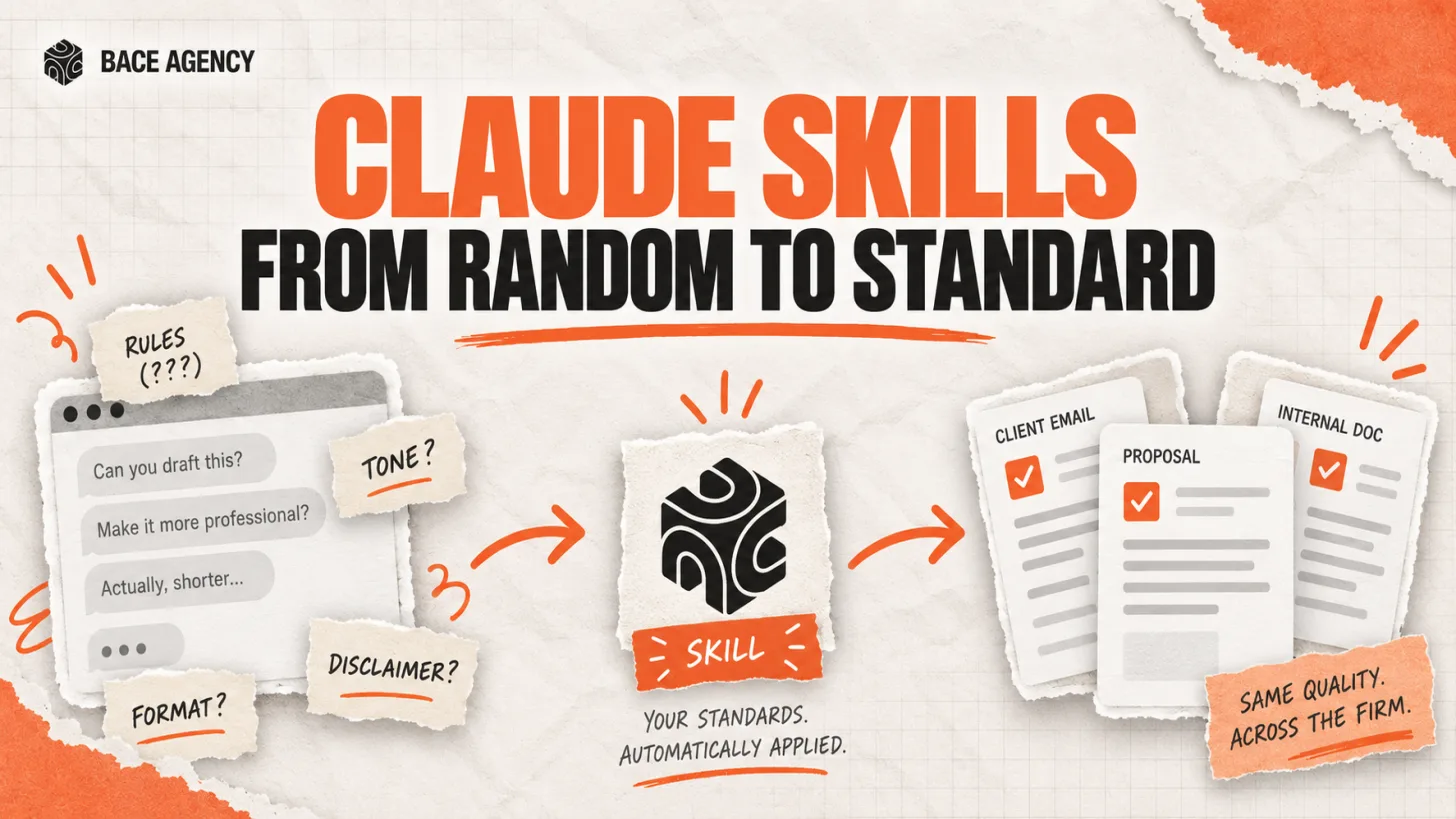
Claude Skills Give a Law Firm One AI Standard
One associate gets sharp drafts, another gets generic filler from the same tool. A Claude Skill turns one person's rules into a standard the whole firm can rely on.
Let AI Agents Handle Intake at Evanston Law Firms
Most Evanston firms still run intake on a phone and a Word template. The firms pulling ahead hand the whole new-matter pipeline to an agent, then review its work before anything reaches the client.

Oregon Federal Court Fines Lawyers $110,000 Over AI
Two lawyers were fined $110,000 for filing AI-invented case citations. The lesson is not to avoid AI. It is to verify it. Here is the workflow that prevents it.
About the author

Written by
Michael Pavlovskyi
Founder, Bace Agency
Michael builds custom Claude and GPT workflows for insurance agencies, law firms, and PE firms on Chicago's North Shore. Speaker at Northwestern and Lake Forest College on practical AI adoption for professional services.
Connect on LinkedInSee it in your firm
Book an audit.
A free 30-minute AI audit. No obligation, no pitch deck.
Book a free AI audit