
AI Client Intake for Small Law Firms
A small Lake Forest firm can answer every new client in minutes, without adding staff or risking confidentiality.


Key Takeaways
- ✓ The firm that answers first usually wins the matter. At intake, speed beats size.
- ✓ AI intake handles the first ten minutes: capture from any channel, qualify, reply instantly, and route a clean summary to your team, while every legal judgment stays with a lawyer.
- ✓ Confidentiality applies from the very first contact, so a law firm intake system has to keep prospect data on infrastructure you control, with a human review step.
A new client almost never starts with a signed engagement letter. It starts with a form at 9 p.m., a voicemail during a hearing, or an email that lands while your one paralegal is at lunch. Whoever answers first usually wins the matter. That is the whole game in intake, and most small firms are losing it without realizing it.
I work with professional services firms on the North Shore, and intake is the first place I look. It is rarely a people problem. Your team is busy doing real legal work. It is a workflow problem: requests come in through too many channels, sit in a queue, and get answered when someone finally has a free minute. By then the prospect has called the next firm on their Google search.
The cost of a slow first response
Speed of response is not a soft metric. In the Harvard Business Review study The Short Life of Online Sales Leads, firms that reached a new inquiry within an hour were far more likely to have a real conversation with the decision maker than firms that waited even sixty minutes longer, and dramatically more likely than firms that waited a full day. The study looked at sales teams, but the behavior is identical for legal clients. A person with a legal problem is anxious, and anxious people keep dialing until someone picks up.
~7x
more likely to reach the decision maker when you respond within an hour
Harvard Business Review
~60x
more likely than firms that wait a full day to follow up
Harvard Business Review
~$72K
illustrative annual fees a 3-attorney firm can lose to slow intake
Illustrative, not a Bace benchmark
For a small firm the cost is not abstract. Picture marketing that brings you a dozen inquiries a week. If just two qualified ones a month go cold before anyone replies, and a typical matter is worth, say, a few thousand dollars in fees, you are quietly handing tens of thousands of dollars a year to whichever firm called back first. Those are illustrative numbers, not a benchmark. Run your own and the leak is rarely small.
You do not see this on any report. It just quietly does not happen. This is the exact problem we group under client intake and response time when we map a firm's operations. The fix is not "hire a full-time receptionist." It is to make the first response automatic, fast, and consistent, so a human only steps in where judgment is actually required.
What AI client intake actually does
Let me be plain about the work, because "AI intake" sounds bigger and scarier than it is. We are not replacing your lawyers. We are handling the first ten minutes that currently leak away.
A practical intake system does four things:
- Captures the request from any channel, email, web form, phone, or text, into one place.
- Sorts the request: is this a personal injury question, an estate matter, a possible conflict, or spam.
- Responds immediately with a useful reply that confirms receipt, sets expectations on timing, and gathers a few basic facts.
- Routes the qualified inquiry to the right person on your team with a short summary, so the attorney opens a clean note instead of a raw voicemail.
What it does not do is decide whether to take the case, give legal advice, or quote a fee. Those stay with you. The system clears the runway. A person still lands the plane.
If you want a sense of how careful this kind of automation can be when it is built right, the same principles show up in our piece on why AI agents are safer than most firm owners think. The short version: a narrow system with a human review step is far safer than a tired associate at the end of a long day.
Confidentiality and conflicts start at hello
Here is the part most "just use a chatbot" advice skips, and it is the reason I move it to the front of every law firm conversation. Your duty of confidentiality to a prospective client begins at the first consultation, even if you never take the matter. That is not my opinion. It is spelled out in ABA Model Rule 1.18 on duties to prospective clients. The minute someone shares the facts of their problem, you are holding information you are obligated to protect.
That changes how you build the system. A free consumer chatbot pasted onto your site is the wrong tool, because you do not control where that data goes. An intake system for a law firm has to keep prospect information inside infrastructure you control, log what it collected and why, and avoid pulling in conflicting details it does not need. Rule 1.18 actually rewards a lighter touch at intake: gather only what is reasonably necessary to decide whether you can take the matter.
Conflict screening matters here too. Catching a conflict at intake is cheap. Catching it three weeks in is expensive and embarrassing. We wrote about that math for North Shore firms in AI conflict checks and the cost of a miss, and the same logic applies the moment a new name enters your system.
A Lake Forest example, with numbers
Here is a hypothetical that matches what I see often. Imagine a three-attorney Lake Forest firm doing estate planning and small business work. They get maybe fifteen new inquiries a week, split across a contact form, the main phone line, and referrals that come in by email. The office manager handles intake on top of billing, scheduling, and everything else.
On a normal week, about a third of those inquiries, call it five, do not get a real response until the next business day. Two or three a month never hear back at all, because the email got buried. Nobody is doing anything wrong. There are simply more entry points than there are free minutes. If just two of those lost inquiries a month would have signed a $3,000 estate plan, that is around $72,000 a year the firm never books. The number is hypothetical. The pattern is not.
With an intake workflow in place, every one of those fifteen gets an instant, professional reply within a minute or two, day or night. The system asks two or three qualifying questions, flags the obvious conflicts before they become a problem, and drops a tidy summary into the office manager's queue with a suggested next step. Say it moves the firm from answering within the hour about half the time to nearly always. On fifteen inquiries a week, that is several more matters a month reaching a real conversation at the exact moment the prospect is deciding who to call back.
She starts her morning with a sorted list instead of a guessing game. The attorneys see only the matters worth their time. Nothing about the firm's judgment changed. The leak in the bucket just got sealed.

A prompt you can try today
You do not need a vendor to feel how this works. Open Claude or ChatGPT, paste in a real inquiry from last week (strip the client's name and any private details first), and try the prompt below. It triages the message the way a good intake system would.
SAMPLE CLAUDE PROMPT
"You are the intake assistant for a small law firm. Read the inbound message below. 1) Classify the matter type: estate planning, small business, litigation, other, or spam. 2) List any names or companies we should run through a conflict check. 3) List the two or three facts we still need to evaluate the matter. 4) Draft a warm, two-sentence reply that confirms receipt and sets a callback expectation, with no legal advice and no fee quote. Rate urgency LOW, MEDIUM, or HIGH and explain why."
You will get back a matter type, the facts you still need, a conflict flag, and a warm holding reply, in about five seconds. That is the first ten minutes, handled. The production version just does it automatically, every time, and keeps the data on infrastructure you control. If you want more of these, we collected a few in five Claude features most small business owners miss.
How to start without blowing up your week
You do not need a six-month project or new case management software. The honest first step is small. Spend one week writing down every way a new client can reach you, and roughly how long each one currently waits for a real answer. Most firms are surprised. Here is what that map usually looks like, using illustrative response times, not promises:
| Channel | Typical first response now | With intake automation |
|---|---|---|
| Web contact form | Next business day | Under 2 minutes, any hour |
| After-hours phone | Next morning | Answered immediately, 24/7 |
| Emailed referral | Several hours to a day | Minutes, with a summary |
| Voicemail | Same or next day | Minutes, transcribed and routed |
These are illustrative patterns from firms I see, not guaranteed numbers. Your own audit will tell you which row is hurting you most. Pick the single worst channel, usually the web form or the after-hours line, and automate just that one. Get the instant response and the routing working there, watch it for two weeks, and only then expand. Once intake is clean, the same approach extends naturally to the next bottleneck, whether that is document and contract review or matter summaries.
Build it narrow, keep a human on anything client-facing, and grow it only when it has earned the trust.
The takeaway
Intake is the cheapest place for a small law firm to stop losing money, because the clients are already raising their hands. You are just not answering fast enough or consistently enough, and there is no shame in that when three people are doing the work of ten. The point of AI here is not to sound impressive. It is to make sure the person who needs a lawyer at 9 p.m. hears back from yours before they call the next one.
The firm that wins the matter is usually not the biggest one or the one with the fanciest website. It is the one that answered first. AI just makes sure that firm is yours.
For firms ready to see what this looks like in practice, a free 30-minute AI audit is available in person on the North Shore or on video. No obligation. The output is a one-page plan your team can act on inside a quarter.
Frequently Asked Questions
Is AI client intake compliant with attorney confidentiality rules? +
Yes, when it is built correctly. Your duty of confidentiality begins at the first contact under ABA Model Rule 1.18, so the system has to keep prospect information on infrastructure you control, collect only what is reasonably necessary, and log what it gathered. A free consumer chatbot pasted onto your site does not meet that bar, because you do not control where the data goes.
Will an AI intake system give legal advice to potential clients? +
No. A well-built intake system captures the inquiry, sorts it, sends a warm holding reply, and routes a clean summary to your team. It does not decide whether to take the case, quote a fee, or offer legal advice. Every legal judgment stays with a lawyer.
How fast can an AI intake system respond to a new inquiry? +
Within a minute or two, any hour of the day. The point is to reach the prospect while they are still deciding who to call, instead of the next business day. Speed at first contact is the single biggest lever in intake.
Do I need to replace my case management software? +
No. Intake automation sits in front of your existing tools and hands off a clean summary. You do not need a six-month project or new case management software to start. The honest first step is to automate your single worst channel and expand only once it has earned the trust.
Can a small firm afford this, and how do we start? +
Yes. You start narrow: pick the one channel that leaks the most, usually the web form or the after-hours line, and automate just that. A free 30-minute AI audit will map where your intake is losing matters and give you a one-page plan you can act on inside a quarter.
Related Articles
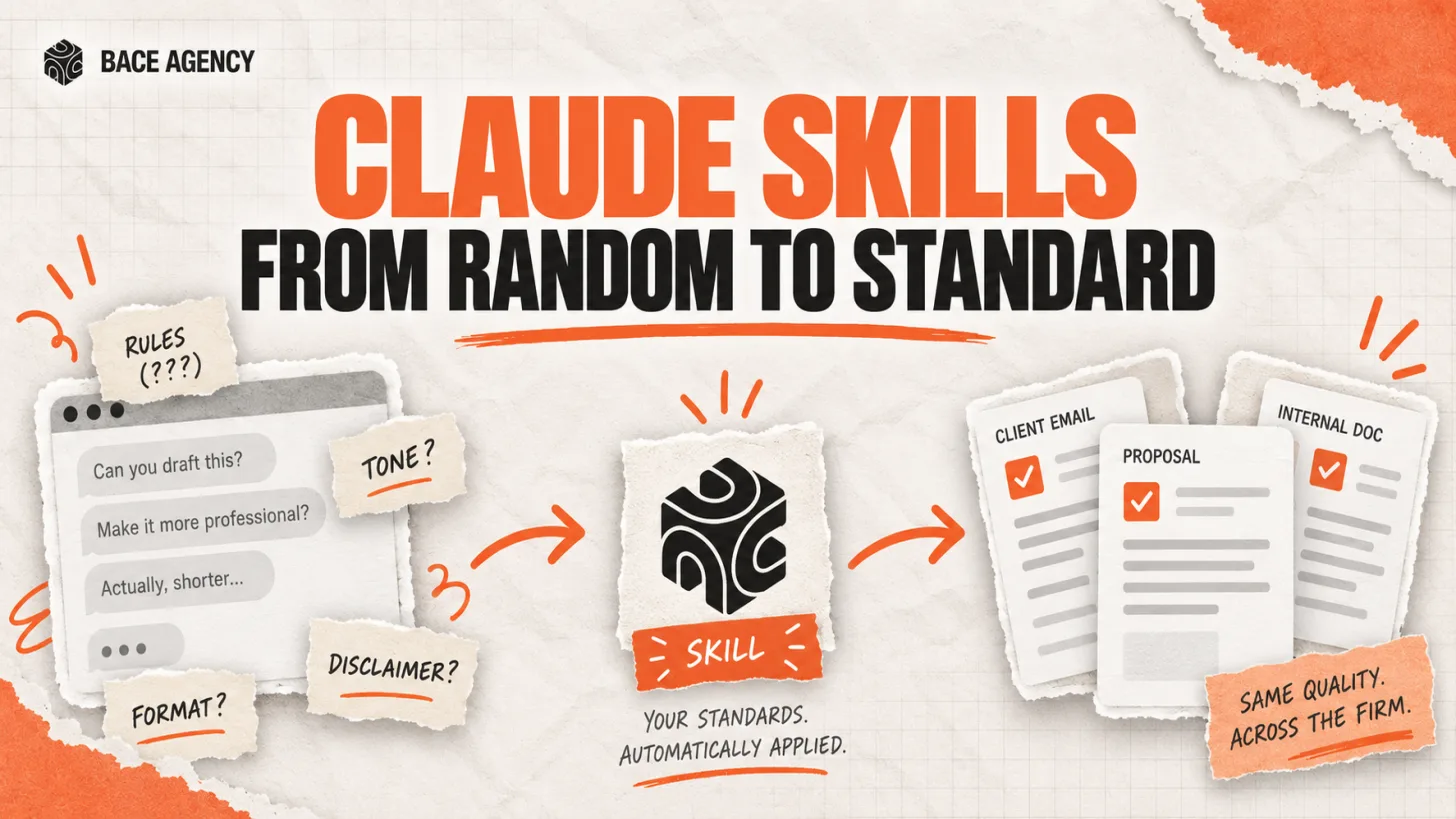
Claude Skills Give a Law Firm One AI Standard
One associate gets sharp drafts, another gets generic filler from the same tool. A Claude Skill turns one person's rules into a standard the whole firm can rely on.
Let AI Agents Handle Intake at Evanston Law Firms
Most Evanston firms still run intake on a phone and a Word template. The firms pulling ahead hand the whole new-matter pipeline to an agent, then review its work before anything reaches the client.

Oregon Federal Court Fines Lawyers $110,000 Over AI
Two lawyers were fined $110,000 for filing AI-invented case citations. The lesson is not to avoid AI. It is to verify it. Here is the workflow that prevents it.
About the author

Written by
Michael Pavlovskyi
Founder, Bace Agency
Michael builds custom Claude and GPT workflows for insurance agencies, law firms, and PE firms on Chicago's North Shore. Speaker at Northwestern and Lake Forest College on practical AI adoption for professional services.
Connect on LinkedInSee it in your firm
Book an audit.
A free 30-minute AI audit. No obligation, no pitch deck.
Book a free AI audit