
Discovery Quality Scales With Volume, Not Headcount
Highland Park litigation partners who use Claude for first-draft discovery responses produce more work with the same team without compromising what the attorney must own.


Key Takeaways
- ✓ Discovery response quality scales with volume and consistency, not headcount: Claude produces first-draft interrogatory responses from your case files, freeing attorney time for the strategic decisions that require legal judgment.
- ✓ The attorney review step is not a bottleneck: a 20-minute partner review of an AI-drafted response set is faster and more accurate than six associate hours of original drafting, because review is where legal judgment already lives.
- ✓ ABA Model Rule 1.1 creates a competence obligation to understand technology relevant to practice: in 2026, understanding how AI affects discovery work is part of that duty, whether or not your firm uses AI for drafting.
If you run a litigation practice in Highland Park, your production bottleneck is not legal strategy. It is drafting: the hours your associates spend writing first-draft interrogatory responses that follow patterns your firm established on the first case of this type you handled. The typing is not the value. The judgment is.
Claude can produce first-pass discovery responses from case files, prior pleadings, and attorney instructions in a fraction of the paralegal time the same task takes manually. The partner reviews, edits, and signs off. Quality stays wherever you set it. Production volume grows without adding to headcount.
The Volume Problem in Civil Litigation
A single complex commercial matter can generate 30 to 80 interrogatories, plus requests for production and requests for admissions. Each response must be factually accurate, legally defensible, and written in your firm's voice. Multiply that across five active matters and a three-associate team, and you have a drafting calendar that crowds out the strategic work your clients actually pay for.
Discovery response quality is not primarily about legal insight. Most interrogatories follow predictable patterns, and most responses follow predictable structures. Your value as the supervising partner is in the exceptions: the loaded question that needs a careful objection, the admission that needs to be avoided, the response that shapes your deposition strategy. That judgment takes seconds when a competent first draft is already in front of you. It takes hours when the associate is still producing the draft.
According to the ABA's 2024 Legal Technology Survey, 30% of lawyers now use AI tools in their work, nearly tripling from 11% in 2023. Civil litigation is one of the fastest-adopting practice areas. Discovery drafting is the reason: it is a volume and consistency problem, and those yield to AI quickly.
30%
of lawyers use AI tools today, nearly tripling from 11% in 2023
54%
cite time savings and efficiency as the primary benefit of AI in legal practice
75%
cite accuracy concerns as the top reason for hesitation about adopting AI tools
That 75% accuracy concern is real. It is also manageable with the right process. A first draft that needs 20 minutes of partner review is substantially faster than a first draft that takes an associate four to six hours to produce. And the partner review is where accuracy gets locked in. You are not removing the accuracy check: you are moving it earlier and making it faster.
How Does Claude Handle Interrogatory Drafting?
An AI discovery response is a first-pass draft of interrogatory answers, responses to requests for production, or responses to requests for admissions, produced by an AI model working from the documents and instructions the attorney provides. The model does not create facts. It organizes and expresses facts from the record you supply.
Claude, built by Anthropic, reads long documents well and follows detailed written instructions. For discovery work, that means Claude can process a complaint, prior interrogatory responses from a related matter, your firm's standard general objections, and an incoming interrogatory set, and then draft a full response set that applies your established objection language and fact patterns.
The critical constraint is input quality. Claude drafts from what you provide. If your case file is organized and your instructions are specific, the output is close to final. If the file is thin or the instructions are vague, the draft reflects that. The model is not guessing at facts: it is organizing and drafting from the record you have already built. That constraint is useful. It forces you to surface your evidentiary record before opposing counsel does it for you.
You do not need the Claude API or custom software to run this workflow. A standard Claude subscription handles it. If you want to understand when an API build adds genuine value versus when a subscription covers the same work, the post on when your law firm does not need the API explains the line clearly.
"Efficiency is doing things right; effectiveness is doing the right things."
Peter Drucker, management theorist and authorThat distinction maps well onto AI-assisted discovery. Claude handles efficiency: producing a draft with consistent objection language, correct format, and coverage of every interrogatory. The attorney handles effectiveness: confirming that every response serves the litigation strategy and that the case record supports what was written. That is the right division of labor, and it mirrors how good litigation partners have always supervised capable paralegals.
A Working Process in Four Steps
The following process runs on Claude today, without technical setup or additional software beyond a standard Claude subscription.
Assemble the input packet
Upload the complaint, prior interrogatory responses from a related matter for format reference, your firm's standard general objections, and the incoming interrogatory set. If your case summary exists as a document, include that too. Claude reads all of it before drafting a single response.
Write specific drafting instructions
Tell Claude your format: general objections first, then individual responses. Include topic-specific guidance about privilege, trade secrets, or matters where your client's position is particularly sensitive. Specific instructions produce less editing at the back end.
Review the draft against the record
Partner or senior associate review confirms each response against the facts in your case file. Ask Claude to flag any interrogatory where the uploaded record is insufficient to answer accurately, so those come to you pre-identified for additional attorney input rather than buried in the draft.
Add strategic edits and finalize
Adjust objections where the litigation strategy calls for a different approach. Tighten responses that touch contested facts. The final output is yours: in your firm's voice, signed by the supervising attorney, legally defensible.
Here is the prompt structure to run in Claude:
SAMPLE CLAUDE PROMPT
"I am drafting discovery responses for a commercial litigation matter in Lake County, Illinois. I am uploading: (1) the plaintiff's complaint, (2) interrogatory responses from a related case as a format and style reference, (3) our firm's standard general objections, and (4) the plaintiff's first set of interrogatories. Please draft responses to each interrogatory using our standard general objection language at the top of each response. Respond factually where the uploaded record supports it. Flag any interrogatory where the record I have provided is insufficient to answer accurately, and note specifically what additional information I should gather before responding."
What AI Handles vs. What the Attorney Must Own
The right mental model separates what Claude does well from what requires attorney judgment. These two layers do not overlap, and the division maps onto how litigation partners have always supervised paralegals and associates.
| Discovery Task | Claude handles | Attorney must own |
|---|---|---|
| General objections | Applies your standard boilerplate consistently to every interrogatory in the set | Decides whether a non-standard or targeted objection is appropriate for a specific request |
| Factual responses | Drafts from the record you provide, organizing documented facts clearly | Confirms each fact is accurate and disclosed as intended under the litigation strategy |
| Privilege assertions | Flags responses that may implicate privilege based on your written instructions | Makes the privilege call and reviews the privilege log for completeness |
| Format and consistency | Applies the same numbering, structure, and language style across all responses | Reviews final format and confirms compliance with applicable rules before service |
| Strategic shaping | Cannot determine which admissions to avoid or which facts to lead with strategically | Shapes each response to serve the overall litigation strategy |
This division holds across matter types. Claude applies it simultaneously across every active matter on your docket, at a consistent level, without the variation that comes from rotating assignments across associates with different experience levels.
For practices running discovery across multiple concurrent matters, the post on Claude Managed Agents for discovery and diligence covers architectures where extended review tasks run without keeping a session open. For the intake side of the pipeline, AI client intake automation for law firms applies the same structured-review approach upstream of discovery.
To identify which workflows in your firm are ready for AI handling and which need additional controls, the Bace AI readiness assessment maps your current workflows against the areas where AI changes the economics. It takes under five minutes.
Is Claude-Assisted Discovery Ethically Defensible?
The most common objection from litigation partners considering this workflow: "Is it ethical to use AI for discovery drafting?" The question is right. The answer is also clear.
ABA Model Rule 1.1 on competence was amended in 2012 to specify that attorneys must keep current with "the benefits and risks associated with relevant technology." In 2026, that obligation includes understanding how AI tools affect discovery production, regardless of whether your firm uses them. Abstention is not the cautious choice: it is a choice to fall behind on a competence requirement while opposing counsel may not be.
The practical answer is that attorneys have always used tools to produce discovery drafts: form books, prior responses, paralegal assistance following firm templates. Claude is a more capable version of the same workflow. The review obligation, the duty of candor, and the requirement that a licensed attorney supervise and certify every response remain unchanged. What changes is how much of the drafting burden falls on your associates versus your AI tools.
The question practitioners raise most often is not "should we use AI?" but "what process makes it defensible?" The process above answers that: documented instructions, attorney review at every step, and a flagging system that surfaces gaps before the partner review rather than during it. That is a more defensible workflow, not a less careful one.
To build a documented AI discovery workflow for your Highland Park or Lake County firm, including a review of which tasks are ready for Claude today and which need additional controls, contact Bace Agency for a free 30-minute AI audit.
Frequently Asked Questions
Is it ethical for a Highland Park attorney to use Claude to draft discovery responses? +
Yes. ABA Model Rule 1.1 requires attorneys to understand relevant technology and its risks. Using Claude to produce first-draft discovery responses is consistent with longstanding practice of using templates, paralegals, and form books for first-pass drafting. The attorney review obligation, duty of candor, and supervising-signature requirement are unchanged. What matters is that a licensed attorney reviews and certifies every response before service.
Will Claude invent facts in a discovery response? +
Claude drafts from the documents and case record you provide. If you give it the complaint, prior responses, and a case summary, it works from that record. It cannot access external information about your matter. The accuracy gate is the attorney review step, where every response is confirmed against the actual case file. Instruct Claude to flag any interrogatory where the record you uploaded is insufficient to answer, so those gaps are identified before the review, not during it.
What documents does Claude need to draft discovery responses? +
The most useful inputs are: (1) the incoming interrogatories, (2) the complaint or relevant pleadings, (3) your firm's standard general objections, and (4) prior responses from similar matters as a format reference. A case summary or client timeline document also improves the output. The more organized and specific your input, the less editing the attorney needs to do on the draft.
How long does it take to set up this AI discovery drafting workflow? +
No technical setup is required. You need a Claude subscription and your existing case files. The first time through, assembling the input packet and writing the drafting instructions takes roughly 30 to 45 minutes. On subsequent matters, the process is faster because your general objections and format instructions are already prepared. The AI subscription costs a flat monthly fee rather than per-use API pricing, which keeps the economics predictable across high-volume discovery periods.
Do I need to disclose to opposing counsel that AI helped draft my discovery responses? +
This is an active area of developing guidance that varies by jurisdiction and court. Some federal courts have issued AI disclosure standing orders, primarily covering briefs and court filings. For discovery responses, the more immediate obligation is the supervising attorney's certification that responses are complete and accurate. Consult your firm's ethics counsel for jurisdiction-specific guidance, and monitor Lake County Circuit Court and any applicable federal court standing orders for AI disclosure requirements.
Related Articles
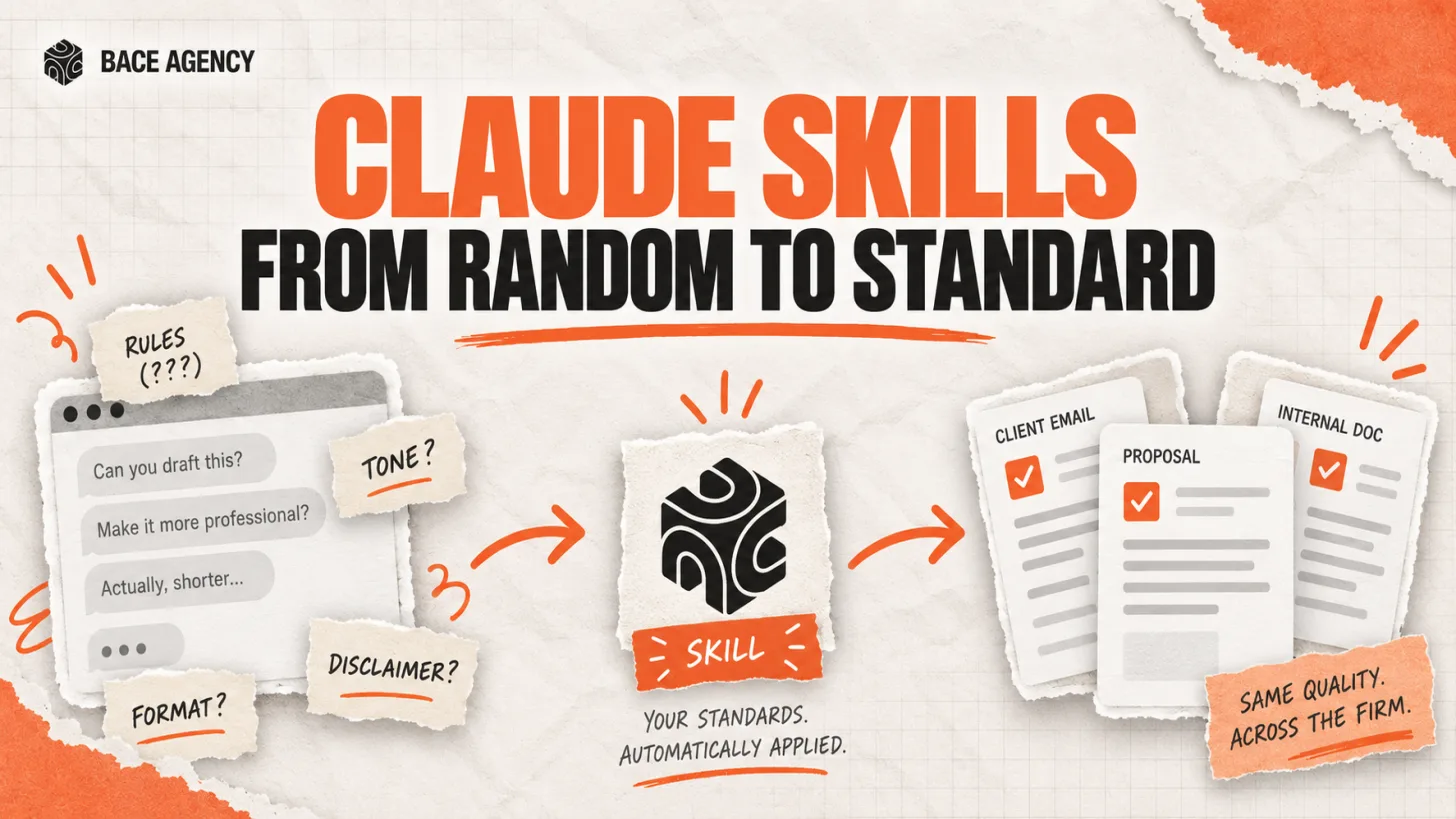
Claude Skills Give a Law Firm One AI Standard
One associate gets sharp drafts, another gets generic filler from the same tool. A Claude Skill turns one person's rules into a standard the whole firm can rely on.
Let AI Agents Handle Intake at Evanston Law Firms
Most Evanston firms still run intake on a phone and a Word template. The firms pulling ahead hand the whole new-matter pipeline to an agent, then review its work before anything reaches the client.

Oregon Federal Court Fines Lawyers $110,000 Over AI
Two lawyers were fined $110,000 for filing AI-invented case citations. The lesson is not to avoid AI. It is to verify it. Here is the workflow that prevents it.
About the author

Written by
Michael Pavlovskyi
Founder, Bace Agency
Michael builds custom Claude and GPT workflows for insurance agencies, law firms, and PE firms on Chicago's North Shore. Speaker at Northwestern and Lake Forest College on practical AI adoption for professional services.
Connect on LinkedInSee it in your firm
Book an audit.
A free 30-minute AI audit. No obligation, no pitch deck.
Book a free AI audit