
North Shore Law Firms Are Betting on Legal AI
Survey data shows legal AI adoption among lawyers more than doubled in a single year. Here is what it means for your North Shore practice and where to start.


Key Takeaways
- ✓ Legal AI adoption more than doubled in a single year, reaching 69% of legal professionals in 2026, per the 8am Legal Industry Report covering more than 1,300 lawyers.
- ✓ The Wolters Kluwer Future Ready Lawyer 2026 Survey found 52% of firms report revenue growth after AI adoption and 62% save 6 to 20% of their weekly working hours.
- ✓ Only 34% of law firms have formally adopted AI at the organizational level, meaning a North Shore firm that formalizes an AI policy and training program now is ahead of the majority of competitors.
- ✓ Data security is the top cited barrier at 46%, but enterprise-grade tools like Claude's Business plan and Harvey AI operate under data-handling agreements that address the specific concerns attorneys raise around client confidentiality.
The share of legal professionals using AI for daily work more than doubled in a single year. In 2025, 31% of attorneys used generative AI tools. By 2026, that number reached 69%, according to the 8am Legal Industry Report 2026, which surveyed more than 1,300 legal professionals. If your Lake Forest or Highland Park firm is still deciding whether to look at AI, you are no longer the majority. The question has already moved from whether to how.
The Adoption Numbers That Changed the Conversation
Two surveys published in early 2026 together paint a clear picture of where the legal profession stands. The 8am report found that 69% of legal professionals now use AI, up from 31% the previous year. The Wolters Kluwer Future Ready Lawyer 2026 Survey, covering 810 lawyers across the United States and nine European countries, found that 62% of respondents save between 6% and 20% of their weekly working hours through AI. Fifty-two percent report revenue growth after adoption.
69%
of legal professionals use AI for work in 2026
8am Legal Industry Report, 2026
62%
of lawyers save 6 to 20% of their weekly working hours
Wolters Kluwer, Future Ready Lawyer 2026
52%
of firms report revenue growth after AI adoption
Wolters Kluwer, Future Ready Lawyer 2026
What does a 10% reduction in weekly hours look like for your Wilmette or Glencoe practice? At a standard 40-hour workweek, that is four hours. For an attorney billing at $400 an hour, that is $1,600 in recovered capacity each week, not through overtime, but by letting AI handle document summaries, research memos, and correspondence drafts that previously needed a full manual pass. Firms reporting revenue growth are not making more per hour. They are handling more matters because they reclaimed the time to do it.
"Efficiency is doing things right. Effectiveness is doing the right things."
Peter Drucker, management theoristMost attorneys are already efficient. The opportunity AI offers is effectiveness: getting high-value hours back to spend on client strategy, business development, or the cases that need genuine legal judgment. Drafting a first-pass engagement letter is not a task that requires a licensed attorney. Deciding whether to take a matter does.
What Attorneys Are Actually Using AI For
The 8am survey found that the top uses among legal professionals are drafting correspondence (58%), general research (58%), brainstorming (54%), and summarizing documents (47%). None of these require a custom software build or a technical team. They work with a well-written prompt and a consumer or business AI subscription. The Clio Legal Trends Report found similarly that mid-sized firms have moved AI from experimentation into operational practice, with 86% of mid-sized law firms reporting AI use in 2025.
Here is where the most common tasks map to specific tools your firm can put to work today:
| Task | How AI handles it | Tool example |
|---|---|---|
| Contract review | Upload a PDF; ask Claude to flag non-standard clauses and compare against your template language | Claude (Anthropic) |
| Legal research | AI-assisted research built directly into your existing Westlaw or LexisNexis subscription | Westlaw Precision, Lexis+ AI |
| Drafting correspondence | Prompt with the key facts and your tone preference; edit the output to your standard | Claude, ChatGPT |
| Deposition summaries | Upload the transcript; ask for a timeline of key admissions and contradictions organized by topic | Claude for Desktop |
| Client intake qualification | AI-enabled intake forms that classify matter type, flag potential conflicts, and draft engagement letters | Clio Duo, Harvey AI |
For longer multi-step work, reviewing a 200-page disclosure package, tracking document requests across a full discovery set, or checking a portfolio of contracts for a specific clause pattern, the Claude Managed Agents approach discussed for Wilmette law firms handles those jobs without timing out or losing context mid-task. These are not experimental features. They are production-ready capabilities available on subscriptions your firm may already hold or can access this week.
The Data Security Concern Everyone Raises
The 8am report found that 46% of legal professionals cite data security concerns as a barrier to AI adoption, and 42% cite ethical concerns. Both are reasonable starting points for any attorney handling client-privileged information. They are also solvable with the right tool configuration and a few hours of due diligence.
Here is the practical reality. Claude's Team and Business plans, along with the enterprise tiers of major legal AI tools like Harvey AI and Lexis+ AI, operate under defined data-handling agreements that do not train on your inputs. Your prompts and uploaded documents are not used to improve the model. The question is not whether AI is generically safe. The question is whether you have read the data processing terms for the specific tool you are considering, verified that client data stays within a compliant environment, and confirmed that your firm is operating under a business agreement rather than a personal consumer account.
Many state bar associations, including Illinois, have now published formal guidance on attorney use of AI tools and the obligations that attach. The primer on AI agents and data security for North Shore firms covers the architecture in plain English. The short version: the risk profile of a well-configured enterprise AI tool is not categorically different from the risk profile of the cloud document storage your firm already relies on. The due diligence question is the same. Read the terms. Confirm the data stays put. Document your review.
The attorneys who cite security as a reason to avoid AI entirely have often not done that due diligence. They are applying a blanket concern to tools that have already addressed the specific concern. That is the difference between a legitimate risk assessment and a delay tactic.
The Gap Between Individual and Firm Adoption
Here is a number that should interest any managing partner on the North Shore. Individual legal AI adoption hit 69% in 2026. Firm-level formal adoption, meaning an organization that has actually implemented AI tools with a written policy, stands at only 34%, per the 8am report. Fifty-four percent of firms have provided no training on responsible AI use and have no plans to do so.
That gap is an opening. If your firm formalizes an AI approach now, you are ahead of roughly two-thirds of firms at the organizational level. Your individual attorneys may already be using AI tools on their own, without firm guidance. That is the more common situation. The risk of not having a firm policy is not that AI is being ignored. It is that AI is being used inconsistently, without standards, and in some cases with personal consumer-grade accounts that were never designed for client-privileged work.
A structured rollout does not have to be complicated. Choose one tool, agree on which matters it touches first, confirm the data terms are satisfied, and train the team. That is a one-week project, not a six-month initiative. If you want to understand where your firm currently stands before you start, the Bace Agency AI readiness assessment gives you a baseline in about five minutes.
If the question in your firm is whether to build a custom AI integration or start with a flat consumer or business plan, the post on proactive agents for Lake Forest law firms draws that line clearly. Most North Shore boutiques do not need a custom API build to get meaningful results. A business subscription and a well-maintained set of prompt templates does the same work for far less.
"Your most unhappy customers are your greatest source of learning."
Bill Gates, founder of MicrosoftApply the same principle internally. The attorneys on your team who are frustrated with how long routine tasks take are telling you exactly where AI should start. Ask them. The answer will be faster than any technology audit.
Where Your Firm Starts This Week
The Wolters Kluwer survey found that cost ranked surprisingly low as a barrier, cited by only about 24% of respondents per the 8am data. The bigger barriers are uncertainty about ethics and the absence of a structured starting point. Both are solvable in a week without outside help.
Here is the sequence that works for most North Shore law firms:
- Pick one recurring task. Choose the task that takes the most time and involves the most mechanical work. Deposition summaries, first-draft engagement letters, and research memos are the most common starting points. Do not try to automate the whole firm at once.
- Set up Claude for Desktop or a business plan account. Upload one real, non-privileged document and test the prompt below. Compare the output against what you would have written. Adjust the prompt until the output is close enough that editing takes less time than starting from scratch.
- Confirm the data terms before you touch client files. Verify that the tool you are using does not train on inputs, and that you are covered by a business or team agreement, not a personal consumer account. Document that review in writing.
- Run a brief team training. Thirty minutes showing your team which tasks to use AI for, which prompt structures work, and what to never upload is sufficient. The 8am report found that only 11% of firms have mandatory firm-wide training. Being in that 11% is a meaningful differentiator.
SAMPLE CLAUDE PROMPT
"Here is a [contract / deposition transcript / engagement letter draft]. Please identify any clauses or statements that are unusual, non-standard, or potentially unfavorable to my client's position in an Illinois [practice area] matter. For each item, include: the original text, your observation, and a suggested alternative. Format as a numbered list. Flag anything that requires attorney review before proceeding."
That prompt works for contract review, deposition prep, and document analysis. Adjust the practice area and matter type. The output will need your professional review and judgment. That is the design. AI handles the first pass; you handle the call. That is where North Shore law firms that have moved on this are saving hours each week without compromising the work product their clients expect.
If you want to talk through where AI fits your specific practice and what a structured rollout looks like for a firm your size, reach out for a free 30-minute AI audit. We work with law firms and professional services practices on the North Shore and can tell you quickly what makes sense and what does not.
Frequently Asked Questions
What AI tools are North Shore law firms actually using in 2026? +
The most commonly used AI tools in law firms in 2026 include Claude (Anthropic) for contract review, document drafting, and research memo generation; Westlaw Precision and Lexis+ AI for AI-assisted legal research within existing subscriptions; Harvey AI for legal-specific drafting and analysis; and Clio Duo for client intake, conflict checking, and practice management workflows. Most firms start with a business or team plan for Claude or ChatGPT and apply it to drafting correspondence, summarizing depositions, and brainstorming legal arguments before moving to legal-specific tools.
Is client data safe when using AI tools in a law firm? +
Attorney-client privilege and client confidentiality obligations apply regardless of the tools you use. The key due diligence steps are: confirm the AI tool operates under a business or enterprise agreement (not a personal consumer account), verify that the tool does not train on your inputs, and ensure data stays within a compliant cloud environment. Claude's Team and Business plans, Harvey AI, and the enterprise tiers of Lexis+ AI and Westlaw Precision all operate under defined data-processing agreements that meet these requirements. Read the terms, document your review, and check your state bar's published guidance on AI tool use. Illinois attorneys should review the ISBA's current AI ethics guidance before handling client files with any AI tool.
Does adopting AI threaten the billable hour model for law firms? +
The Wolters Kluwer Future Ready Lawyer 2026 Survey found that 62% of legal departments expect AI-driven efficiencies to reduce reliance on traditional billable-hour billing in favor of fixed-fee and alternative arrangements. For most North Shore boutique firms, the near-term effect is not a billing model change but a capacity gain: the same attorneys can handle more matters because routine research and drafting takes less time. The longer-term pricing pressure will likely come from in-house legal teams, which doubled their AI adoption in a single year, doing more work internally and relying less on outside counsel for routine tasks.
How does a small law firm start with AI without a big IT department or budget? +
A small North Shore law firm does not need custom software or an IT team to start with AI. A business plan for Claude (currently available at a flat monthly rate per seat) gives your team access to the same capabilities used by larger firms for document review, drafting, and research. The practical starting sequence: pick one task that takes the most time each week, set up a business account, confirm the data terms are satisfied, run a 30-minute team training on which prompts work and what not to upload, and test on non-privileged documents before touching client files. Most firms that follow this sequence see usable results in the first week.
Related Articles
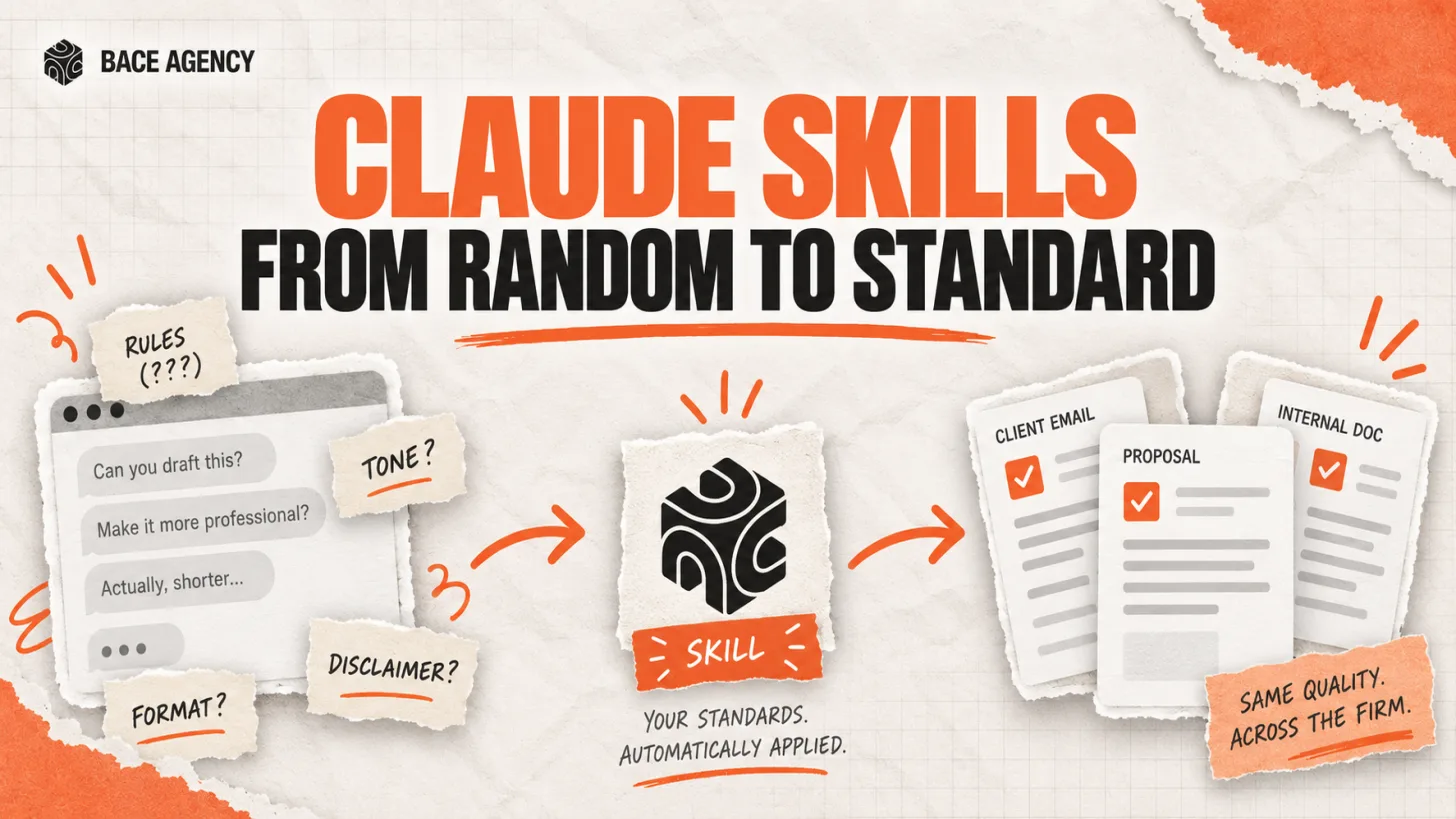
Claude Skills Give a Law Firm One AI Standard
One associate gets sharp drafts, another gets generic filler from the same tool. A Claude Skill turns one person's rules into a standard the whole firm can rely on.
Let AI Agents Handle Intake at Evanston Law Firms
Most Evanston firms still run intake on a phone and a Word template. The firms pulling ahead hand the whole new-matter pipeline to an agent, then review its work before anything reaches the client.

Oregon Federal Court Fines Lawyers $110,000 Over AI
Two lawyers were fined $110,000 for filing AI-invented case citations. The lesson is not to avoid AI. It is to verify it. Here is the workflow that prevents it.
About the author

Written by
Michael Pavlovskyi
Founder, Bace Agency
Michael builds custom Claude and GPT workflows for insurance agencies, law firms, and PE firms on Chicago's North Shore. Speaker at Northwestern and Lake Forest College on practical AI adoption for professional services.
Connect on LinkedInSee it in your firm
Book an audit.
A free 30-minute AI audit. No obligation, no pitch deck.
Book a free AI audit